📅 June 2026 | ✍️ Mitti Gold Organic | 🗂️ Machinery & Markets
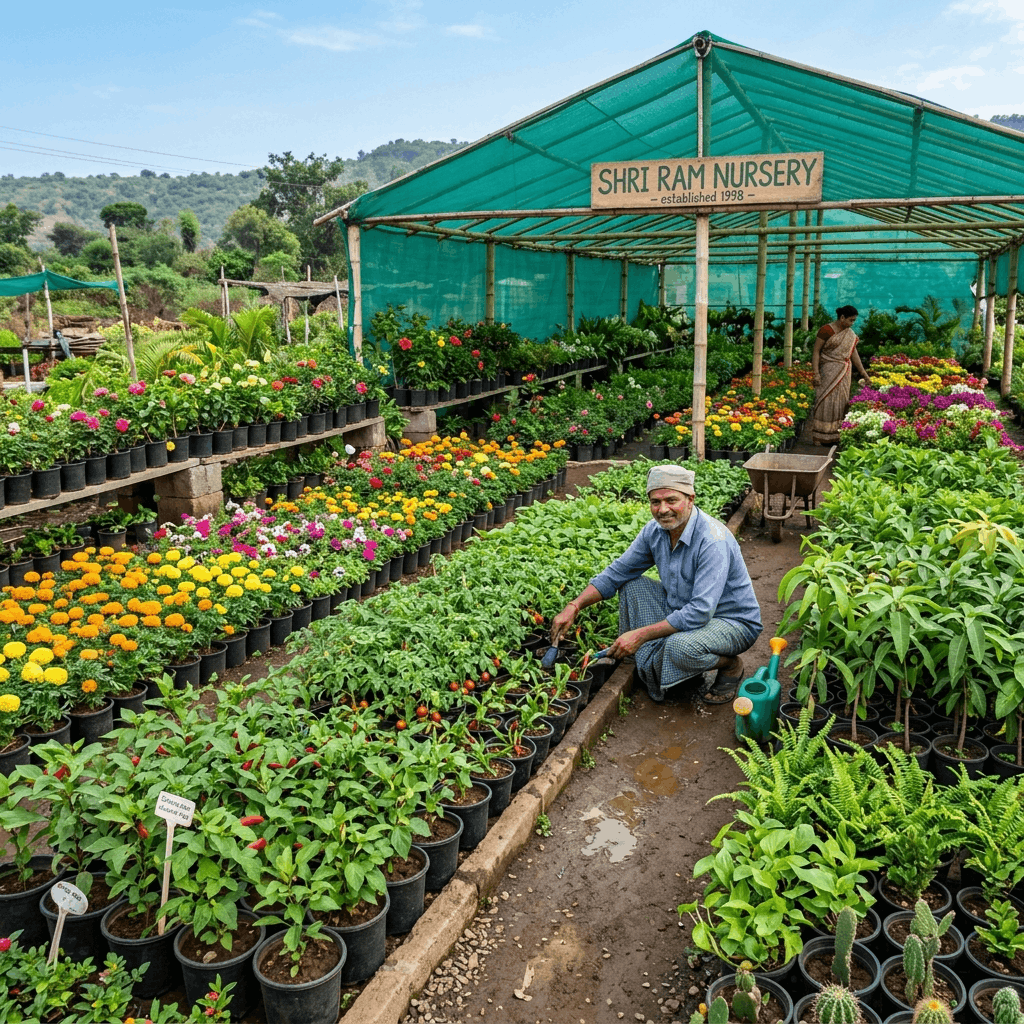
Why a Plant Nursery is One of the Best Agri-Business Opportunities in India
India's plant nursery industry is currently estimated at over ₹15,000 crore annually and growing at 15–20% per year, driven by a massive surge in home gardening, government afforestation programmes, highway and railway landscaping, and the booming organised horticulture sector. This rapid growth creates extraordinary opportunities for farmers and entrepreneurs who start a nursery business.
A plant nursery requires relatively modest initial investment compared to most agricultural businesses, uses far less land than field farming, is less susceptible to weather risks (especially in a covered nursery), and provides year-round income rather than seasonal crop income. Most importantly, the profit margins in nursery businesses are significantly higher than conventional crop farming — a seedling that costs ₹5–₹15 to produce can sell for ₹25–₹150 depending on the plant species and market channel.
Nursery businesses are particularly well-suited to small and medium farmers who have at least 1–2 bigha of land, access to water, and basic farming skills. In Gujarat, states like Anand, Navsari, Valsad, and Surat districts are already home to hundreds of thriving nurseries supplying plants to the entire western India market.
🌿 Which Plants to Grow in Your Nursery?
Plant selection is the most critical business decision in nursery management. The right plant mix balances profitability, market demand, production difficulty, and capital availability. Here are the best categories for Indian nursery starters:
1. Vegetable Seedlings (Fastest ROI): Tomato, chilli, capsicum, brinjal, cauliflower, cabbage seedlings are in constant, year-round demand from farmers and vegetable growers. Production time: 25–35 days. Selling price: ₹1–₹5 per seedling. Very high volume, fast turnover. Ideal for beginners.
2. Fruit Tree Saplings (High Value): Mango (grafted), lemon, guava, pomegranate, chikoo (sapodilla), papaya, dragon fruit. Selling price: ₹80–₹500 per plant depending on species, age, and grafting. Production time: 4 months to 2 years. These command premium prices and are always in demand from farmers starting orchards and home gardeners.
3. Ornamental and Flowering Plants: Rose, marigold, bougainvillea, mogra, hibiscus, portulaca. Year-round demand from urban home gardeners, event decorators, and landscapers. High margins in urban markets.
4. Medicinal and Aromatic Plants: Aloe vera, tulsi, ashwagandha, lemongrass, stevia. Growing demand from Ayurvedic manufacturers, herbal product companies, and health-conscious consumers. Premium pricing with government support under NHM (National Horticulture Mission).
📐 Investment Required: How Much Land and Capital Needed?
Starting a nursery business can be scaled from a micro-level home enterprise to a large commercial operation. Here is a realistic breakdown for different scales:
- Small Nursery (1–2 bigha / 0.5–1 acre): Initial investment: ₹1.5 lakh – ₹3.5 lakh. Setup includes: shade net structure, drip irrigation, propagation beds, potting medium materials, basic tools. Annual revenue potential: ₹4 lakh – ₹8 lakh. Net profit (Year 2 onwards): ₹2 lakh – ₹5 lakh per year.
- Medium Nursery (3–5 bigha / 1.5–2.5 acres): Investment: ₹5 lakh – ₹12 lakh. Includes: polyhouse or greenhouse, advanced irrigation, variety of plant species. Revenue: ₹15 lakh – ₹35 lakh. Net profit: ₹8 lakh – ₹18 lakh.
- Large Commercial Nursery (10+ bigha): Investment: ₹25 lakh – ₹1 crore+. Revenue: ₹50 lakh – ₹5 crore. Suited for export, government tenders, and large horticulture supply contracts.
Per bigha of operational nursery space, a well-run small-to-medium nursery can produce 2,000–5,000 saleable plants annually from production plants (fruit saplings, timber species) and 15,000–50,000 seedlings from vegetable and ornamental propagation annually. The per-bigha revenue potential is typically ₹2 lakh – ₹4 lakh, making it 4–8 times more profitable per unit of land than traditional field crop farming.
💡 Business Tip: Start with vegetable seedlings to generate quick cash flow in the first season, then use profits to invest in higher-value fruit tree saplings and ornamentals that take longer but return more. This phased approach minimises initial risk while building nursery skills and market connections.
📋 Step-by-Step: Setting Up Your Nursery Business
Plan and Register Your Nursery
Register your nursery with the State Horticulture Department to access government subsidies, scheme benefits, and certified planting material programs. In most states, registration requires a simple application with your land records, an Aadhaar card, and a basic site plan. Registered nurseries gain access to NHM (National Horticulture Mission) subsidies of 25–50% on infrastructure costs.
Set Up Infrastructure
Install shade net (50% shade factor for most plants, 75% for shade-loving ornamentals), a drip or sprinkler irrigation system, propagation benches or beds, and potting medium storage. For vegetable seedling production, plug trays (98 or 128 cell size) and a cocopeat-based growing medium are standard. Shade net structures with steel framing cost ₹80–₹120 per sq. metre installed.
Source Quality Planting Material
The quality of your planting material (seeds, mother plants, rootstocks for grafting) determines the quality and market value of your final plants. Purchase seeds only from reputed, certified seed companies. Obtain mother plants for vegetative propagation from government nurseries or established commercial nurseries. For grafted varieties, learn grafting techniques from your local Krishi Vigyan Kendra (KVK).
Establish Production Schedules
Plan your production calendar based on crop seasons and market demand peaks. Vegetable seedlings for kharif should be ready in May-June, for rabi in September-October, for summer crops in January-February. Ornamental plants should be ramped up before festivals (Navratri, Diwali, Holi) and wedding seasons. Fruit tree saplings should be ready before the pre-monsoon planting season (May-June).
Build Your Market Network
Identify and cultivate multiple market channels simultaneously: direct farm sales, APMC market presence, tie-ups with local gardening shops, connections with government horticulture departments for bulk orders, and online sales through platforms like Ugaoo, NurseryLive, or your own social media pages. A diversified market base protects against price fluctuations in any single channel.
📊 Profit and Return on Investment
A well-run medium-scale plant nursery in India can generate remarkable returns compared to traditional crop farming. Consider this example from a 3-bigha (approximately 1.5 acre) mixed nursery in Anand district, Gujarat: The nursery produces 30,000 vegetable seedlings per month (₹2 per seedling average = ₹60,000 revenue), 500 grafted mango saplings (₹150 average = ₹75,000 revenue), and 1,000 ornamental pot plants (₹80 average = ₹80,000 revenue) — generating a total monthly revenue of approximately ₹2,15,000 and an annual revenue of ₹25,80,000.
After deducting costs (labour: ₹60,000/month, materials: ₹30,000/month, utilities and maintenance: ₹20,000/month), the net monthly profit is approximately ₹1,05,000, or ₹12,60,000 per year. On a 3-bigha farm, this represents a net income per bigha of ₹4,20,000 — compared to ₹50,000–₹80,000 per bigha for conventional field crops. The initial investment of ₹8 lakh typically pays back within 18–24 months.
🛡️ Protection from Plant Diseases in the Nursery
Disease management in a nursery environment requires extra vigilance because young seedlings and cuttings are particularly vulnerable to fungal infections, viral diseases, and bacterial wilts. The most common nursery diseases in India are damping-off (Pythium, Fusarium), leaf blight, mosaic viruses, and bacterial leaf spot.
Prevention strategies: Use cocopeat-based growing medium rather than soil in seedling trays — it is naturally free of most soil-borne pathogens. Sterilise reused trays with hot water or a diluted bleach solution. Apply Trichoderma biofungicide to propagation media at the rate of 5 g per litre of water as a preventive treatment. Maintain strict hygiene — remove and dispose of diseased plants immediately before infection spreads. Keep your nursery well-ventilated to reduce humidity that favours fungal growth. Use Mitti Gold Vermicompost in your potting mix — the beneficial microbes it contains (including natural Trichoderma strains) provide biological suppression of nursery pathogens.
🏪 Market Channels: Where to Sell Your Nursery Plants
A successful nursery business requires access to multiple market channels to maintain steady revenue throughout the year. Here are the most important markets for Indian nursery businesses:
1. Farmer Market: Direct sales to vegetable and horticulture farmers is the highest volume, most consistent revenue source. Develop relationships with progressive farmers in your region who regularly need vegetable seedlings and fruit tree saplings. Offer doorstep delivery for bulk orders of 500+ seedlings.
2. Nursery-to-Nursery: Supply wholesale to other smaller nurseries who do not produce all plant types. This is a high-volume, lower-margin channel but provides reliable large orders.
3. Gardener Market (Home and Urban): Urban and peri-urban home gardeners are among the most profitable customers per plant, as they are willing to pay premium retail prices for quality, healthy plants. Establish a roadside nursery showroom on a highway or main road for walk-in customers. Participate in weekend plant fairs and exhibitions in nearby cities.
4. Government and Institutional: State horticulture departments, forest departments, municipal corporations, highway authorities (NHAI), and railway authorities regularly float tenders for large quantities of planting material for afforestation and landscaping. These are large, guaranteed payment orders that can significantly stabilise your annual revenue. Register on the government GeM portal (gem.gov.in) to participate in government procurement.
5. Export Market: Certified organic nurseries producing exotic species, medicinal plants, and high-value grafted varieties can explore export opportunities to the Middle East, South-East Asia, and Europe. APEDA (Agricultural and Processed Food Products Export Development Authority) provides support and certification assistance for nursery exporters.
🔗 Related Articles: 🌾 Use of Ash (Rakh) in Farming: How, When & Benefits for Indian Farmers | 💧 How to Recharge Water in Your Farm and Increase Crop Yield | 🌱 How to Start a Nursery Business: Complete Guide with Profit, Market & Where to Sell | 🚜 Tractor Hydraulic System: All Parts and Their Functions Explained
📦 Bulk Orders & Export
Mitti Gold Organic: For bulk orders of all organic fertilizers — Farmers, Nurseries, and Export. WhatsApp: +91 95372 30173
❓ Frequently Asked Questions: Nursery Business
For selling vegetable and ornamental plants, no mandatory licence is required for most states. However, for propagating and selling regulated planting material (citrus, mango, coconut, etc.) and for accessing government subsidies, you must register with the state Horticulture Department under the Plants, Fruits and Seeds (Regulation of Import into India) Act. Registration also helps when applying for GST, bank loans, and government schemes.
The highest-profit plants vary by region, but consistently high-margin categories across India include: Grafted mango saplings (Kesar, Alphonso, Dashehari varieties — ₹150–₹500/plant), dragon fruit saplings (₹150–₹300/plant due to high demand), grafted lemon (₹80–₹150/plant), stevia (₹15–₹30/plant with guaranteed buyback from herbal companies), and exotic ornamentals (ficus bonsai, rare succulents — ₹200–₹5,000 per plant to urban customers).
Start with free social media channels: create a dedicated Instagram and Facebook page for your nursery with daily plant photos and reels. WhatsApp Business account allows you to maintain a customer list and broadcast new plant availability. List your nursery on Google Maps for local search visibility. For online sales, platforms like NurseryLive.com and Ugaoo.com accept supplier registrations. Your own website with WhatsApp order integration is the long-term goal for building a direct customer base.
Yes. The National Horticulture Mission (NHM) provides 25–50% subsidy on nursery infrastructure (shade nets, micro-irrigation, propagation equipment). MIDH (Mission for Integrated Development of Horticulture) provides assistance for establishing model nurseries. State-specific schemes vary — in Gujarat, the iKhedut portal lists all applicable horticulture schemes. Apply before setting up infrastructure as subsidies typically require pre-approval.
Potting mix quality is absolutely critical to nursery success. Poor potting mix leads to slow growth, weak root systems, disease susceptibility, and unsellable plants. The ideal nursery potting mix for Indian conditions consists of: 40% cocopeat (for water retention and root aeration), 30% Mitti Gold Vermicompost (for nutrition and disease suppression), and 30% river sand or perlite (for drainage). This mix produces plants with superior root systems, darker green foliage, and better survival rates after transplanting — which directly improves your customer satisfaction and repeat purchases.