📅 June 2026 | ✍️ Mitti Gold Organic | 🗂️
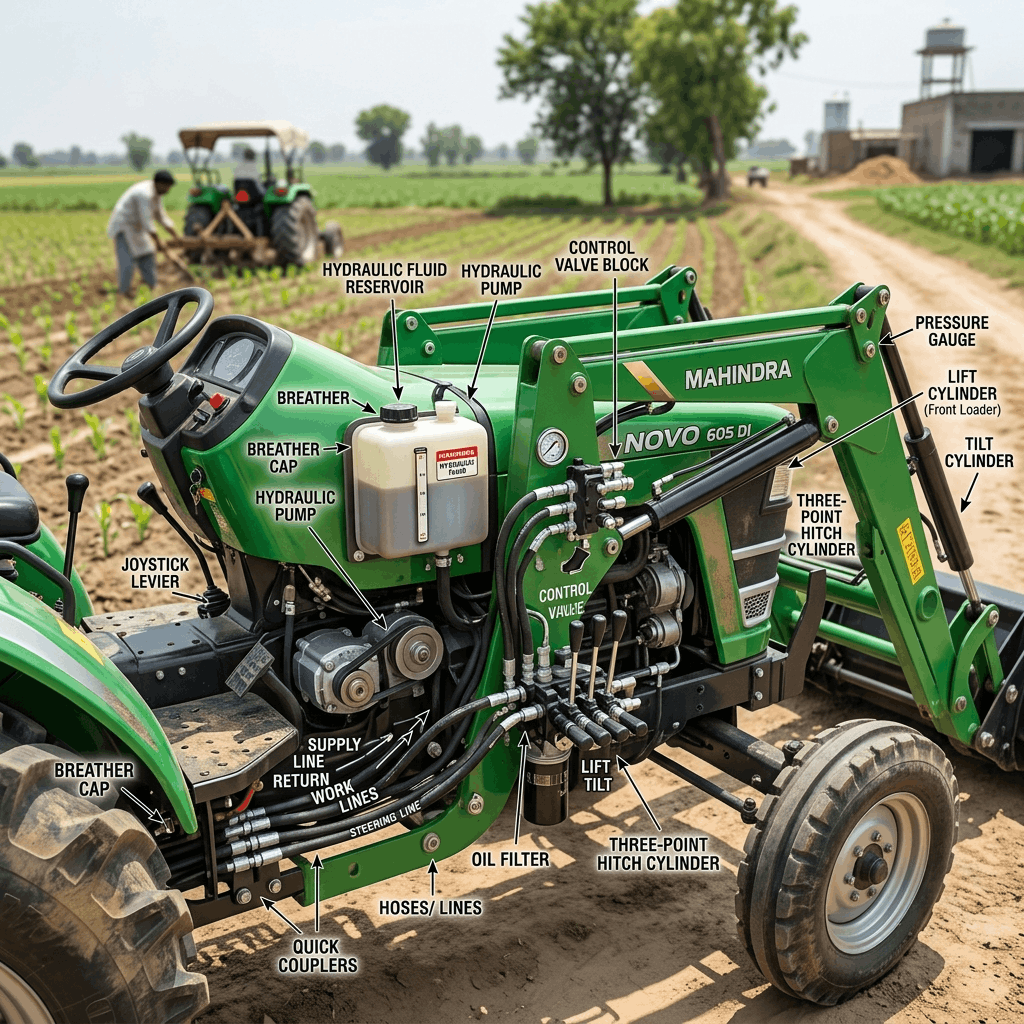
What is the Hydraulic System in a Tractor?
The hydraulic system is one of the most important and powerful mechanisms in any modern agricultural tractor. It uses the physical principle that liquids cannot be compressed — when pressure is applied to a confined fluid, that pressure is transmitted equally in all directions. This allows a relatively small mechanical force to be amplified into enormous lifting and pushing power, making it possible to lift heavy implements, control depth of ploughing, operate farm machinery, and steer modern tractors.
For Indian farmers, understanding the hydraulic system is critical because virtually every implement attached to a tractor — ploughs, cultivators, seed drills, sprayers, front-end loaders, and trolleys — is either controlled or powered by the hydraulic system. A well-maintained hydraulic system means better implement control, greater fuel efficiency, and longer tractor life. A poorly maintained one can lead to implement failures in the middle of a critical farming operation, costly repairs, and lost harvests.
Modern tractors used in India — from Mahindra and TAFE to Sonalika, New Holland, and John Deere — all use the same fundamental hydraulic system architecture, though with varying levels of sophistication. This guide covers all the major components, their functions, common problems, and maintenance best practices.
⚙️ All Major Hydraulic Parts and Their Functions
A tractor's hydraulic system consists of several interconnected components that work together as a single unit. Understanding each part individually helps you diagnose problems and maintain your tractor more effectively.
1. Hydraulic Pump (Hydraulic Pump)
The hydraulic pump is the heart of the entire hydraulic system. It is driven by the tractor's engine via a power take-off gear. The pump draws hydraulic oil from the reservoir and forces it under high pressure through the hydraulic lines to the control valve and cylinder. Most Indian tractors use a gear pump (two meshing gears that trap and push oil) because it is simple, robust, and easy to repair. High-end tractors may use piston or vane pumps for higher pressure and efficiency. Common problems: worn gears causing low pressure, seal failures causing leaks.
2. Hydraulic Oil Reservoir (Gearbox/Rear Axle Housing)
In most Indian tractors, the rear axle housing doubles as the hydraulic oil reservoir. This is known as the wet system or combined transmission-hydraulic system. The hydraulic oil (typically SAE 90 gear oil or manufacturer-specified hydraulic oil) is shared between the transmission and the hydraulic system. This design is cost-effective and space-efficient but means that contamination of the oil affects both systems simultaneously. The oil level must be checked regularly using the dipstick.
3. Hydraulic Control Valve (Selector Valve)
The control valve is operated by the farmer using the hydraulic lever inside the tractor cabin. It has three positions: Raise (sends pressurised oil to the cylinder to lift the implement), Lower (releases oil from the cylinder back to the reservoir, allowing the implement to descend by its own weight), and Neutral (maintains current position by blocking oil flow). Some advanced tractors have a fourth "Float" position that allows the implement to follow ground contours freely.
4. Hydraulic Cylinder (Ram/Piston Cylinder)
The hydraulic cylinder is a sealed steel tube containing a piston. When pressurised oil enters the cylinder, it pushes the piston outward. This linear motion is converted into the lifting motion of the three-point hitch arms. Most Indian tractors use a single-acting cylinder — oil pressure raises the implement, and gravity lowers it. Heavy-duty tractors may use double-acting cylinders that provide positive force in both directions.
5. Three-Point Linkage (3-Point Hitch)
The three-point linkage (also called the three-point hitch or TPH) is the standardised connection system that attaches implements to the tractor. It consists of two lower lift arms and one upper link (top link). The lower arms are connected to the lift rods which are driven by the hydraulic cylinder. The entire system was invented by Harry Ferguson and is universally standardised (Category I, II, III) so that any implement can be attached to any compatible tractor. The three-point hitch allows the farmer to raise or lower implements hydraulically.
6. Draft Control Linkage (Automatic Depth Control)
Draft control is an intelligent automatic system that constantly monitors the resistance (draft) experienced by the implement as it works through the soil. When the implement encounters hard ground and the pulling resistance increases beyond the set point, the hydraulic system automatically raises the implement slightly to reduce the load on the engine. When resistance drops (soft ground), it lowers automatically. This prevents engine stalling in difficult soil conditions and maintains consistent tillage depth. It is controlled by the draft control lever, usually the rear-most hydraulic control lever.
7. Position Control Linkage
Position control allows the farmer to set a fixed height for the implement independent of soil resistance. Unlike draft control which responds to pulling force, position control simply maintains the implement at a set height above the ground. This is used for operations like levelling, transport between fields, and when working with implements that should not penetrate the soil (like mowers or sprayers).
8. Hydraulic Oil Filters
Hydraulic oil filters trap metal particles, dirt, and contaminants from the hydraulic oil before they can reach the pump, valve, and cylinder where they would cause abrasive damage. Most Indian tractors have a suction strainer (at the oil intake) and a return filter (on the oil return line). These must be cleaned or replaced at the intervals specified in the tractor's service manual — typically every 250–500 hours of operation.
9. Relief Valve (Pressure Safety Valve)
The relief valve is a critical safety component that protects the entire hydraulic system from over-pressure. It is set to open at a specific maximum pressure (typically 180–210 bar in Indian tractors). If system pressure exceeds this limit — due to a blocked line, a stalled cylinder, or overloading — the relief valve opens and routes excess oil back to the reservoir, preventing burst hoses, pump damage, or cylinder seal failure.
10. Hydraulic Hoses and Couplings
Hydraulic hoses are high-pressure flexible tubes that carry oil between the various components. They are reinforced with wire mesh or braided steel to withstand pressures of up to 350 bar. Quick-release couplings at the rear of the tractor (called "remote hydraulic ports" or "auxiliary hydraulic") allow external implements like front-end loaders, tipping trailers, and disc harrows to be connected to the tractor's hydraulic power without permanent connection.
🛢️ Hydraulic Oil Capacity and Change Intervals
Maintaining the correct hydraulic oil level and changing it at the right interval is the single most important maintenance task for your tractor's hydraulic system. Here are the standard specifications for popular Indian tractors:
- Small tractors (25–35 HP, e.g., Mahindra JIVO, Sonalika DI 35): Hydraulic/transmission oil capacity: 25–35 litres. Oil change interval: every 500 hours or 1 year.
- Medium tractors (40–55 HP, e.g., Mahindra 475, TAFE 45): Capacity: 35–55 litres. Change interval: every 500 hours.
- Large tractors (60–75 HP, e.g., New Holland 6010, John Deere 5310): Capacity: 55–80 litres. Change interval: every 500 hours or as per manufacturer specification.
Always use the manufacturer-recommended oil grade. Using incorrect oil is the most common cause of hydraulic system failure in India. Most Indian tractors require Servo Trans HP 90 or equivalent GL-4 gear oil. Never mix different oil brands or grades.
💡 Quick Fact: The hydraulic lift on a modern 50 HP Indian tractor can generate over 2,000 kg of lift force — equivalent to lifting a small car — using nothing but fluid pressure and a relatively small pump.
🔧 Step-by-Step: How to Check and Maintain Your Hydraulic System
Check Oil Level Daily
Before starting the tractor, check the hydraulic/transmission oil level using the dipstick on the rear axle housing. The oil should be between the MIN and MAX marks. Never operate with low oil — it causes pump cavitation and rapid wear.
Inspect Hoses and Fittings Weekly
Walk around the tractor and visually inspect all visible hydraulic hoses for cracks, abrasion, bulging, or oil seepage. Check all couplings for tightness. A small hydraulic leak under high pressure can cause serious injury — never check for leaks with your bare hands.
Check Filter Condition Every 250 Hours
Remove and clean or replace the suction strainer. If the tractor has a paper return filter, replace it. A clogged filter starves the pump of oil and causes overheating.
Change Hydraulic Oil Every 500 Hours
Drain the rear axle housing completely, flush with clean oil if heavily contaminated, and refill with fresh manufacturer-specified oil. Always change oil warm — drain immediately after operating to ensure all suspended particles drain out with the oil.
Test System Pressure Annually
Use a hydraulic pressure gauge to test system pressure at the relief valve setting. If pressure is significantly below specification (more than 15% low), the pump or relief valve needs servicing. This test should be done by a qualified tractor mechanic.
🛡️ Protection from Hydraulic System Failures
Hydraulic system failures are among the most expensive tractor repairs. A single blown pump can cost ₹8,000–₹25,000. A burst hose in the field can halt operations at the most critical time. The following preventive measures will dramatically reduce breakdown risk:
Always use clean oil. Contaminated oil is the leading cause of hydraulic pump wear. Use an oil filter funnel when topping up. Store hydraulic oil in sealed containers away from dust and moisture. Never use brake oil, engine oil, or any other fluid as a substitute for hydraulic oil. Replace oil at recommended intervals even if it looks clean — oil degrades chemically before it looks dirty. Protect hoses from heat sources like the exhaust pipe, as high heat degrades hose materials rapidly.
🏪 Market: Hydraulic Parts Supply in India
India has a robust aftermarket for tractor hydraulic spare parts, primarily centred around major agricultural machinery hubs. For Gujarat farmers, Rajkot is the undisputed hub for tractor parts, with hundreds of dealers in the Gondal Road industrial area stocking both OEM and aftermarket hydraulic components. Unjha, Jasdan, and Morbi also have significant tractor parts markets.
For farmers in other states: Ludhiana (Punjab) is the largest tractor parts market in North India. Hyderabad (Andhra Pradesh) and Pune (Maharashtra) are major hubs in South and West India respectively. When purchasing hydraulic parts, always prefer OEM (Original Equipment Manufacturer) components or reputed aftermarket brands like Bharat Gears, Endurance, and Allied Products for critical components like pumps and control valves.
🔗 Related Articles: 🌾 Use of Ash (Rakh) in Farming: How, When & Benefits for Indian Farmers | 💧 How to Recharge Water in Your Farm and Increase Crop Yield | 🌱 How to Start a Nursery Business: Complete Guide with Profit, Market & Where to Sell | 🚜 Tractor Hydraulic System: All Parts and Their Functions Explained
⚙️ Professional Machinery & Setup
Planning to set up a professional organic fertilizer production unit (Vermicompost, Jeevamrut, or Cow Dung Processing)? We provide complete consultancy and high-capacity machinery for commercial projects. WhatsApp: +91 95372 30173
❓ Frequently Asked Questions: Tractor Hydraulics
The most common causes are: (1) Low hydraulic oil level — check and top up. (2) Worn hydraulic pump producing insufficient pressure. (3) Internal cylinder seal leakage — the piston seal is bypassing oil instead of building pressure. (4) Relief valve set too low or stuck open. Have a qualified mechanic check system pressure with a gauge to diagnose the specific cause.
Most Mahindra tractors (including the 265, 275, 415, 475, 575, 605 series) require SAE 90 GL-4 gear oil for the combined transmission-hydraulic system. Mahindra recommends its own branded Mahindra Genuine Oil. Equivalent alternatives include HPCL Servo Trans HP 90, BPCL Mak Trans HD 90, or Indian Oil Servo Trans HP 90. Always check your specific model's owner manual.
Slow implement drift (gradual lowering when the lever is in neutral) is typically caused by: (1) Worn control valve spool — oil bypasses internally from the pressure side to the return side. (2) Cylinder piston seal failure — oil bypasses the piston within the cylinder. (3) A leaking check valve. This requires professional diagnosis and usually involves replacing the control valve or cylinder seal kit.
Yes. Most Indian tractors can be fitted with additional remote hydraulic couplings (also called auxiliary hydraulic ports) as an aftermarket accessory. This allows you to connect implements that require independent hydraulic control. However, adding additional circuits does reduce the overall pressure available per circuit, so ensure your tractor's pump capacity can handle the additional load. Consult a certified tractor mechanic before modification.
The suction strainer (metal mesh filter) should be cleaned every 250 hours or at each oil change. If your tractor has a paper-element return line filter, replace it every 500 hours. In dusty Indian field conditions, check the filter more frequently — every 150–200 hours during intensive land preparation season.