📅 June 2026 | ✍️ Mitti Gold Organic | 🗂️ Legal
📥 Download Sample Format
Get the sample document format in English, Hindi, Gujarati, or Urdu.
Introduction to Wasteland Allocation
In a world increasingly challenged by food security issues and shrinking arable land due to urbanization, the reclamation and allocation of wasteland present a massive opportunity for agricultural expansion. Governments across various states hold substantial tracts of land classified as \"wasteland\"—areas that are currently barren, degraded, or uncultivated due to poor soil quality, lack of irrigation, or dense scrub cover. To boost agricultural production and support the farming community, state governments often have provisions allowing existing agricultural landowners or landless farmers to apply for the allotment of these wastelands. For an ambitious agricultural landowner, acquiring adjacent or nearby wasteland can be a strategic move to significantly expand their holding, diversify their crops, and increase their overall yield. However, the government does not simply hand over this land upon request. The process is highly regulated, designed to ensure that the land is given to capable individuals who genuinely intend to develop it for agricultural purposes, rather than holding it for real estate speculation.
Defining and Categorizing Wasteland
Before embarking on the application process, it is essential to understand what legally constitutes \"wasteland\" in government records. Wasteland is generally defined as degraded land that can be brought under vegetative cover with reasonable effort, and which is currently under-utilized and land deteriorating for lack of appropriate water and soil management. Governments typically categorize wastelands into two main types: Culturable Wasteland and Unculturable Wasteland. Culturable wastelands include gullied or ravinous land, undulating upland with or without scrub, waterlogged or marshy land, and land affected by salinity or alkalinity. These lands have the potential for agriculture if reclaimed. Unculturable wastelands, on the other hand, include barren rocky areas, steep sloping areas, and snow-covered areas, which cannot be developed for agriculture. As an applicant, you must ensure through preliminary checks with the local revenue office that the parcel of land you are targeting is officially classified as culturable wasteland and is available for allotment, rather than being earmarked for public utilities, forest reserves, or industrial zones.
Understanding Government Policies and Objectives
The allocation of government wasteland is governed by state-specific land revenue codes and wasteland disposal rules. The primary objective of these policies is not revenue generation for the government, but rather socio-economic development. Governments aim to increase the total net sown area, promote afforestation, improve soil conservation, and uplift the economic status of the farming community. Therefore, the policies are often heavily skewed in favor of marginalized groups, landless agricultural laborers, ex-servicemen, and small or marginal farmers. For an existing agricultural landowner seeking to apply, understanding this hierarchy of priority is crucial. While existing landowners can certainly apply, their applications might be considered only after the needs of the prioritized groups have been met, or if they can prove that the specific parcel of wasteland is contiguous to their existing landholdings and is essential for viable agricultural operations. Familiarizing yourself with the specific Wasteland Allotment Rules of your state will clarify the specific objectives and priority criteria applied by your local administration.
Eligibility Criteria for Existing Landowners
While landless farmers have the first right of refusal in many states, existing agricultural landowners are also eligible to apply for wasteland, provided they meet strict criteria. The most critical factor is the statutory \"Land Ceiling Limit.\" Every state has laws defining the maximum amount of agricultural land an individual or a family can hold. If acquiring the wasteland pushes your total landholding beyond this ceiling limit, your application will be outright rejected. Secondly, proximity plays a significant role. Landowners applying for wasteland that is directly adjacent to their existing farms have a much stronger case. This is because contiguous land is easier to manage, irrigate, and develop efficiently. Furthermore, the government will assess the applicant's financial capacity and agricultural expertise. The authorities need assurance that the landowner possesses the necessary capital, machinery, and intent to invest heavily in reclaiming the degraded land, transforming it from a barren patch into a productive agricultural asset within the mandated timeframe.
Essential Documents Required for the Application
A meticulous and comprehensive compilation of documents is required to prove your eligibility and intent to the revenue authorities. The standard application form must be accompanied by certified copies of your existing land records (7/12 extract or Khatauni) to prove you are a bona fide agriculturist and to establish your current landholding size. You must also submit a detailed sketch or map of the proposed wasteland, clearly indicating its survey numbers, boundaries, and its exact location relative to your existing property. Personal identification and address proofs are mandatory. Crucially, applicants must often submit a sworn affidavit declaring their total landholdings across the state, confirming they will not exceed the ceiling limit upon allotment. Additionally, presenting a preliminary \"Land Development Plan\" can significantly bolster your application. This plan should outline your strategy for soil reclamation, proposed irrigation methods, the types of crops or plantations intended, and an estimated budget, proving your serious commitment to cultivating the wasteland.
The Initial Application and Submission Process
The formal process begins by submitting a detailed written application to the competent revenue authority, which is typically the Tehsildar, the Sub-Divisional Magistrate (SDM), or the District Collector, depending on the acreage of the wasteland applied for. Smaller parcels are often handled by the Tehsildar, while larger tracts require the Collector's approval. The application must explicitly state the purpose of the request—be it for standard agriculture, horticulture, agro-forestry, or setting up agricultural infrastructure. Upon submission, the inward clerk will provide a receipt, and the application file is officially opened. The Collector or Tehsildar will then forward the file to the local village accountant (Patwari) and the Circle Inspector for a ground-level preliminary report. It is highly advisable for the applicant to maintain a copy of the stamped application and follow up regularly with the revenue office, as bureaucratic delays are common in processes involving government land alienation.
Land Survey and Ground Assessment
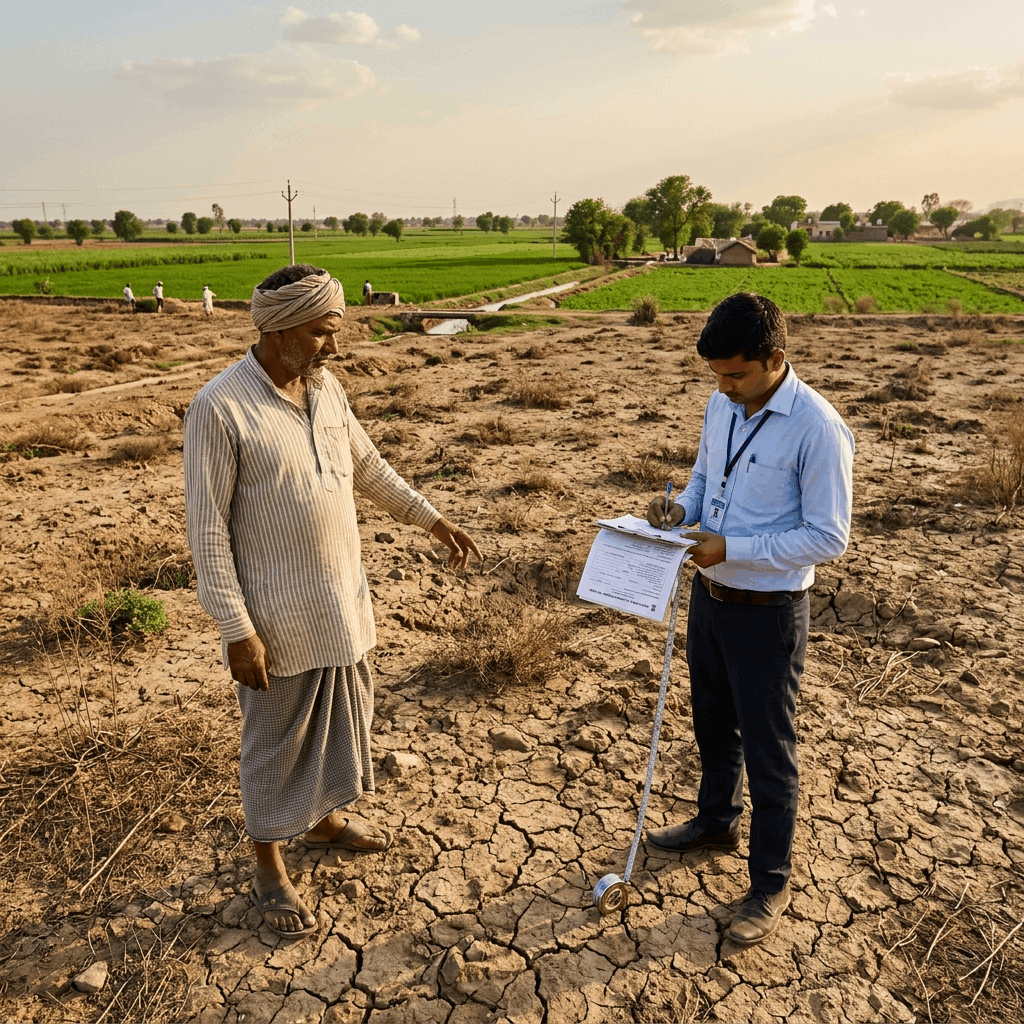
Following the initial submission, the revenue department initiates a rigorous ground assessment. The Patwari, often accompanied by a government surveyor and sometimes officials from the agriculture or forest department, visits the site. Their primary objective is to verify the physical status of the land. They confirm whether the land is indeed uncultivated, assess its soil quality, terrain, and availability of nearby water sources. They also check for any unauthorized encroachments by local villagers, existing structures, or usage of the land as common grazing grounds (Gauchar). The surveyor will measure the exact dimensions and create a spot map (Panchnama). This assessment ensures that the land is technically viable for the proposed agricultural use and that its allotment will not disrupt existing village ecosystems or local rights. The findings are compiled into a comprehensive report that forms the technical backbone of the revenue department's decision-making process regarding your application.
Environmental and Ecological Clearances
In contemporary land administration, environmental considerations are paramount. Just because land is classified as \"wasteland\" does not mean it is devoid of ecological value. Some wastelands may act as natural drainage basins, harbor local wildlife, or consist of fragile scrubland ecosystems. Consequently, the revenue department often routes the application through the local Forest Department and the Environmental Board for a No Objection Certificate (NOC). The forest department will verify that the land is not part of a notified forest area or an essential wildlife corridor. If the applicant plans to fell any existing scrub or trees to clear the land for cultivation, specific permissions will be required. Furthermore, if the land is located near a riverbed or a natural water body, authorities will ensure that the proposed agricultural activities—especially the use of chemical fertilizers or heavy irrigation—will not lead to soil erosion or water contamination. Clearing these ecological hurdles is a mandatory and often time-consuming phase of the application.
The Crucial Role of the Gram Panchayat
Government wasteland located within a village's boundaries is often intricately linked to the local community's daily life. Therefore, the local Gram Panchayat (Village Council) plays a highly influential role in the allotment process. The revenue authorities will officially seek a resolution or NOC from the Gram Panchayat regarding the application. The Panchayat convenes a Gram Sabha (village meeting) to discuss the potential impact of giving away the land to a private individual. The villagers may raise concerns if the land is currently being used informally for grazing cattle, collecting firewood, or hosting seasonal village fairs. If the Gram Panchayat objects to the allotment, citing the infringement of community rights or requirements for future village expansion, the District Collector will generally honor that objection and reject the application. Engaging with the village community, addressing their concerns transparently, and ensuring that your agricultural project might generate local employment can help in securing a favorable resolution from the Panchayat.
Public Notice and the Hearing of Objections
Similar to other land alienation processes, transparency is enforced through the publication of a formal public notice. Once the ground reports are positive and the Gram Panchayat NOC is secured, the Tehsildar issues a proclamation stating the government's intent to allot the specific parcel of wasteland to the applicant. This notice is published in local newspapers and displayed prominently at the Panchayat office and the Tehsildar's notice board. A statutory period, usually 30 days, is granted for any member of the public to file written objections. Objections could arise from neighboring landowners disputing the boundaries, individuals claiming prior, albeit undocumented, possession of the land, or environmental groups highlighting ecological concerns. If objections are received, the Collector or SDM holds a quasi-judicial hearing, allowing both the applicant and the objectors to present their cases and evidence. The application can only proceed if all objections are legally dismissed and resolved to the satisfaction of the presiding revenue officer.
Payment of Premium, Lease, or Occupancy Price
If the application clears all public and administrative scrutiny, the government will formally approve the allotment. However, government land is rarely given away for free to existing landowners. The District Collector will determine the financial terms of the allotment. Depending on the state's specific policies, the land may be allotted on a long-term leasehold basis (e.g., 30 or 99 years) or granted on an ownership basis. The applicant will be required to pay an \"occupancy price,\" a premium, or an annual lease rent. This price is usually calculated based on the prevailing ready reckoner rates or circle rates of the area, though it may be subsidized considering the degraded nature of the land. The applicant is given a strict deadline, often 30 to 60 days, to deposit this amount into the government treasury. Failure to pay the stipulated amount within the timeframe will result in the immediate cancellation of the allotment order, and the applicant will have to forfeit any initial deposits or processing fees paid.
Strict Conditions of Allotment and Usage
Receiving the allotment order is a milestone, but it comes with strings attached. The government imposes strict, legally binding conditions on the use of the wasteland to ensure it meets the policy's objectives. The most fundamental condition is that the land must be used exclusively for the purpose stated in the application (e.g., agriculture or horticulture). Converting this land for commercial, industrial, or residential real estate purposes is strictly prohibited and constitutes a severe breach of contract. Furthermore, the allotment often comes with a \"lock-in period,\" ranging from 10 to 15 years, during which the landowner is completely barred from selling, gifting, or transferring the land to any third party. The land can usually only be mortgaged to nationalized banks or cooperative societies for the specific purpose of securing agricultural loans to develop that very parcel of land. These conditions are explicitly noted in the revenue records to prevent illegal transfers.
Timelines for Mandatory Land Development
The government does not tolerate the hoarding of allotted wasteland. To ensure productive use, the allotment order stipulates mandatory timelines for land development. Typically, the landowner is required to bring a certain percentage of the wasteland under cultivation within a specified period—for example, making 50% of the land arable within three years and fully developing the entire tract within five years. This involves intensive labor and capital: clearing scrub, leveling the terrain, testing and treating the soil with correct amendments, and installing irrigation systems like borewells or drip lines. Revenue officials will conduct periodic inspections during these initial years to monitor the progress. If the landowner fails to initiate development or leaves the land barren beyond the grace period, the government retains the legal right to cancel the allotment, resume possession of the land without paying any compensation for minor improvements made, and re-allot it to a more capable applicant.
Strategies for Converting Wasteland to Cultivable Land
Successfully transforming wasteland into a thriving agricultural hub requires a scientific and phased approach. The first step is comprehensive soil testing to identify deficiencies in macronutrients, pH imbalances, or excessive salinity. Based on the results, deep ploughing and the heavy application of organic matter, such as farmyard manure, compost, and green manure crops (like Dhaincha or Sunhemp), are necessary to rebuild soil structure and fertility. For saline or alkaline soils, treatments with gypsum and intensive leaching with fresh water are required. Water management is equally critical; if the area is rain-fed, constructing watershed structures like percolation tanks, check dams, and contour trenches will help harvest rainwater and recharge groundwater. Initially, it is advisable to plant hardy, drought-resistant pioneer crops or agro-forestry tree species that demand less water and naturally fix nitrogen in the soil. As the soil health gradually improves over a few seasons, the landowner can transition to higher-value, more demanding commercial crops.
Conclusion: A Rewarding but Rigorous Undertaking
Applying for and developing government wasteland is not a task for the faint-hearted. It is a rigorous legal, administrative, and agricultural undertaking that demands immense patience, substantial capital investment, and a long-term vision. The bureaucratic process is laden with checks and balances—from proving eligibility and adhering to land ceilings to securing environmental clearances and Panchayat approvals. However, for a dedicated agricultural landowner, the rewards are profoundly significant. Successfully reclaiming wasteland not only expands your agricultural footprint and boosts personal profitability but also contributes heavily to national food security, ecological restoration, and local employment. By thoroughly understanding the state's specific legal frameworks, strictly adhering to the conditions of allotment, and applying scientific land reclamation techniques, landowners can transform barren, overlooked patches of earth into vital, thriving assets that yield rich dividends for generations to come.
📦 Bulk Orders & Export
Mitti Gold Organic: For bulk orders of all organic fertilizers — Farmers, Nurseries, and Export. WhatsApp: +91 95372 30173
Frequently Asked Questions on Wasteland Application
Can anyone apply for government wasteland?
No. While policies vary by state, priority is generally given to landless agricultural laborers, marginalized communities, and ex-servicemen. Existing agricultural landowners can apply, provided they prove their capability to develop the land and do not exceed the state's statutory land ceiling limits.
How do I find out if a piece of land is classified as wasteland?
You need to visit the local Tehsildar or Patwari office and inspect the village land records (Village Map and Record of Rights). The records will indicate whether the specific survey number is classified as government culturable wasteland available for allotment.
Will I get the wasteland for free?
Generally, no. Existing landowners are usually required to pay a premium, occupancy price, or an annual lease rent determined by the District Collector based on the area's prevailing circle rates, though it may be offered at a concessional rate compared to prime agricultural land.
Can I sell the wasteland immediately after acquiring it?
Absolutely not. Allotment orders come with a strict lock-in period (often 10 to 15 years) during which you cannot sell, gift, or transfer the land. The explicit purpose is agricultural development, not real estate speculation.
What happens if I fail to cultivate the allotted wasteland?
The allotment conditions mandate that you bring the land under cultivation within a specific timeframe (usually 3 to 5 years). If you fail to develop the land, the government has the legal authority to cancel the allotment and take the land back without compensation.