📅 June 2026 | ✍️ Mitti Gold Organic | 🗂️ Vermicompost
Comprehensive Application Rates and Quantitative Soil Analysis
In the evolving landscape of modern agriculture, the debate between organic Vermicompost and synthetic chemical fertilizers has reached a critical turning point. As soil degradation becomes a global crisis, farmers are looking for solutions that not only provide immediate crop nutrition but also ensure the long-term viability of their land. Mitti Gold Vermicompost represents the pinnacle of organic soil technology, offering a biological alternative to the harsh salts found in Urea and DAP.
The Quantitative Gap: Understanding Application Rates
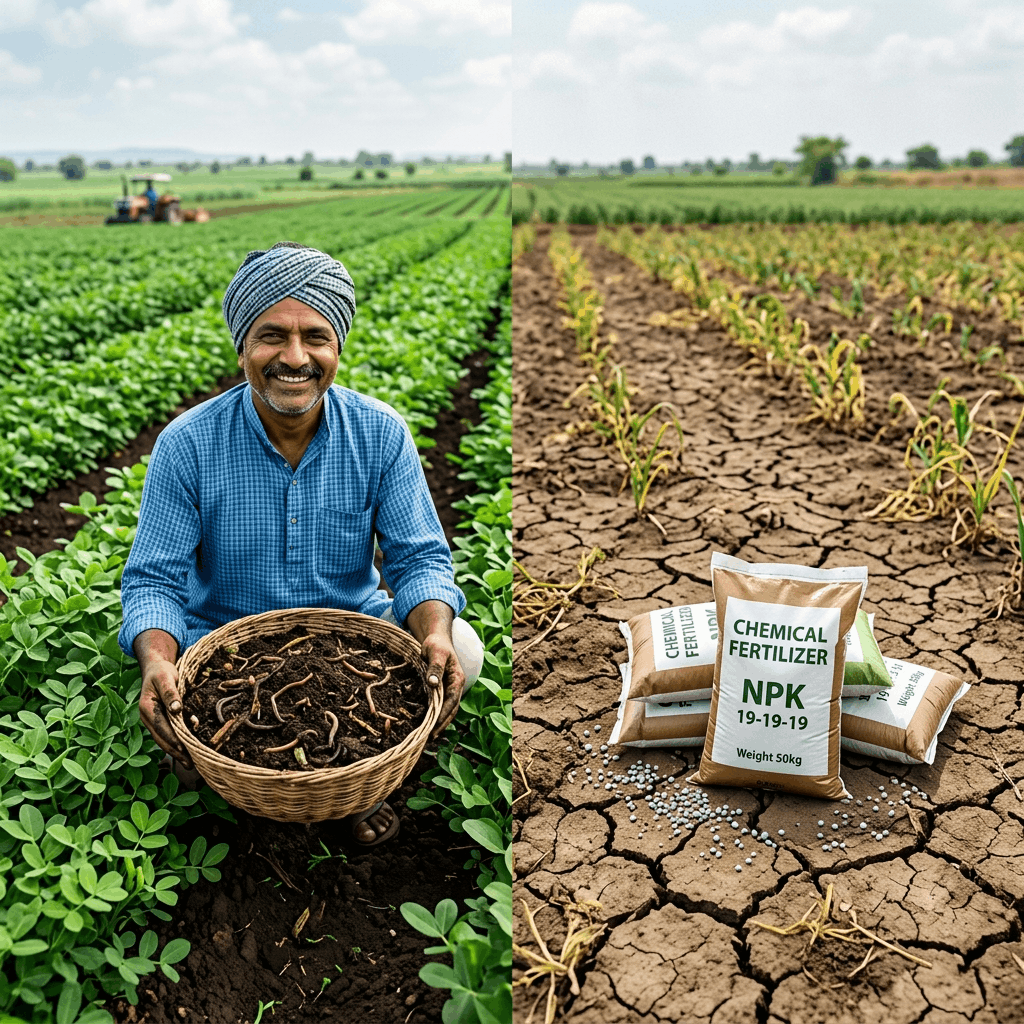
For a standard 1-bigha plot (approximately 0.4 acre), the recommended quantity of Mitti Gold Vermicompost is 800 kg to 1.2 Tonnes for the initial soil rejuvenation phase. This might seem significantly higher than the 50-100 kg of Urea or DAP typically applied by chemical-dependent farmers. However, the comparison is not one-to-one. Chemical fertilizers provide a sharp, unstable "spike" of Nitrogen, Phosphorus, or Potassium that is often 60-70% lost to the atmosphere or groundwater leaching.
In contrast, Mitti Gold Vermicompost is a "Smart-Release" system. Every kilogram is packed with millions of beneficial microbes and humic substances that "hold" nutrients in the root zone. By switching to Vermicompost, you are not just feeding the plant; you are building a biological asset. Farmers who maintain a consistent Vermicompost regimen report a 40% reduction in overall input costs within three growing seasons, as the soil begins to fix its own nitrogen and release "locked" minerals.
Nutrient Density and Bioavailability
Chemical fertilizers are often rated by their NPK percentage (e.g., 19-19-19). While Vermicompost has lower raw percentages (typically 2-1-2), its nutrients are in a chelated, organic form that plants can absorb almost 100% efficiently. Synthetic fertilizers are essentially "fast food" for plants—they provide a quick growth burst but lead to weak cell walls and higher susceptibility to pests. Vermicompost is the "complete balanced diet," providing all 17 essential macro and micro-nutrients, including Boron, Zinc, Iron, and Magnesium, which are almost entirely absent from chemical NPK bags.
Furthermore, the high organic carbon content in Mitti Gold (often exceeding 20-30%) provides the energy source for soil bacteria to thrive. Without this carbon, chemical salts eventually turn fertile fields into "dead dust" or "hard pan" soil that requires more and more chemicals each year just to maintain the same yield—a phenomenon known as the "Chemical Addiction Loop."
The Science of Application: Best Practices for Organic Success
The application method for Vermicompost is fundamentally different from the "broadcast and pray" method used with chemical granules. Because Mitti Gold is a living biological product, it requires careful handling to maximize its efficiency.
Basal Dose and Field Preparation
The most effective time to apply Vermicompost is during the final field preparation, just before sowing. This is known as the "Basal Dose." It should be incorporated into the top 4-6 inches of the soil where the young roots will develop. Unlike chemical fertilizers, which can "burn" delicate seedlings if they come into direct contact, Vermicompost is perfectly safe and even encourages faster seed germination.
Top-Dressing and Root Zone Application
For standing crops, top-dressing should be done near the root zone or the "drip line" of the plant. After application, it is critical to cover the Vermicompost with a thin layer of soil (mulching) and follow with a light irrigation. This protects the sensitive microbes and earthworm cocoons from direct UV radiation and ensures they remain active in the moist soil environment.
Compatibility with Drip Irrigation and Vermiwash
While solid Vermicompost cannot pass through drip emitters, it can be applied manually at the emitter points. To supplement this, we recommend the use of Mitti Gold Vermiwash as a foliar spray or through the fertigation system. This combination provides both slow-release soil nutrients and immediate liquid nourishment, a strategy used by export-oriented fruit and vegetable growers to achieve 100% residue-free harvests.
The Harvest Outcome: Quality, Yield, and Market Premium
The ultimate test of any fertilizer is the harvest. While chemical fertilizers focus solely on the "weight" of the crop, Mitti Gold focuses on the "Quality and Value."
Superior Crop Quality and Shelf Life
Vegetables and fruits grown with Mitti Gold Vermicompost have significantly higher "Brix" levels (sugar content) and better nutritional profiles. Because organic crops have thicker cell walls, they lose moisture much slower than "water-bloated" chemical crops. This results in a shelf life that is 30-50% longer, a critical factor for farmers shipping produce to distant markets or exporters.
Residue-Free and Export Ready
In 2026, the global market for "Residue-Free" produce is expanding rapidly. Chemical fertilizers often come contaminated with heavy metals or leave salt residues that fail international MRL (Maximum Residue Limit) tests. By using Mitti Gold, farmers can enter the "Organic Export" segment, where prices for crops like Dragon Fruit, Pomegranate, and Spices are often 2-3 times higher than local Mandi prices.
Yield Stability vs Yield Volatility
Chemical farming is highly volatile—one drought or heatwave can wipe out a crop because the plants are "lazy" and have shallow roots. Vermicompost-fed crops develop deep, robust root systems and a high concentration of proline (an amino acid that helps plants survive stress). This ensures yield stability even in adverse weather conditions, providing a "financial insurance" for the farmer.
Restoring the Micro-Ecosystem: Bringing the Soil Back to Life
The most profound difference between Mitti Gold and chemical fertilizers is their impact on soil life. Chemical fertilizers are essentially "microbe killers," as their high salt concentration creates an osmotic pressure that dehydrates and kills beneficial soil organisms.
The Return of the Earthworm
Mitti Gold acts as an "Earthworm Magnet." The humic substances and organic matter in our Vermicompost signal to native earthworms to return to your field. These earthworms act as a 24/7 labor force, tunneling through the soil (natural aeration) and producing their own castings (free fertilizer). A single acre of healthy organic soil can contain over a million earthworms, doing the work of multiple tillers and laborers for free.
Fungal and Bacterial Symbiosis
Mitti Gold is inoculated with Mycorrhizae and Trichoderma. These fungi form a symbiotic relationship with plant roots, effectively extending the root system by 100x and allowing the plant to "mine" phosphorus and water from deep within the earth. Chemical phosphorus (DAP) inhibits this relationship, forcing the plant to depend entirely on the farmer for every gram of nutrient.
Natural Immunity: The End of Expensive Pesticides
Modern farmers spend nearly 30% of their budget on pesticides and fungicides. This is largely because chemical-fed plants are "weak-targets" for pests. High chemical Nitrogen makes plant sap "sweet" and the tissues "soft," which attracts aphids, whiteflies, and bollworms.
Systemic Induced Resistance (SIR)
Plants grown with Mitti Gold Vermicompost develop a natural "armor." The presence of beneficial microbes triggers the plant's own immune system, a process known as Systemic Induced Resistance. The plant produces its own defensive chemicals (phenolics and alkaloids) that make it unpalatable to pests.
Suppression of Soil-Borne Pathogens
Soil diseases like Fusarium Wilt, Root Rot, and Damping-off are the nightmare of every farmer. Mitti Gold contains specialized bacteria that "starve" these pathogens of iron (siderophores) and out-compete them for space. In many cases, switching to 100% Mitti Gold has allowed farmers to completely eliminate the use of expensive soil-drenching fungicides.
Economic Reality: Farmer Profitability and the Global Organic Shift
While the "cost per bag" of Urea is subsidized and appears cheap, the "Total Cost of Cultivation" (TCC) for chemical farming is skyrocketing. Rising water costs, increasing pesticide needs, and the requirement for more and more chemical bags as soil fails are driving many farmers into debt.
The Financial Breakdown
An organic farmer using Mitti Gold saves money on:
- Water: Organic soil holds 3x more water, reducing irrigation frequency by 20-30%.
- Pesticides: Natural immunity reduces spray costs by 50%+.
- Long-term Inputs: Soil health improves over time, allowing for a gradual reduction in fertilizer quantity.
The "Premium" Advantage
Mitti Gold farmers are not just "growers"; they are "premium producers." Whether it is for high-end urban nurseries, organic retail chains, or international exporters, the Mitti Gold brand on your soil analysis report opens doors to high-value markets that chemical farmers simply cannot access. In 2026, "Soil Health" is the new "Wealth," and Mitti Gold is your most reliable investment.
🌿 Bulk Vermicompost Orders
Mitti Gold Organic: For bulk supply of premium Vermicompost Fertilizer — Ideal for Farmers, Nurseries, and Export. WhatsApp: +91 95372 30173