📅 June 2026 | ✍️ Mitti Gold Organic | 🗂️
What is a Sanedo? Understanding Gujarat's Traditional Walking Tractor
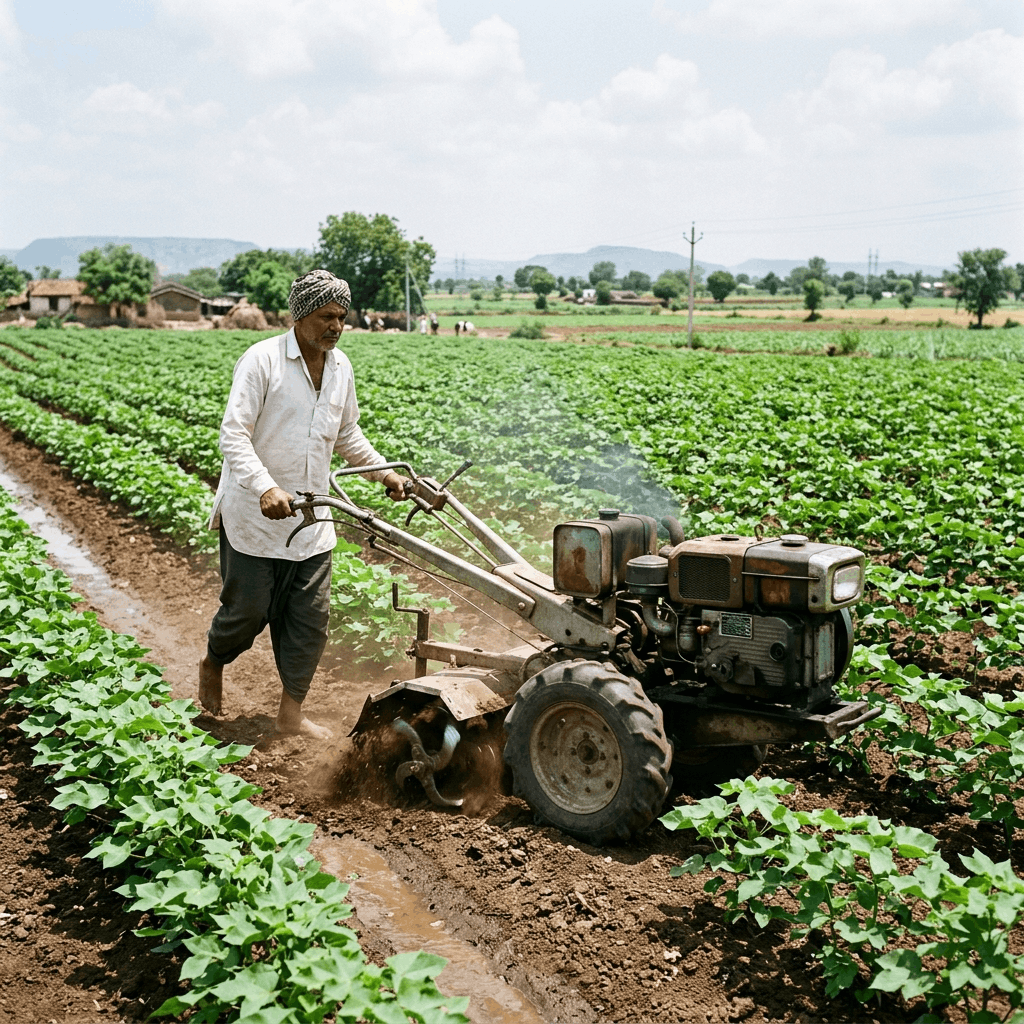
The Sanedo (also spelled Sanedo, Sanedhu, or sometimes referred to as a "power tiller" or "walking tractor" in official documents) is a traditional, small-scale agricultural machine that has been a cornerstone of small and marginal farm mechanisation in Gujarat — particularly in the Saurashtra region — for several decades. Unlike a conventional tractor where the farmer sits and drives, a Sanedo is operated by a farmer who walks behind the machine, controlling it with two long handlebars.
The name "Sanedo" comes from the Gujarati language and is believed to derive from a word describing the act of tilling or turning the soil. The machine is essentially a two-wheeled, self-propelled power tiller driven by a small diesel or petrol engine (typically 6–12 HP), with a rotavator or cultivator attachment at the front. It is far cheaper than a full-sized tractor, requires much less maintenance, can access narrow fields and orchards where a large tractor cannot manoeuvre, and is within the financial reach of small and marginal farmers.
In rural Gujarat, the Sanedo has a legendary status. For a generation of small farmers in Saurashtra who could not afford a conventional 35–50 HP tractor, the Sanedo was the machine that allowed them to mechanise their land preparation, reduce their dependency on manual labour or bullock power, and achieve timely cultivation — all of which significantly improved crop yields and farming efficiency.
📜 History and Development of the Sanedo in Gujarat
The widespread adoption of Sanedo-type machines in Gujarat began in the 1970s and 1980s, coinciding with the Green Revolution's push for agricultural mechanisation across India. While similar power tillers were available from manufacturers elsewhere in India and Japan, Gujarati farmers and local engineers in the Saurashtra region — particularly in and around Rajkot, Morbi, Gondal, and Junagadh — began adapting, modifying, and locally manufacturing these machines to suit local farming conditions, soil types, and the specific needs of Saurashtra's smallholder farmers.
The Rajkot industrial belt, already a thriving centre for agricultural machinery manufacturing (submersible pumps, diesel engines, agricultural implements), became the primary hub for Sanedo production in Gujarat. Local manufacturers produced simplified, robust, low-cost versions of imported power tillers that could be repaired using locally available parts, serviced by local mechanics, and purchased by farmers at a fraction of the cost of imported machinery.
The machines became particularly popular in groundnut-growing areas of Saurashtra — Rajkot, Jamnagar, Junagadh, Amreli, Bhavnagar, and Porbandar districts — where small farm sizes (typically 2–10 bigha per family) made full-sized tractors economically impractical. The Sanedo allowed these small farmers to prepare their groundnut fields quickly during the narrow pre-monsoon window without waiting to hire a tractor.
⚙️ Key Parts and How the Sanedo Works
A standard Gujarat-made Sanedo consists of the following major components:
1. Engine: A single-cylinder diesel or petrol engine of 6–15 HP. Common engines used include Kirloskar, Field Marshal, Lister, and various Chinese-manufactured single-cylinder diesel engines. The engine drives the machine through a gearbox.
2. Gearbox/Transmission: A simple gear transmission system providing 2–6 forward speeds and 1–2 reverse speeds. Speed selection controls the working speed of the machine through the field.
3. Rotavator / Tines (Primary Tillage Tool): The rotating blades or tines are driven by the engine and cut into the soil, breaking it up and turning it. This is the primary tillage action. Different sets of tines are used for different soil types and tillage depths.
4. Drive Wheels: Two large, heavily lugged steel or rubber wheels provide traction through the field. The lugs dig into the soil to prevent slipping.
5. Handlebars: The farmer controls direction and depth using two long steel handlebars. The machine's steering requires significant physical effort, making operation physically demanding — particularly in hard soils.
6. Depth Control Skid: A simple drag skid or tail wheel at the rear of the rotavator controls the depth of tillage. Adjusting the height of this skid increases or decreases how deeply the tines penetrate the soil.
7. Attachments: Modern Sanedo machines accept a range of quick-attach implements beyond the basic rotavator, including: furrow openers (for seed drilling and fertilizer placement), ridgers (for earthing up crops like potato and groundnut), mowers (for green manure crops), and small trailers for short-distance material transport.
⛽ Fuel Consumption and Operating Costs per Bigha
One of the most important practical considerations for a farmer deciding whether to buy a Sanedo is the actual operating cost. Here is a realistic breakdown based on typical conditions in Saurashtra, Gujarat:
- Fuel consumption: A standard 8–10 HP diesel Sanedo consumes approximately 1.0–1.5 litres of diesel per hour during rotavation. At Gujarat diesel prices of approximately ₹90/litre, this translates to ₹90–₹135 per hour of operation.
- Coverage rate: In medium-hard Saurashtra groundnut soil, a Sanedo can rotavate approximately 0.5–0.8 bigha per hour. This means a full bigha of soil preparation costs approximately ₹115–₹270 in fuel alone.
- Labour cost: One skilled operator is required. Daily labour cost for Sanedo operation: ₹400–₹600 in current Gujarat market rates.
- Total operating cost per bigha: ₹300–₹600 (fuel + labour proportional), significantly cheaper than hiring a large tractor at ₹600–₹1,200 per bigha in the same region.
- Purchase price (new): ₹1.2 lakh – ₹2.5 lakh for a new machine depending on HP, brand, and configuration. Second-hand Sanedos are widely available for ₹40,000–₹80,000.
📋 Step-by-Step: Operating a Sanedo for Best Results
Pre-Operation Check
Check engine oil level, fuel level, and cooling water (if water-cooled engine). Inspect tine bolts for tightness — loose tines can cause vibration damage and safety hazards. Check that all guards are in place.
Set Tillage Depth
Adjust the depth control skid to the required tillage depth. For primary tillage (first pass through the field), set for maximum depth (20–25 cm). For secondary tillage or seedbed preparation, set to shallow (10–15 cm). Deeper tillage uses more fuel.
Start the Engine and Engage
Start the engine according to manufacturer procedure. Allow the engine to warm up for 2–3 minutes at idle before engaging the power drive. Engage the PTO drive that powers the tines, then release the wheel clutch to begin forward movement.
Control Direction and Depth
Guide the machine using the handlebars. Turn by lifting slightly on the inside handlebar. Maintain consistent depth by applying light downward pressure. Work across the field in parallel strips, slightly overlapping each previous strip by 10–15 cm to ensure complete coverage.
Post-Operation Maintenance
After completing fieldwork, clean all soil from tines and wheel lugs. Check tine condition — replace worn or broken tines before the next use. Grease all grease nipples per the service schedule. If storing for more than 1 week, add engine preservative oil to the cylinder if specified by the manufacturer.
📊 Crop Yield Impact of Sanedo Tillage
The primary benefit of using a Sanedo for field preparation is the quality and timeliness of tillage it achieves on small farms. For Saurashtra's groundnut farmers, the ability to prepare their fields within the narrow 7–10 day pre-monsoon window — when the first rains soften the soil — is critical. Delayed field preparation after this window means delayed sowing, which directly impacts groundnut yield. Farmers using a Sanedo report completing their field preparation 3–5 times faster than manual labour or bullock-driven cultivation.
The deep, fine tilth created by the rotavating action of a Sanedo is also superior to the shallow, cloddy result of a conventional disc plough for groundnut cultivation. Groundnuts require loose, well-aerated soil for proper pod development below the surface. The uniform fine seedbed created by Sanedo rotavation consistently produces groundnut yields that are 15–25% higher than equivalent fields prepared with traditional bullock cultivation, according to data from Junagadh Agricultural University's farm mechanisation studies.
🌿 Environmental and Ecological Impact
The Sanedo has a more nuanced ecological impact than large conventional tractors. Because it is smaller and lighter, it causes significantly less soil compaction than a conventional 4-wheel tractor. Soil compaction from heavy tractors destroys soil pore structure, reduces water infiltration, and damages earthworm populations. A Sanedo's lighter footprint is gentler on the soil ecosystem, particularly in the between-row positions in orchards and vegetable crops where large tractors simply cannot go.
However, the intensive rotavation action of a Sanedo — while excellent for seedbed preparation — can over-till the soil if used too frequently, destroying soil structure and earthworm habitat. Farmers are advised to limit rotavation passes to 1–2 per crop cycle and supplement with sub-soil loosening (chisel ploughing) every 3–4 years to break up any plough pan that forms at the depth of rotavation.
🛡️ Protection: Maintenance Tips to Avoid Breakdowns
A Sanedo is a simple, rugged machine, but like all mechanical equipment, it requires regular maintenance to perform reliably and avoid costly breakdowns during critical farming operations. The most common Sanedo breakdowns in Gujarat fields and their prevention:
Tine breakage: Most common in rocky soils. Prevention: Inspect field for buried stones before tillage. Slow down the machine in rocky areas. Use hardened steel replacement tines rather than cheap soft metal substitutes.
Engine overheating: Caused by air-cooled engine running without adequate air flow, or water-cooled engines running low on coolant. Prevention: Clean air filter weekly during field operations. Check coolant level daily on water-cooled models. Never run at full load in extreme heat without monitoring engine temperature.
Gearbox oil leaks: Common after many hours of operation. Prevention: Check gearbox oil level monthly. Inspect oil seals annually. Change gearbox oil per manufacturer schedule (typically every 200–300 hours). Use the specified oil grade — SAE 90 GL-4 is standard.
🏪 Market: Where Sanedo Thrives in Gujarat
The Sanedo is most heavily used and most widely sold in Gujarat's Saurashtra region, which encompasses the districts of Rajkot, Jamnagar, Junagadh, Amreli, Bhavnagar, Porbandar, and Gir Somnath. This region's characteristics make it ideal for Sanedo adoption: predominance of small and marginal farms (2–10 bigha average holding), groundnut and cotton as primary crops requiring good seedbed preparation, undulating terrain with many small fields unsuitable for large tractors, and a strong culture of farm mechanisation and engineering in the Rajkot industrial belt.
The second major market for Sanedo in Gujarat is the Kutch region, where the vast semi-arid plains require rapid cultivation across large areas before the erratic monsoon provides the narrow planting window. Kutch farmers use Sanedos for date palm, cotton, and castor crop field preparation.
For farmers wanting to purchase a Sanedo in Gujarat, the primary market centres are:
- Rajkot: Gondal Road and Aji Industrial Estate have dozens of agricultural machinery dealers
- Junagadh: Main agricultural machinery market near the Junagadh APMC
- Jasdan: Known specifically as a hub for used tractor and farm machinery trading
- Gondal: Agricultural equipment market serving the central Saurashtra farmer community
🔗 Related Articles: 🌾 Use of Ash (Rakh) in Farming: How, When & Benefits for Indian Farmers | 💧 How to Recharge Water in Your Farm and Increase Crop Yield | 🌱 How to Start a Nursery Business: Complete Guide with Profit, Market & Where to Sell | 🚜 Tractor Hydraulic System: All Parts and Their Functions Explained
⚙️ Professional Machinery & Setup
Planning to set up a professional organic fertilizer production unit (Vermicompost, Jeevamrut, or Cow Dung Processing)? We provide complete consultancy and high-capacity machinery for commercial projects. WhatsApp: +91 95372 30173
❓ Frequently Asked Questions: Sanedo Tractor
New Sanedo power tillers in Gujarat range from ₹1.2 lakh to ₹2.5 lakh depending on engine horsepower (6HP to 15HP), brand (Indian vs Chinese engine), configuration, and accessories included. Popular 8–10 HP models are typically priced between ₹1.4 lakh and ₹1.8 lakh. Second-hand Sanedos in working condition are available for ₹40,000–₹80,000 through dealers in Rajkot, Jasdan, and Junagadh agricultural machinery markets.
A Sanedo is most effective for: groundnut, cotton, bajra, wheat, and vegetable crop field preparation; inter-row cultivation in vegetable and sugarcane crops; orchard floor management; and paddy seedbed preparation. It is less suited for heavy clay soils, waterlogged conditions, and very large open fields where a conventional tractor is more economical. With the right attachment (paddy cage wheels), some Sanedo models can also be used for paddy cultivation in irrigated areas.
Yes. Power tillers are included under the SMAM (Sub-Mission on Agricultural Mechanisation) scheme and RKVY (Rashtriya Krishi Vikas Yojana). In Gujarat, subsidies of 40–50% of purchase price (up to ₹50,000 for general farmers, up to ₹75,000 for SC/ST farmers) are available through the iKhedut portal (ikhedut.gujarat.gov.in). Applications must be submitted before purchasing the machine. The subsidy is disbursed directly to the farmer's bank account via DBT (Direct Benefit Transfer) after verification.
The key differences: (1) Size: Sanedo is a 2-wheeled walking tractor; a conventional tractor has 4 wheels and the farmer sits on it. (2) Power: Sanedo: 6–15 HP; conventional tractor: 25–75 HP. (3) Cost: Sanedo: ₹1.2–₹2.5 lakh; tractor: ₹5–₹20 lakh. (4) Manoeuvrability: Sanedo can work in very small fields and orchards; tractors need wider turning radius. (5) Operator: Farmer walks behind Sanedo; tractor has seated operator. (6) Attachments: Tractors support a much wider range of heavy implements via 3-point linkage and PTO.
For Gujarat's conditions (hard black cotton and sandy loam Saurashtra soils, hot climate), a single-cylinder 10 HP water-cooled diesel engine is generally considered the best balance of power, fuel efficiency, and reliability. Water-cooled engines tolerate the extreme summer heat (45°C+) better than air-cooled engines. Field Marshal and Kirloskar engines have a strong reputation for reliability and easy local servicing in Gujarat. Chinese-made engines are cheaper but spare parts availability can be inconsistent in rural areas.