?? June 2026 | ?? Mitti Gold Organic | ??? Govt Schemes
Subsidy Ratios and Financial Impact
In 2026, the Gujarat government continues to prioritize water conservation through the Gujarat Green Revolution Company (GGRC). For farmers in regions like Saurashtra, North Gujarat, and Kutch, drip irrigation is not just a choice but a necessity for survival. The subsidy structure for 2026 has been refined to favor small, marginal, and tribal farmers, offering up to 70% to 80% coverage of the total project cost.
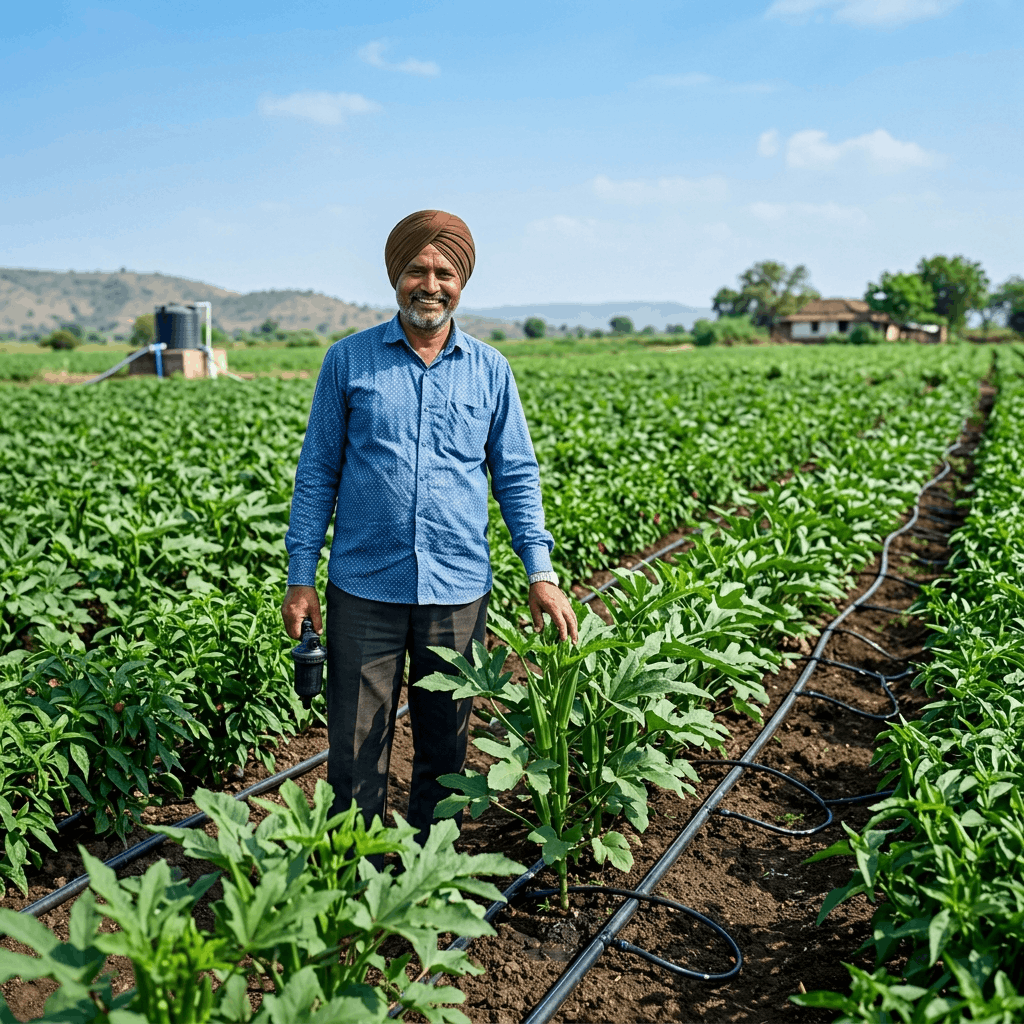
For a standard 1-hectare field (approx 6.25 bigha in many parts of Gujarat), the cost of a high-quality drip system can range from ₹60,000 to ₹1,00,000 depending on the crop spacing (e.g., closer spacing for vegetables vs. wider spacing for fruit trees like Mango or Pomegranate). With the subsidy, a small farmer might only need to pay ₹18,000 to ₹30,000 as their contribution. This investment typically pays for itself within a single season through reduced labor costs and increased yields.
Calculation of Benefits per Bigha
- Water Saving: 40% to 60% compared to traditional flood irrigation.
- Power Saving: 30% reduction in electricity bills as the pump runs for fewer hours.
- Yield Increase: 25% to 40% improvement in crop quality and weight.
Furthermore, the 2026 scheme includes incentives for "Smart Controllers" and "Auto-Backwash Filters" for larger holdings, making it easier to manage irrigation via smartphone apps. This modernization is part of the Digital India Agriculture mission, aiming to make farming "precise" and less labor-intensive.
Operational Guide and System Maintenance
Operating a drip system requires a shift from "volume-based" to "time-based" irrigation. For 2026, the GGRC recommends that farmers use the "Daily Evapotranspiration" data provided via SMS to determine exactly how many minutes to run their systems. In summer, a cotton crop might need 45 minutes of drip every day, whereas in winter, 20 minutes every alternate day might suffice.
Maintenance is the key to longevity. The 2026 guide emphasizes the use of acid treatment once a month to clear calcium carbonate deposits in regions with hard water. Additionally, using a 120-mesh disc filter is mandatory for all GGRC-subsidized installations to prevent emitter clogging.
i-Khedut Registration
Register your intent on the i-Khedut portal or directly with a GGRC-authorized vendor.
Document Verification
Submit your 7/12, 8-A, Aadhaar, and Bank details for eligibility check.
Technical Design
An engineer will visit your field to design the system based on water pressure and crop layout.
Farmer Share Payment
Pay the remaining amount (after subsidy) to the vendor via a digital channel.
TPI (Third Party Inspection)
Once installed, an independent agency will verify the system before the subsidy is released to the vendor.
Operational Training
Attend the mandatory 1-day training session on system maintenance provided by the vendor.
Comparing Results: Traditional vs. Drip Irrigation
When you compare the outcomes, the difference is visual and financial. In a traditional flood-irrigated field, the crop at the start of the row is often over-watered (leading to yellowing and root rot), while the crop at the end of the row is under-watered. With the 2026 Drip System, every plant receives exactly 2.4 liters per hour (or whatever the emitter rating is). This lead to uniform flowering and fruiting.
For fruit crops like Pomegranate, drip irrigation prevents "fruit cracking" by maintaining consistent soil moisture levels. In cotton, it allows for better "boll opening" and reduces the incidence of pink bollworm by keeping the canopy less humid than flood irrigation would.
Soil Health and Biological Synergy
Drip irrigation is the best friend of soil biology. Unlike flood irrigation which "suffocates" the soil by displacing air, drip maintains the perfect ratio of air and water (aerobic conditions). This allows earthworms to stay near the surface where they can consume organic matter and produce Vermicompost in-situ. It also supports the growth of Nitrogen-fixing bacteria which thrive in well-aerated, moist soil.
Disease Prevention via Fertigation
Using the "Venturi" system included in the 2026 GGRC kits, farmers can practice "Fertigation." By injecting liquid biostimulants like Mitti Gold Vermiwash directly through the drip, you build the plant's systemic resistance. This "bottom-up" nutrition strengthens the cell walls, making it harder for sucking pests and fungal pathogens like Phytophthora to attack. It essentially acts as a vaccine for your crops.
Market Focus: Exporters and High-Value Crops
For farmers looking to export Mangoes, Grapes, or Spices, a subsidized drip system is a prerequisite. International buyers look for "Water Footprint" certificates, and drip irrigation proves that the crop was grown sustainably. It also ensures the fruit size and sugar content (Brix level) are consistent across the entire batch, which is vital for fetching premium prices in European and Middle Eastern markets.
Core Components of Drip Systems
📅 Official Application & Deadline Guide
💧 Drip Irrigation & Subsidy Support
Get a customized drip irrigation design and help with government subsidy schemes. We supply all core components and installation services. WhatsApp: +91 95372 30173