📅
June 2026 | ✍️ Mitti Gold Organic | 🗂️
Vermicompost
Application Rates and Volumetric Efficiency: Why Less is More
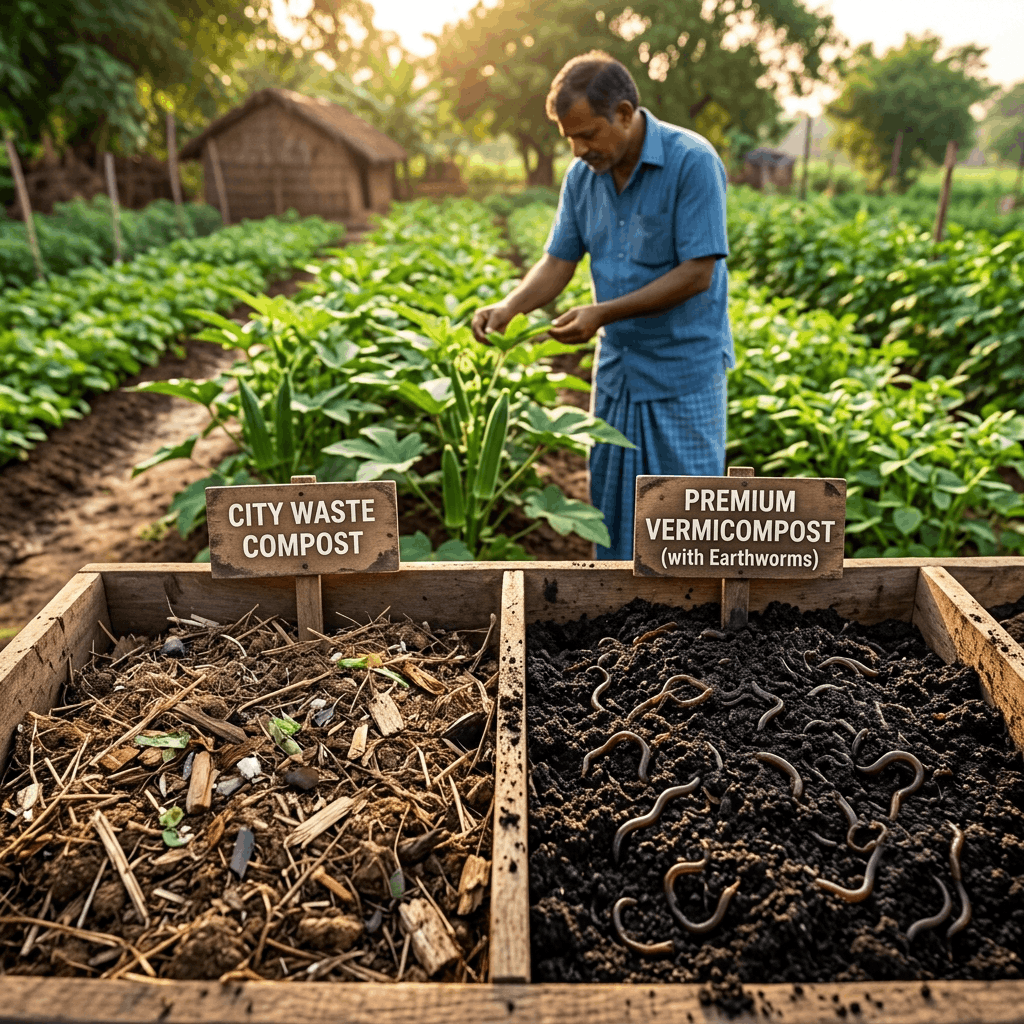
When we talk about "Bulk Organic Matter," the source determines the outcome. City Compost (often referred to as MSW or Municipal Solid Waste compost) is a low-density nutrient source. Because it is derived from diverse urban waste, including paper, food scraps, and street sweepings, its nutrient concentration is highly variable and generally low. To see even a minor improvement in soil physical properties, farmers typically have to apply 2 to 5 Tons per bigha. This creates a massive logistical burden, requiring multiple tractor trips and heavy manual labor for spreading.
In sharp contrast, Mitti Gold Premium
Vermicompost is a concentrated biological amendment. Through the specialized digestive process of earthworms, nutrients are concentrated into "Casts" that are immediately bio-available. For standard cereals and oilseeds, an application of just 800kg to 1 Ton (16-20 bags) per bigha provides more effective nutrition than triple the amount of city compost. This is about "Precision Nutrition." By using a smaller, higher-quality volume, you reduce transportation costs, minimize weed seed introduction (common in city waste), and ensure that every gram of material is feeding your crop, not just filling up space in the field.
The Microbial Edge: Castings vs. Debris
The fundamental scientific difference lies in the "Biological Maturity." Vermicompost is a "Finished" product that has passed through the earthworm’s gut, where it is enriched with a unique microbial flora that constant city waste windrows cannot replicate. City compost often contains "Immature" carbon that can cause "Nitrogen Robbing"—a phenomenon where soil microbes steal nitrogen from your plants to finish breaking down the city waste! Mitti Gold is biologically stabilized, meaning it provides a "Net Nitrogen Gain" from the moment it touches your soil.
Heavy Metal Analysis & Safety Protocols
A critical concern with City Compost is Heavy Metal Contamination (Lead, Cadmium, Mercury). Urban waste is rarely sorted perfectly, and traces of batteries, electronics, and industrial runoff often find their way into the final compost. Repeated application can lead to toxicity in the soil and the crop. Mitti Gold is produced from 100% pure cow dung and agricultural residue, ensuring 0% heavy metal risk. This is vital for farmers targeting the premium export market or those feeding their own families.
Strategic Application Guide: When & How to Apply
Timing is everything in organic farming. For maximum ROI, we recommend the "Split-Basal" method. Apply 70% of your Mitti Gold during final land preparation (Last Plowing) and 30% after 25 days of sowing. This ensures that the seedlings have an initial surge of nutrition and the young plants have a secondary boost during the critical "Tillering" or branching phase. Unlike city compost, which must be buried deep to avoid odor and pests, Mitti Gold can be used as a top-dressing—its clean, earthy aroma proves it is safe for surface application.
Step-by-Step Application Guide
1
Land Preparation
Perform deep plowing to aerate the soil. Clear any plastic or glass debris left from previous chemical or city-compost applications.
2
Basal Application
Spread 800kg of Mitti Gold per bigha. If possible, mix with 50kg of Neem Cake for added soil empowerment.
3
Sowing & Inoculation
Sow seeds directly into the enriched soil. The proximity to Vermicompost ensures 95%+ germination rates.
4
Growth Supplement
At 25-30 days, apply the remaining 30% dose around the base of the plants to support reproductive growth.
5
Observation & Feedback
Check soil softness after 45 days. You will find that the soil has become crumbly (Friable), a sign of a healthy ecosystem.
Climate Resilience: Building a Water-Sponge Soil
In an era of erratic monsoons, soil water-holding capacity (WHC) is the difference between profit and loss. Vermicompost contains high levels of Humic and Fulvic acids, which act like microscopic sponges. While city compost adds volume, it lack the structural "Glue" (Glomalin) that Vermicompost provides to hold soil particles together. This improved structure allows your field to breathe during heavy rains and retain moisture for 5-7 days longer during heatwaves.
Carbon Sequestration Efficiency
In an era of erratic monsoons, soil water-holding capacity (WHC) is the difference between profit and loss. Vermicompost contains high levels of Humic and Fulvic acids, which act like microscopic sponges. While city compost adds volume, it lack the structural "Glue" (Glomalin) that Vermicompost provides to hold soil particles together. This improved structure allows your field to breathe during heavy rains and retain moisture for 5-7 days longer during heatwaves.
Synergy in the Field: Using Vermicompost with Modern Bio-fertilizers
Vermicompost is the perfect "Carrier" for other biological inputs. If you are using G-PROM (Granular Phosphate Rich Organic Manure) or liquid Azotobacter, mixing it with Vermicompost enhances their survival rate by 400%. The porous nature of the worm castings provides a "Microbial Hotel" where beneficial bacteria can multiply before they meet the harsh conditions of the open field. City compost often has a pH that is too unstable to support these delicate bio-ferts.
The "Mitti Gold" Multiplier Effect
When you apply our Vermicompost alongside intercropping systems (like Pigeon Pea with Cotton), the biological synergy is maximized. The Vermicompost helps the legumes fix more nitrogen, which is then shared with the main crop through a vast underground network of Mycorrhizal fungi that thrive in our organic matter.
The Harvest Outcome: Quality, Weight, and Market Value
What does a farmer actually see at the end of the season?
- Uniformity: City compost often leads to patchy growth due to nutrient "Hot Spots." Vermicompost ensures a dead-uniform crop height and maturity.
- Nutrient Density: Fruits and grains grown with Mitti Gold have higher protein and mineral content, leading to a "Heavy Bag" (higher weight per volume).
- Shelf Life: The high Potassium availability in Vermicompost strengthens cell walls. Your tomatoes or mangoes will stay fresh for 3-5 days longer than those grown with bulky waste.
This superior quality allows you to sell to "Premium Markets" like supermarkets or exporters, often fetching 20-40% higher prices than standard produce.
The Invisible Army: How Mitti Gold Protects Your Soil Biology
City compost production often involves high-heat processes that sanitize the waste but leave it "Dead." Mitti Gold is a "Living Fertilizer." It contains millions of beneficial bacteria per gram, including Nitrosomonas (Nitrogen fixers) and Bacillus (Phosphate solubilizers). More importantly, our Vermicompost contains Earthworm Cocoons. Once applied to your field, these cocoons hatch, establishing a permanent, self-multiplying population of earthworms in YOUR soil. This turns your field into a 24/7 internal fertilizer factory, a benefit that city compost can never provide.
Biological Protection: The Natural Defense against Pathogens
Earthworm castings are rich in a substance called Chitinase. This is an enzyme that breaks down the outer shells of harmful insects and the cell walls of many soil fungi. By using Mitti Gold, you are building a biological shield around your crop’s roots, significantly reducing the incidence of "Wilt," "Root Rot," and "Damping Off." This isn’t just fertilizer; it is a natural, non-toxic pesticide substitute.
Economic Multiplier: ROI Analysis for Small & Large Farmers
Let’s look at the math. While City Compost might be cheaper per ton, the "Cost per Bio-available Nutrient" is actually higher due to transportation, heavy labor, and the potential risk of land contamination (which can take years and lakhs of rupees to fix). Mitti Gold is a High-Efficiency Input. 1 Ton of our product does the work of 4 tons of city waste. You save on labor, you save on water (due to better WHC), and you earn more on the final sale. It is the smarter, more profitable investment for any farmer looking to build a multi-generational legacy.
Annual Application Schedule
For sustainable success, follow this cycle: Pre-Monsoon (Basal Dose), Mid-Season (Top Dressing), and Post-Harvest (Cover Crop Enrichment). This 3-step cycle ensures your soil carbon never drops below the critical 1% threshold.
🌿 Bulk Vermicompost Orders
Mitti Gold Organic: For bulk supply of premium Vermicompost Fertilizer — Ideal for Farmers, Nurseries, and Export. WhatsApp: +91 95372 30173
Strategic FAQs: City Compost vs. Premium Vermicompost
Is city compost safe for growing organic vegetables? +
City compost often contains traces of lead, cadmium, and microplastics from municipal trash. For safe, organic food production, Premium Vermicompost is the only recommended choice as it is produced from pure cow dung and plant waste.
Why does city compost smell whereas Vermicompost does not? +
Odors in city compost often indicate anaerobic bacteria and poor decomposition (Putrefaction). Premium Vermicompost has a pleasant "earthy" smell, indicating it is a fully stabilized and aerobic product.
Can I use city compost for a home terrace garden? +
We strongly advise against it. City compost may harbor pathogens or sharp debris (glass/metal). For home gardens and potted plants, clean and odorless Vermicompost is far superior and safer for your family.
What is the Nitrogen-Phosphorus-Potassium (NPK) difference? +
Vermicompost typically has 3-5 times higher available nitrogen and significantly higher phosphorus solubility than city compost due to enzymatic activity in the worm’s gut.
Does city compost help in long-term soil carbon? +
While it adds volume, the quality of carbon in Vermicompost (Humic and Fulvic acids) is much higher and more stable, leading to better long-term soil health.