📅 June 2026 | ✍️ Mitti Gold Organic | 🗂️ Govt Schemes
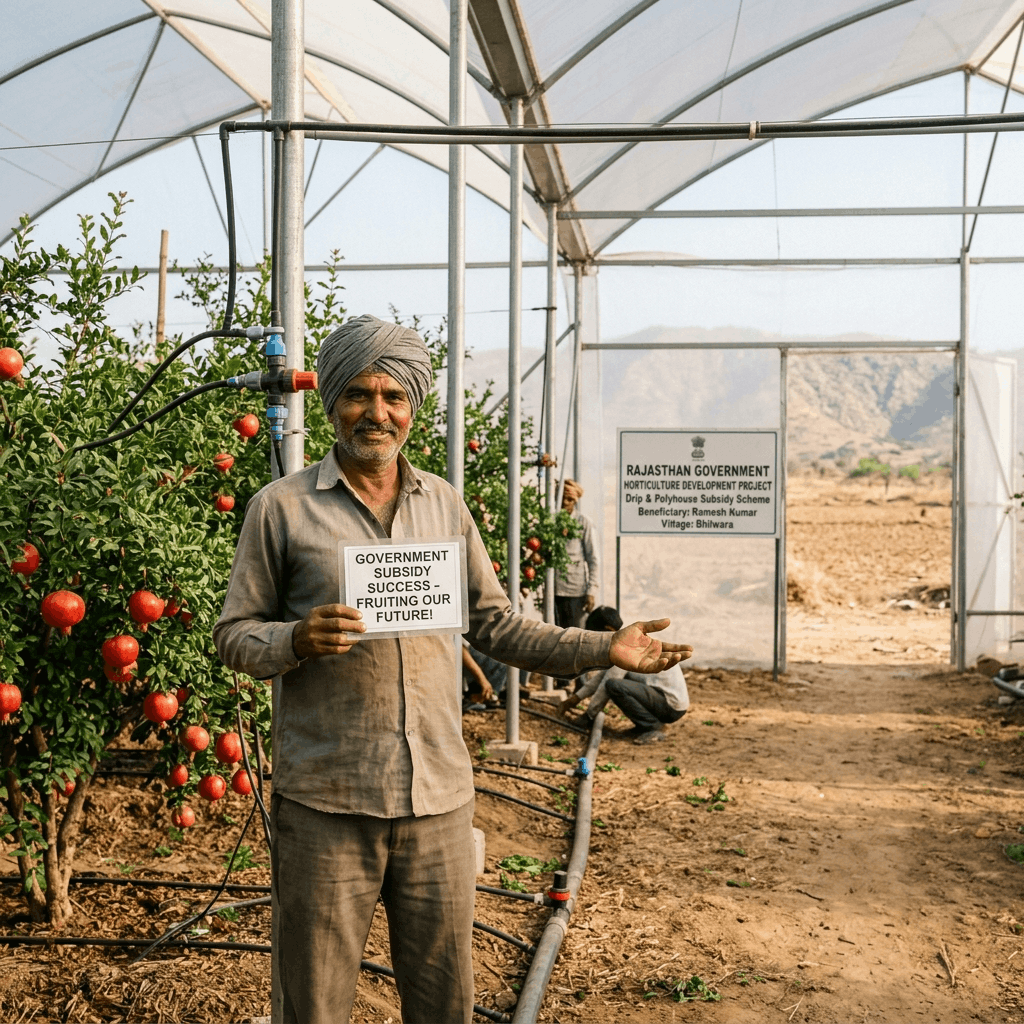
Application Rates: High-Tech Farming in the Desert
Rajasthan's harsh arid climate and acute water scarcity make traditional water-intensive farming difficult. However, the state has massive potential for high-value horticulture. The Government of Rajasthan, through the National Horticulture Mission (NHM) and state schemes, offers unprecedented subsidies to transform barren lands into highly profitable fruit orchards and protected cultivation zones. The scheme heavily promotes the installation of Greenhouses, Shade Net Houses, and Drip Irrigation systems. The subsidy application rates are exceptional: farmers can receive up to 50% to 75% financial assistance for erecting high-tech polyhouses (up to 4,000 sq. meters per beneficiary). For establishing new fruit orchards (like Pomegranate, Date Palm, Kinnow, and Ber), the government provides subsidies covering 50% of the planting material and input costs over three years. Furthermore, under the PMKSY micro-irrigation component, small and marginal farmers in Rajasthan are granted a 70% to 75% subsidy to install comprehensive drip and sprinkler irrigation networks. These massive financial injections allow farmers to apply precision water and organic nutrients (fertigation) directly to the root zones, ensuring maximum crop yield per drop of water.
How to Use Product: Setting Up Protected Cultivation
To leverage the scheme, farmers must understand how to use protected cultivation infrastructure. A subsidized polyhouse is engineered to control temperature, humidity, and light penetration, creating an optimal microclimate regardless of the extreme desert heat outside. Inside the polyhouse, farmers use highly productive organic inputs. When to apply: Prepare the polyhouse soil beds by incorporating 5 to 10 tons of premium vermicompost per acre, heavily enriched with Trichoderma to prevent root diseases. High-value crops like export-quality English cucumbers, colored capsicums, cherry tomatoes, and Dutch roses are planted. Water and liquid organic fertilizers (like Jeevamrutha or liquid seaweed extract) are applied precisely through the subsidized inline drip irrigation system. This controlled environment drastically reduces evaporation, cuts water usage by 80%, and accelerates plant growth, allowing farmers to harvest up to three high-yield crops a year.
1
Register on Raj Kisan Sathi Portal
All applications must be submitted digitally. Log in to the Raj Kisan Sathi portal using your Jan Aadhaar and link your digitized land records (Jamabandi).
2
Select Scheme and Obtain Quotations
Select the specific horticulture scheme (e.g., Polyhouse construction or Pomegranate orchard). Obtain technical quotations from empanelled, government-approved manufacturers.
3
Pre-Verification and Installation
Following a pre-verification site visit by the horticulture officer, proceed with the installation. Upon successful completion and geo-tagged post-verification, the subsidy is credited via DBT.
How to Compare Product Outcomes: Polyhouse vs Open Field Farming
The economic and agronomic outcomes of subsidized horticulture compared to traditional open-field farming in Rajasthan are staggering:
- Yield Multiplication: A polyhouse yields 5 to 8 times more produce per square meter than open-field cultivation. A 1,000 sq. meter polyhouse can generate an annual net profit of ₹3 Lakh to ₹5 Lakh.
- Water Efficiency: Drip-irrigated orchards save up to 80% of water. A farm pond integrated with a drip system can sustain a 5-acre pomegranate orchard year-round.
- Premium Quality Harvest: Protected crops are shielded from harsh sun scorch, hail, and dust storms. The resulting fruits and vegetables are uniform in size, color, and completely blemish-free, fetching premium "A-Grade" prices in urban supermarkets.
How to Help into Creature: Biodiverse Orchards
Establishing subsidised fruit orchards (like Kinnow or Pomegranate) creates permanent green canopies in the desert, fundamentally helping local creatures. The deep roots of the fruit trees stabilize the sandy soil, preventing wind erosion. The leaf litter from the trees, combined with organic vermicompost applied in the root basins, fosters a rich habitat for earthworms and soil microorganisms. Furthermore, organic orchards attract an abundance of wild bees and pollinators to the desert landscape. To enhance this, many farmers under the scheme integrate subsidized honey bee boxes (Apiculture) into their orchards. The bees ensure maximum flower pollination—increasing fruit yield by up to 25%—while providing the farmer with highly lucrative, pure organic desert honey.
Protection from Disease: Integrated Pest Management (IPM)
Protected horticulture demands strict protection from disease, as the warm, humid environment inside a polyhouse can invite rapid fungal growth. The scheme heavily promotes Integrated Pest Management (IPM). Instead of chemical pesticides, farmers use biological controls. When to apply: Install yellow and blue sticky traps every 10 meters inside the polyhouse to capture aphids, thrips, and whiteflies physically. Nematode infections are a major threat to polyhouse cucumbers and tomatoes; farmers combat this by applying organic neem cake and biological nematicides (like Paecilomyces lilacinus) through the drip lines. For fungal protection, spraying liquid Trichoderma viride and Pseudomonas fluorescens creates a biological shield over the leaves, ensuring the crop remains completely chemical-residue free and safe for human consumption.
Market: Farmer, Nursery, Gardener, Export
The subsidy scheme completely upgrades the farmer's market positioning. The Farmer shifts from selling low-value grains in local mandis to exporting high-value, exotic vegetables directly to five-star hotels and luxury retail chains in Delhi, Mumbai, and Jaipur. For the Nursery sector, the scheme provides 50% subsidies to establish high-tech plug-type vegetable seedling nurseries, creating a booming local business selling disease-free saplings to other polyhouse growers. In the Export market, Rajasthan has become a massive exporter of premium, drip-irrigated Pomegranates and Date Palms to the Middle East and Europe. By utilizing organic inputs and government-subsidized packhouses (for sorting and grading), farmers easily meet international phytosanitary standards, earning high foreign exchange and transforming the arid landscape into a multi-billion rupee green economy.
📅 Official Application & Deadline Guide
⏳
Last Date of Application
Continuous / Scheme-Specific (Review individual guidelines)
🌐
Official Portal to Apply
RajKisan Saathi Portal, Government of Rajasthan
Apply Online Here ↗
🍅 Rajasthan Horticulture Subsidy & Polyhouse Setup
Need assistance applying for polyhouse, drip irrigation, or fruit orchard subsidies on Raj Kisan Sathi? WhatsApp: +91 95372 30173
Rajasthan Horticulture Subsidy FAQ
How much subsidy is available for a Polyhouse in Rajasthan?
Farmers can receive a 50% to 75% subsidy (depending on their category) for establishing a high-tech polyhouse up to a maximum area of 4,000 square meters.
What is the subsidy for Drip Irrigation systems?
Under PMKSY, small and marginal farmers in Rajasthan receive a 70% to 75% subsidy to install highly efficient drip and sprinkler micro-irrigation systems.
Can I get a subsidy for planting a Pomegranate or Date Palm orchard?
Yes, the National Horticulture Mission (NHM) provides subsidies covering 50% of the cost of planting material and maintenance for high-value fruit orchards over a 3-year period.
Where do I apply for these horticulture subsidies?
All applications must be submitted online through the official Raj Kisan Sathi portal (rajkisan.rajasthan.gov.in) using your Jan Aadhaar and land records.
What are the best crops to grow inside a subsidized polyhouse?
The most profitable crops include export-quality English cucumbers, colored capsicum (bell peppers), cherry tomatoes, and Dutch roses, which fetch premium market rates.