📅 July 2026 | ✍️ Mitti Gold Organic | 🗂️ Machinery & Markets
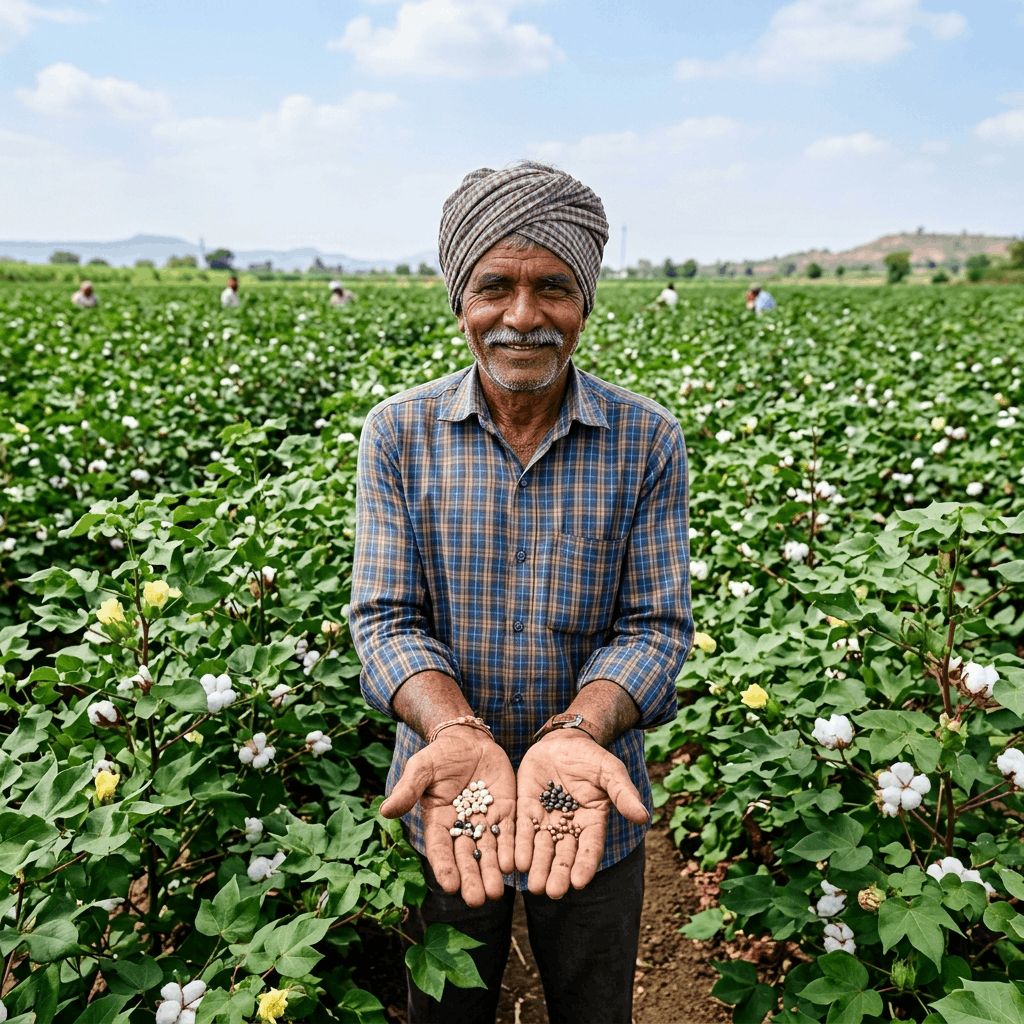
The Critical Importance of Cotton Seed Selection
Cotton, universally recognized as \"White Gold,\" remains one of the most critical and lucrative cash crops in the global agricultural economy. The foundation of a successful, highly profitable cotton harvest rests entirely on one single, critical decision made at the beginning of the season: the seed. Today, the agricultural market is completely saturated with hundreds of heavily marketed varieties, dominated almost entirely by genetically modified Bt (Bacillus thuringiensis) Cotton hybrids, which are specifically engineered to biologically resist the lethal bollworm pest complex.
Navigating this crowded market requires deep knowledge. A farmer must thoroughly understand the specific staple (fiber) length of different seeds (categorized as short, medium, long, and extra-long), the required maturation duration, and the seed's specific, engineered resistance to local pests. Selecting the precisely correct seed for your specific region guarantees not only a massive, heavy yield but also ensures the production of premium, high-strength fiber quality, while simultaneously drastically slashing the exorbitant costs associated with chemical pesticide applications.
Precise Seed Rate and Advanced Spacing Strategies
The exact requirements for cotton seed quantity and plant spacing vary significantly based on whether you are planting advanced, vigorous hybrids or traditional straight varieties, and crucially, whether you are farming under purely rainfed (dryland) conditions or fully irrigated systems. For modern Bt Cotton hybrids, which grow into massive, bushy plants, the required seed rate is surprisingly low, generally ranging from a mere 450 to 900 grams per bigha.
To maximize the yield of these powerful hybrids, \"precision dibbling\" (manually planting seeds at exact intervals) is highly recommended over mechanical drilling. Depending on the expected final canopy size of the specific hybrid, seeds should be planted at precise distances (e.g., 4x4 feet or 3x3 feet apart), placing only one or two seeds per \"hill.\" This wide spacing is not a waste of land; it is essential to ensure that every single plant receives optimal, unobstructed sunlight and vital air circulation, which prevents the rotting of lower bolls.
How to Choose the Right Hybrid for Your Land
Choosing a cotton seed is highly location-specific. You must consult extensively with local agricultural university experts or trusted KVK scientists to determine exactly which specific hybrids have a proven track record of top performance in your exact soil type (be it deep black cotton soil, lighter red soil, or sandy loam). Some aggressive varieties are perfectly suited for early sowing under full irrigation and heavy fertilization, while other, tougher varieties possess the deep root systems necessary to survive and yield under harsh, dryland, rainfed farming conditions.
Furthermore, authenticity is paramount. The cotton market is plagued by counterfeit seeds. You must absolutely always purchase your seeds from highly reputable, government-authorized dealers in fully sealed, holographically marked packets. Planting fake or uncertified Bt seeds is the single leading cause of catastrophic crop failure and massive financial ruin for cotton farmers.
Maximizing the Harvest Outcome and Lint Quality
The performance gap between an average, generic seed and a premium, well-matched hybrid is vast. A properly selected, high-quality Bt Cotton seed, planted in fertile, well-prepared soil and managed under optimal irrigation, possesses the genetic potential to yield an astonishing 8 to 12 quintals per bigha. Furthermore, the physical characteristics of the harvest are superior: the bolls (the protective cases containing the cotton) are massive, making manual picking much faster and easier, and the ginning percentage (the ratio of valuable white lint to the heavy seed) is exceptionally high.
Quality is just as important as quantity. High-quality seeds engineered for \"long staple\" production yield long, incredibly strong, and fine white fibers. This premium, long-staple cotton is exactly what massive commercial spinning and textile mills desperately require for manufacturing high-end clothing, ensuring the farmer commands the absolute highest premium price per quintal at the market.
The massive financial rewards of producing premium, long-staple cotton extend far beyond the initial sale at the local procurement center. When farmers consistently deliver highly uniform, exceptionally clean, and remarkably strong lint, they establish a powerful reputation that attracts direct contracts from massive international textile conglomerates. These direct, forward-contract agreements completely shield the farmer from the extreme, unpredictable price volatility of the open market, guaranteeing a highly profitable minimum price before the seed is even sown. Furthermore, the massive volume of high-quality cotton seed extracted during the ginning process is sold to crushing mills, producing valuable cottonseed oil and highly nutritious seed cake, creating a massive secondary income stream that fundamentally secures the financial future of the farming enterprise.
The Impact of Bt Technology on Beneficial Insects
It is crucial to understand the ecological mechanics of Bt Cotton. Bt Cotton is genetically modified to internally produce specific crystalline proteins that are highly toxic, but only to a very narrow, specific range of devastating caterpillar pests (most notably the American Bollworm and the Pink Bollworm). Critically, this internal protein is completely safe and harmless to non-target, beneficial insects.
By relying heavily on the seed's built-in, genetic resistance to kill bollworms, farmers are freed from the desperate need to constantly spray highly toxic, broad-spectrum chemical pesticides across their fields. This massive reduction in chemical spraying protects and fosters massive populations of natural predators—such as ladybugs, lacewings, and predatory spiders. These beneficial insects then act as a free, natural army, patrolling the crop and aggressively controlling secondary pest outbreaks, such as aphids and whiteflies, maintaining a healthy ecological balance.
Building Comprehensive Pest and Disease Resistance
While the revolutionary Bt technology provides an almost impenetrable shield against bollworms, cotton plants remain highly vulnerable to an array of aggressive sap-sucking pests (like Jassids, Whiteflies, and Thrips) and devastating viral diseases, most notably the Cotton Leaf Curl Virus (CLCuV), which can completely stunt plant growth.
Therefore, when selecting your seed, it is not enough to just look for the \"Bt\" label. You must aggressively search for \"dual-trait\" or highly specialized hybrids that are explicitly labeled as being genetically tolerant or highly resistant to sucking pests and the Leaf Curl Virus. This layered, genetic protection is your crop's first, strongest, and most cost-effective line of defense, preventing viral outbreaks before they can even take hold.
Best Practices for Cotton Sowing and Cultivation
Step 1: Deep Summer Ploughing and Soil Preparation
Cotton possesses an incredibly deep, powerful taproot system. During the peak heat of summer, execute a very deep ploughing of the field. This critical action exposes deeply buried, soil-borne pest pupae and dormant fungal spores to the sterilizing, intense heat of the sun, while simultaneously preparing a deep, loose bed that allows the taproot to penetrate rapidly to access deep moisture reserves.
Step 2: Heavy Basal Fertilizer Application
Cotton is a heavy feeder. Weeks before sowing, apply a massive, strong basal dose of fully decomposed, high-quality farmyard manure or nutrient-dense vermicompost, combined with the exact required basal doses of chemical NPK (Nitrogen, Phosphorus, Potassium) fertilizers based on a recent soil test.
Step 3: Precision Dibbling and Depth Control
Wait for adequate, deep soil moisture. Using the precision dibbling method, plant the seeds at an exact depth of 2 to 3 centimeters. Sowing any deeper will exhaust the seed's energy before it reaches the surface, causing massive germination failure and requiring costly re-sowing.
Market Grading, Staple Length, and Profit Maximization
The final price you receive for your cotton is not random; it is strictly determined by three metrics: staple length, fiber strength, and pristine color. Varieties genetically programmed to produce \"long\" and \"extra-long\" staple lengths consistently command the absolute highest prices in the global market, as they are essential for spinning fine, luxury textiles.
However, genetics alone are not enough. How you harvest is equally critical. Cotton must be picked cleanly—meaning it must be absolutely free from dry, brittle leaves, soil contamination, or dampness. Delivering pristine, flawlessly clean, bright white cotton ensures that you receive the absolute highest official grade and the maximum possible Minimum Support Price (MSP) at Cotton Corporation of India (CCI) procurement centers or open commercial markets.
📦 Bulk Orders & Export
Mitti Gold Organic: For bulk orders of all organic fertilizers — Farmers, Nurseries, and Export. WhatsApp: +91 95372 30173