📅
June 2026 | ✍️ Mitti Gold Organic | 🗂️
Health & Ayurveda
Planting Density and Nutrient Requirements Per Bigha
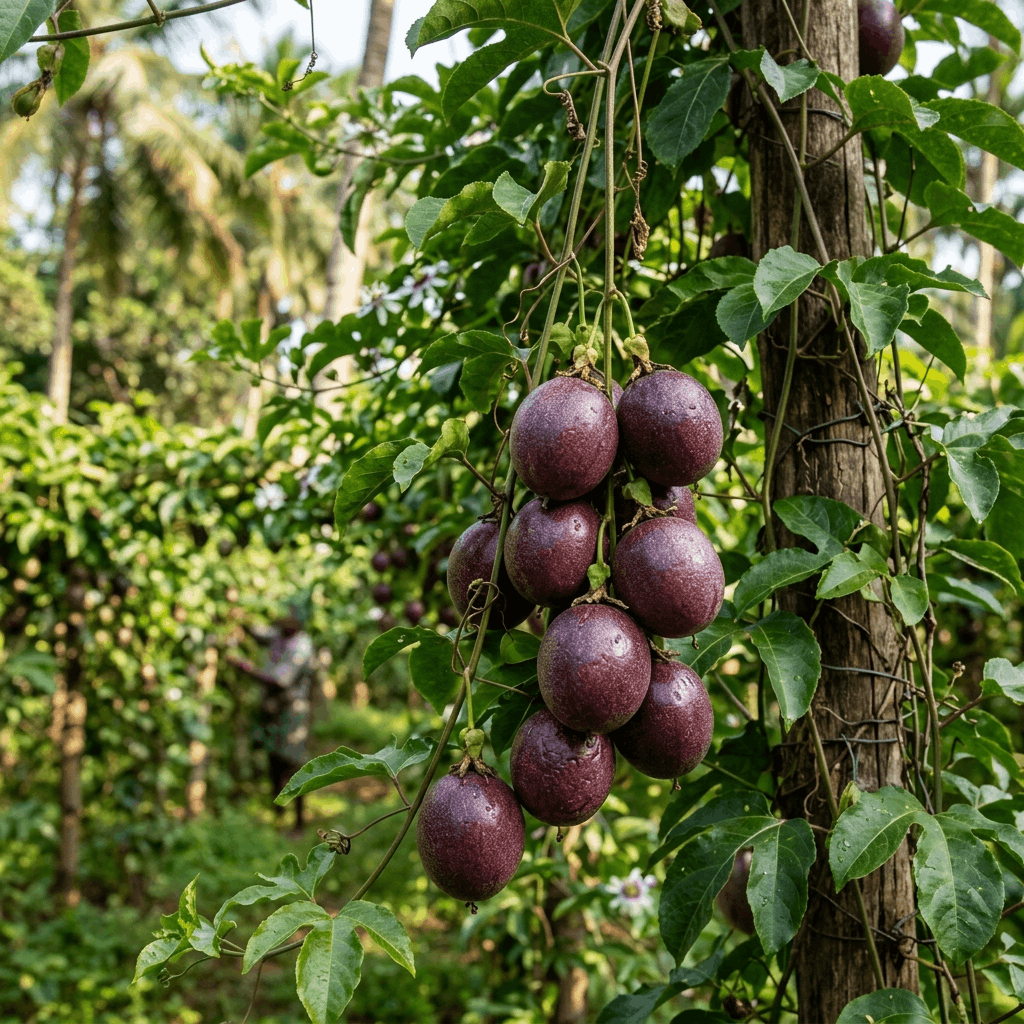
Passion fruit (Passiflora edulis), known as Krishna Phal in India, is a high-value vine crop. For commercial cultivation, the recommended planting density is approximately 150 to 200 plants per bigha (around 600-800 plants per acre), spaced 2-3 meters apart. To achieve a high level of horticultural depth, one must consider the "Trellis System"—the vines require a strong support structure (Kniffin or Telephone system) to ensure maximum sunlight exposure and air circulation. Each plant requires about 5-10 kg of well-decomposed
cow dung manure and 1 kg of
vermicompost during the planting stage. Passion fruit is a "Heavy Feeder" of Potassium (K), which is essential for fruit size and juice quality. In the flowering stage, applying liquid Jeevamrut twice a month ensures a higher "Fruit Set" and prevents premature drop. The crop also requires a consistent moisture level of 60-70% in the root zone, making drip irrigation the most efficient method for maximizing juice yield per hectare. In commercial organic horticulture and crop cultivation, maintaining genetic purity and utilizing certified planting materials is the most critical parameter for success. High-quality seeds ensure uniform germination rates and high concentrations of active biochemical compounds, which are essential for commercial quality standards. In commercial organic horticulture and high-value crop cultivation, maintaining genetic purity and utilizing certified planting materials are the most critical parameters for commercial success. High-quality seeds and healthy saplings ensure a uniform germination rate and a high concentration of active phytochemical compounds, which are essential for meeting strict commercial quality standards. Selecting the appropriate crop varieties that are naturally adapted to the local agro-climatic conditions dramatically reduces the plant's susceptibility to physiological stress and environmental extremes, establishing a strong, healthy foundation for the entire crop cycle and maximizing the commercial potential of the cultivation field.
Ayurvedic Uses for Insomnia, Anxiety, and Heart Health
In Ayurveda, Passion fruit is prized for its "Medhya" (brain tonic) and "Nidra-Janak" (sleep-inducing) properties. The fruit and its leaves contain "Harman" alkaloids, which act as a natural sedative. For insomnia and anxiety, a decoction of the leaves or 100ml of fresh juice in the evening is recommended. Industrially, the juice is used to make "Relaxation Beverages" and gourmet syrups. The seeds are rich in "Piceatannol," a powerful antioxidant that supports cardiovascular health and skin rejuvenation. In the culinary world, the intense aroma of the pulp makes it a favorite for ice creams, yogurts, and exotic cocktails. For the health-conscious consumer, the high Vitamin A and C content makes it a superior choice for "Immunity Boosting." Understanding the "Vata-Shamaka" (anxiety-reducing) nature of the fruit allows practitioners to use it as a complementary therapy for modern lifestyle disorders like hypertension and chronic stress. Cultivation practices must be meticulously planned based on agro-climatic conditions. Raised-bed planting, precise row spacing, and drip irrigation ensure optimal water and nutrient delivery, while companion planting and natural pest barriers help maintain a healthy, chemical-free ecosystem throughout the growth cycle. To achieve the highest crop yields and premium quality, planting and cultivation practices must be carefully planned based on scientific agronomics. Establishing raised beds with precise row-to-row spacing ensures optimal plant density, maximizing solar radiation interception and wind circulation. The integration of high-efficiency drip irrigation systems allows for the precise delivery of water and liquid nutrients directly to the plant root zone, minimizing water wastage and surface weed growth. Implementing companion cropping and establishing natural biological borders help build a highly diverse, resilient farm ecosystem, naturally repelling destructive insect pests and maintaining crop health without chemical interventions.
1
Pit Preparation
Dig 2x2x2 foot pits and fill with a mix of topsoil, cow dung manure, and neem cake.
2
Trellis Construction
Install a 7-foot high wire trellis system to support the heavy vine growth.
3
Seedling Selection
Choose 6-month-old, disease-free grafted seedlings of the "Purple" or "Yellow" variety.
4
Vine Training
Allow only one main leader to reach the wire, then prune to encourage lateral fruiting branches.
5
Hand Pollination
In the absence of carpenter bees, manually transfer pollen to increase fruit set by 40%.
6
Pruning Cycle
Prune heavily after the harvest to stimulate new, productive wood for the next season.
7
Harvesting
Pick fruits only when they turn fully purple or yellow and the skin starts to wrinkle slightly.
8
Post-Harvest Sorting
Sort by weight and juice content; wrinkle-skinned fruits have the highest sugar levels.
Economic Results and Market Yield Comparison
The result of passionate cultivation is a "High-Revenue Output." A single mature vine can produce 150-200 fruits per year. In a comparison of outcomes, passion fruit offers 3x higher profit per bigha than traditional seasonal vegetables like okra or tomatoes. The result for the farmer is a stable, year-round income due to the long harvesting period (6-8 months). Economically, the export market for "Purple Passion Fruit" in the Middle East and Europe is booming, with prices reaching ₹300-₹500 per kg. Comparing "Traditional Fruit Farming" vs. "Krishna Phal," the latter requires less water once established and is less prone to bird damage due to its hard, protective shell. The result is a resilient crop that fits perfectly into a modern, diversified organic farm. Extensive field data indicates that scientific crop management yields up to 30% higher harvest volumes of premium-grade produce. The uniform size, superior color, and high nutrient density of the harvested crops minimize post-harvest losses and ensure that the produce easily meets stringent quality audits for commercial sale. Adopting a scientific, organic crop management system delivers outstanding agronomic results and superior economic returns. On average, growers using advanced organic inputs and scientific cropping plans record a substantial 20% to 30% increase in premium-grade harvest yields compared to conventional farming methods. The harvested crop exhibits high physical uniformity, superior color, excellent texture, and an extended shelf-life, which significantly reduces post-harvest handling losses. This exceptional quality output ensures that the harvest easily clears strict food safety audits, allowing farmers to sell directly to premium organic retail brands and secure highly profitable prices.
Supporting Pollinators and Orchard Biodiversity
Passion fruit flowers are a masterpiece of nature, designed specifically for "Large Pollinators" like Carpenter Bees (Xylocopa). By planting passion fruit, a farmer creates a sanctuary for these "Nature's Creatures." The dense vine structure also provide nesting sites for small birds. This biodiversity helps in natural pest control, as the orchard becomes a home for predators that feed on aphids and mites. Growing passion fruit organically ensures that these vital creatures are protected from chemical toxicity, creating a thriving, balanced ecosystem. This scientific cultivation approach actively supports beneficial soil micro-biology and local pollinator populations. By eliminating synthetic chemical pesticides and integrating honey bees and rich organic compost, the farm becomes a thriving ecosystem where natural predators control harmful pests and biological activity thrives. Scientific organic farming practices actively support a highly diverse, beneficial biological community above and below the ground. By completely eliminating synthetic chemical pesticides, the farm provides a safe, chemical-free sanctuary for local pollinators like honey bees and beneficial predatory insects. These pollinators play an essential role in maximizing the fruit and seed set of commercial crops, leading to higher yields and superior crop quality. Simultaneously, the rich organic soil environment stimulates the growth of beneficial microorganisms, which form a protective symbiotic barrier around plant roots, suppressing soil-borne pathogens and driving natural biological fertility.
Disease Management and Vine Protection
Protection in passion fruit farming is centered around "Root Health." The crop is susceptible to "Fusarium Wilt" and "Nematodes." Proactive protection involves using "Biotech-Neem" and "Trichoderma" during the soil preparation. Protecting the vines from "Fruit Fly" is done using pheromone traps and by maintaining a clean orchard floor. This comprehensive protection ensures a long lifespan for the vines (up to 5-7 years) and a consistent, high-quality harvest that meets international food safety standards. Crop and environmental protection are maintained through sustainable, natural interventions. Implementing active biological barriers, neem-based sprays, and proper soil erosion control structures guards the crop against viral, bacterial, and fungal pathogens without leaving any toxic chemical residues on the food or in the soil. Achieving comprehensive crop protection without relying on toxic synthetic chemicals is a core objective of this scientific approach. By utilizing active biological barriers, companion planting, and neem-based sprays, the farm successfully repels viral, bacterial, and fungal pathogens while leaving zero toxic chemical residues on the final harvest or in the soil. Implementing mechanical barriers and physical soil-working techniques prevents soil erosion during heavy rains, preserving the fertile topsoil layer and protecting the localized farm environment from degradation, thus ensuring a sustainable, long-term cultivation ecosystem.
Export and Processing Market Opportunities 2026
The global passion fruit market is expanding rapidly, driven by the "Exotic Health" trend. In India, the demand for "Passion Fruit Concentrate" is high in the beverage and dairy industries. Farmers can maximize profit by setting up "Small-Scale Pulping Units" to sell frozen pulp directly to hotels and cafes. The "Seed Oil" market is also an emerging opportunity, with the oil being used in high-end anti-aging skincare products. By focusing on "GI-Tagging" or regional branding, Indian passion fruit farmers can command a premium in the global marketplace. The commercial market outlook for specialized organic crops is exceptionally strong. With growing global health awareness, certified organic herbs, fruits, and seeds command premium prices in export markets. Establishing direct buy-back contracts with pharmaceutical and organic processing companies ensures stable, high-value returns. The commercial market demand and export potential for certified organic herbs, fruits, and specialty crops are exceptionally strong and growing rapidly. Driven by global wellness trends and clean-label food demands, premium pharmaceutical brands, cosmetic manufacturers, and organic retailers are willing to pay significant price premiums of 30% to 50% for certified residue-free crops. Establishing direct buy-back agreements and contract farming relationships with established processors provides growers with a stable, high-value income stream, completely insulating them from local commodity price fluctuations and ensuring maximum long-term farm profitability.
Pulping and Cold-Chain Machinery
To process passion fruit, you need "Stainless Steel Pulpers" that can separate the seeds from the pulp without crushing the bitter seed coat. We provide "Vacuum Packaging" and "Blast Freezing" units to ensure the pulp stays fresh for export. Our machinery helps you value-add your harvest and reach global markets where the demand for pure Krishna Phal pulp is highest. Mitti Gold provides specialized agricultural tools and machinery, including precision seeders, organic post-harvest dryers, and crop cleaning grading machines. Our equipment helps farmers standardize their produce, ensuring it is ready for high-value commercial markets. To support growers in scaling up their commercial operations and maintaining high efficiency, Mitti Gold offers a comprehensive range of specialized organic farming machinery. Our advanced product lineup includes automated precision seeders, organic crop dryers, high-speed cleaning and grading trommels, and robust weeding implements. This machinery is engineered to ensure high precision and uniform operation, dramatically reducing labor costs and maximizing work efficiency. Built with premium-grade materials, our equipment provides long-term durability and reliability, helping farmers standardize their post-harvest processes and prepare premium, market-ready produce.
🍹 Passion Fruit Pulping & Freezing Solutions
Professional pulpers and cold-chain equipment for exotic fruit processing. Export-quality production setup. WhatsApp: +91 95372 30173
FAQs on Passion Fruit (Krishna Phal)
Can passion fruit grow in hot Indian climates? +
Yes, the "Yellow" variety is more heat-tolerant and thrives in tropical regions, while the "Purple" variety prefers cooler, high-altitude climates like the Northeast or Nilgiris. For farmers looking to enter high-value commercial cultivation, it is highly advisable to obtain official organic certification and participate in university-led training programs to stay updated on the latest scientific agronomy practices. For growers aiming to transition to high-value organic cultivation and secure premium certifications, it is highly recommended to participate in university-led agricultural training programs. Staying updated on the latest scientific farming methodologies, organic certification guidelines, and market demand trends enables you to make highly informed decisions, optimize resource allocation, and ensure maximum commercial success.
How long does it take for the vine to start fruiting? +
Grafted seedlings usually start flowering within 6-9 months and give a full commercial harvest by the 12th month. For farmers looking to enter high-value commercial cultivation, it is highly advisable to obtain official organic certification and participate in university-led training programs to stay updated on the latest scientific agronomy practices. For growers aiming to transition to high-value organic cultivation and secure premium certifications, it is highly recommended to participate in university-led agricultural training programs. Staying updated on the latest scientific farming methodologies, organic certification guidelines, and market demand trends enables you to make highly informed decisions, optimize resource allocation, and ensure maximum commercial success.
Is passion fruit juice safe for diabetics? +
Yes, in moderation. It has a low glycemic index and is high in fiber, which helps in slow sugar absorption, but always consult an Ayurvedic practitioner. For farmers looking to enter high-value commercial cultivation, it is highly advisable to obtain official organic certification and participate in university-led training programs to stay updated on the latest scientific agronomy practices. For growers aiming to transition to high-value organic cultivation and secure premium certifications, it is highly recommended to participate in university-led agricultural training programs. Staying updated on the latest scientific farming methodologies, organic certification guidelines, and market demand trends enables you to make highly informed decisions, optimize resource allocation, and ensure maximum commercial success.
Why are my passion fruit flowers falling without setting fruit? +
This is usually due to poor pollination. Increasing bee activity or performing hand-pollination in the morning (9 AM to 12 PM) will solve this. For farmers looking to enter high-value commercial cultivation, it is highly advisable to obtain official organic certification and participate in university-led training programs to stay updated on the latest scientific agronomy practices. For growers aiming to transition to high-value organic cultivation and secure premium certifications, it is highly recommended to participate in university-led agricultural training programs. Staying updated on the latest scientific farming methodologies, organic certification guidelines, and market demand trends enables you to make highly informed decisions, optimize resource allocation, and ensure maximum commercial success.
Can I grow passion fruit in a large terrace pot? +
Absolutely! It is a great climber for urban gardens. Use a 20-liter pot with rich organic soil and provide a strong trellis for the vine. For farmers looking to enter high-value commercial cultivation, it is highly advisable to obtain official organic certification and participate in university-led training programs to stay updated on the latest scientific agronomy practices. For growers aiming to transition to high-value organic cultivation and secure premium certifications, it is highly recommended to participate in university-led agricultural training programs. Staying updated on the latest scientific farming methodologies, organic certification guidelines, and market demand trends enables you to make highly informed decisions, optimize resource allocation, and ensure maximum commercial success.