📅 July 2026 | ✍️ Mitti Gold Organic | 🗂️ Machinery & Markets
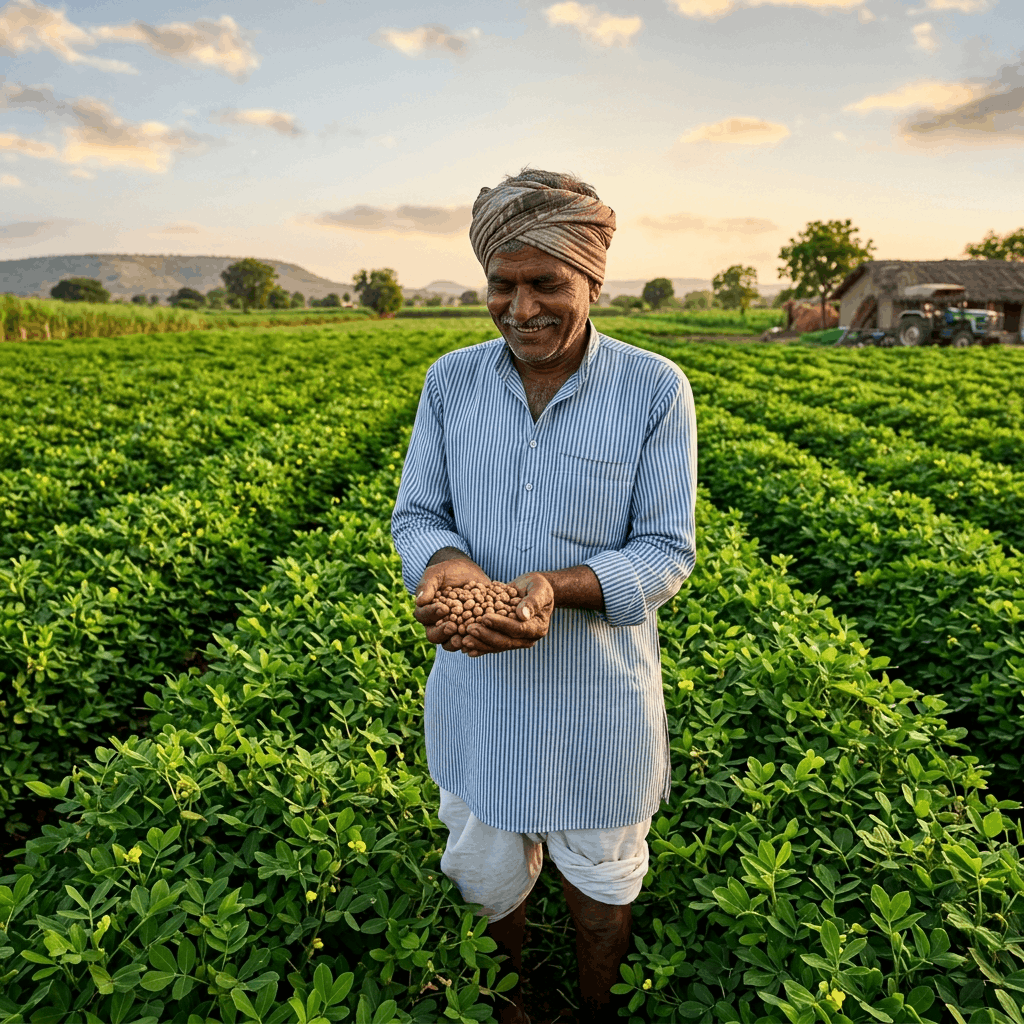
Understanding the Complexities of Groundnut Varieties
Groundnut, often referred to as peanut, is arguably one of the most commercially important oilseed crops cultivated in India. The ultimate success, yield, and profitability of your groundnut farming venture depend overwhelmingly on one foundational decision: selecting the correct seed variety. The Indian agricultural market is flooded with countless seed options, but they are generally categorized into two primary botanical types, each with distinctly different growth habits and requirements.
First, there are the \"Bunch\" types (botanically classified under Spanish or Valencia groups). These plants grow upright, mature relatively quickly (often under 100 days), and are generally easier to harvest mechanically. Second, there are the \"Runner\" or \"Spreading\" types (Virginia group). As the name suggests, these vines spread laterally across the surface of the soil, take significantly longer to reach full maturity, but historically possess the genetic potential to deliver substantially higher overall yields if managed correctly. Selecting the right seed is not a matter of simply buying the most popular brand; it requires meticulously matching the seed's specific characteristics—such as its harvest timeline, inherent drought resistance, and ultimate oil content—with your farm's unique environmental realities.
Precise Seed Rate and Sowing Density Per Bigha
Calculating the exact quantity of seed required per bigha is not a one-size-fits-all metric; it depends entirely on the specific variety you have chosen and your intended sowing method. For the upright, compact Bunch varieties, a much higher plant density is required to achieve maximum yield per acre. Therefore, the recommended seed rate is generally substantially higher, typically ranging between 20 to 25 kilograms of high-quality, graded kernels (seeds stripped of their pods) per bigha.
Conversely, for the Spreading (Runner) varieties, which require significantly more physical space for their vines to extend and for their pegs to penetrate the soil, the plant density must be lower to avoid destructive overcrowding. Consequently, the seed requirement drops to approximately 15 to 18 kilograms per bigha. Regardless of the variety chosen, it is an absolute necessity to ensure a high germination rate by treating the seeds prior to sowing. Applying powerful bio-fungicides like Trichoderma viride protects the vulnerable seeds from devastating soil-borne rotting diseases during the critical germination phase.
How to Select, Prepare, and Sow Your Seeds
When making your final variety selection, you must deeply consider your region's specific rainfall patterns and your exact soil composition. Groundnuts inherently thrive best in light, sandy loam soils that offer excellent drainage and allow the pegs to penetrate easily. If you farm in an area that relies solely on erratic monsoon rains without supplemental irrigation, you must prioritize short-duration, highly drought-tolerant Bunch varieties to ensure a harvest before the moisture completely depletes.
Seed preparation is a delicate process. To maintain maximum viability and vigor, you should only extract the kernels from their protective pods a mere 10 to 15 days before your planned sowing date. Once shelled, the seeds must be rigorously graded. Ruthlessly discard any shriveled, broken, or discolored seeds. Select only the boldest, largest, and healthiest kernels for planting. These robust seeds contain larger energy reserves, ensuring rapid, aggressive early growth that can outcompete emerging weeds.
Yield Expectations, Oil Content, and Financial Results
The decision to invest in high-quality, scientifically bred certified seeds drastically alters the final harvest outcome. A farmer stubbornly relying on traditional, saved seeds from previous harvests might struggle to achieve a yield of 500 to 600 kilograms per bigha. However, by transitioning to improved, High Yielding Varieties (HYVs) bred by agricultural institutes, and managing them with proper agronomic practices, yields can easily soar to 800 to 1200 kilograms per bigha.
Beyond just sheer volume, improved varieties are specifically bred for enhanced internal qualities. They boast a significantly higher shelling percentage (more kernel, less shell) and, crucially, a much higher inherent oil content, frequently exceeding 48%. This high oil content is exactly what commercial oil extraction mills are desperate for, allowing the farmer to aggressively negotiate and secure premium prices at the local Mandi, exponentially increasing their net financial return.
Beyond the immediate financial gains at the local Mandi, the strategic choice of high-quality seeds opens doors to highly lucrative secondary markets. Farmers who organize into Farmer Producer Organizations (FPOs) and pool their high-oil-content harvests can bypass the traditional middlemen completely. By investing in small-scale, decentralized oil extraction units, they can sell premium, cold-pressed groundnut oil directly to highly health-conscious urban consumers, capturing the entire value chain. Additionally, the remaining high-protein oil cake serves as an incredibly valuable, highly nutritious feed for dairy cattle, significantly boosting milk production and generating an entirely separate, reliable daily income stream for the farming family, ensuring total economic stability.
Nodulation: Partnering with Soil Microbes
The groundnut is a legume, which gives it a biological superpower: it possesses a mutually beneficial, symbiotic relationship with Rhizobium bacteria present in the soil. These friendly, microscopic organisms physically infect the roots of the groundnut plant, forming small, visible lumps known as nodules. Inside these nodules, the bacteria perform a miraculous task: they pull inert nitrogen gas directly from the atmosphere and \"fix\" it into a usable chemical form, essentially acting as a free, continuous, natural nitrogen fertilizer factory for the plant.
To massively accelerate and guarantee this process, farmers should actively treat their seeds with a liquid Rhizobium culture immediately before planting. This process, known as inoculation, ensures that billions of these beneficial bacteria are instantly available to the emerging roots, guaranteeing explosive early plant growth, deep green foliage, and drastically reducing the need for expensive, synthetic urea fertilizers, while simultaneously enriching the soil for the next crop cycle.
Selecting Disease-Resistant Varieties
Groundnut crops face relentless threats from aggressive pathogens. The most common and economically devastating diseases include Tikka disease (Early and Late Leaf Spot), aggressive Rust, and lethal Stem Rot. When selecting your seed, do not just look at the yield potential; meticulously search for varieties that have been specifically, genetically bred for robust disease resistance.
For instance, modern agricultural universities have developed specific varieties that are highly resistant to Collar Rot and Bud Necrosis—two diseases that can wipe out an entire field in weeks. Planting inherently resistant seed is universally acknowledged as the single most cost-effective and reliable defense strategy available to a farmer. It provides a built-in biological shield that drastically reduces the desperate need for frequent, expensive, and toxic chemical fungicide sprays throughout the growing season.
Crucial Steps for Successful Groundnut Sowing
Step 1: Rigorous Seed Selection and Grading
Procure only freshly certified seeds from highly trusted, authorized sources like government seed corporations or university counters. Shell the pods manually or with a gentle decorticator, and rigorously grade the kernels, selecting only uniformly large, undamaged seeds for planting to guarantee a uniform crop stand.
Step 2: Dual Seed Treatment (Fungicide and Bio-fertilizer)
First, treat the seeds with a bio-fungicide like Trichoderma viride to prevent soil-borne rots. Next, apply a Rhizobium culture. Mix the seeds extremely gently to coat them evenly without accidentally breaking their very thin, fragile pink seed coats, which would ruin germination.
Step 3: Sowing at the Perfect Depth and Spacing
Sow the seeds into soil that possesses adequate, deep moisture. The absolute ideal sowing depth is 5 centimeters (2 inches). Sowing deeper will suffocate the seed, while shallower sowing exposes it to birds and rapid drying. Ensure exact row spacing based on whether you are planting a compact Bunch or a wide Spreading variety.
Targeting Market Demand for Maximum Profitability
Ultimately, the broad market dynamics dictate what specific variety you should choose to grow. Bold-seeded varieties (commonly known as HPS or Hand Picked Selection types) are in massive demand for direct human consumption, roasting, the snack industry, and highly lucrative international export markets. These massive, visually appealing kernels always command the absolute highest premium prices, maximizing your financial returns significantly.
Conversely, if your local market is dominated by large-scale oil extraction mills, they will exclusively seek out and pay premiums for varieties specifically bred for maximum oil content, regardless of the physical size of the kernel. By intelligently aligning your initial seed selection with your most accessible, highest-paying target market (the food sector versus the industrial oil sector), you strategically position yourself to maximize your final profitability, ensuring a highly successful harvest season overall.
📦 Bulk Orders & Export
Mitti Gold Organic: For bulk orders of all organic fertilizers — Farmers, Nurseries, and Export. WhatsApp: +91 95372 30173