📅
June 2026 | ✍️ Mitti Gold Organic | 🗂️
General Guides
What Is Bagasse and How Much Is Available?
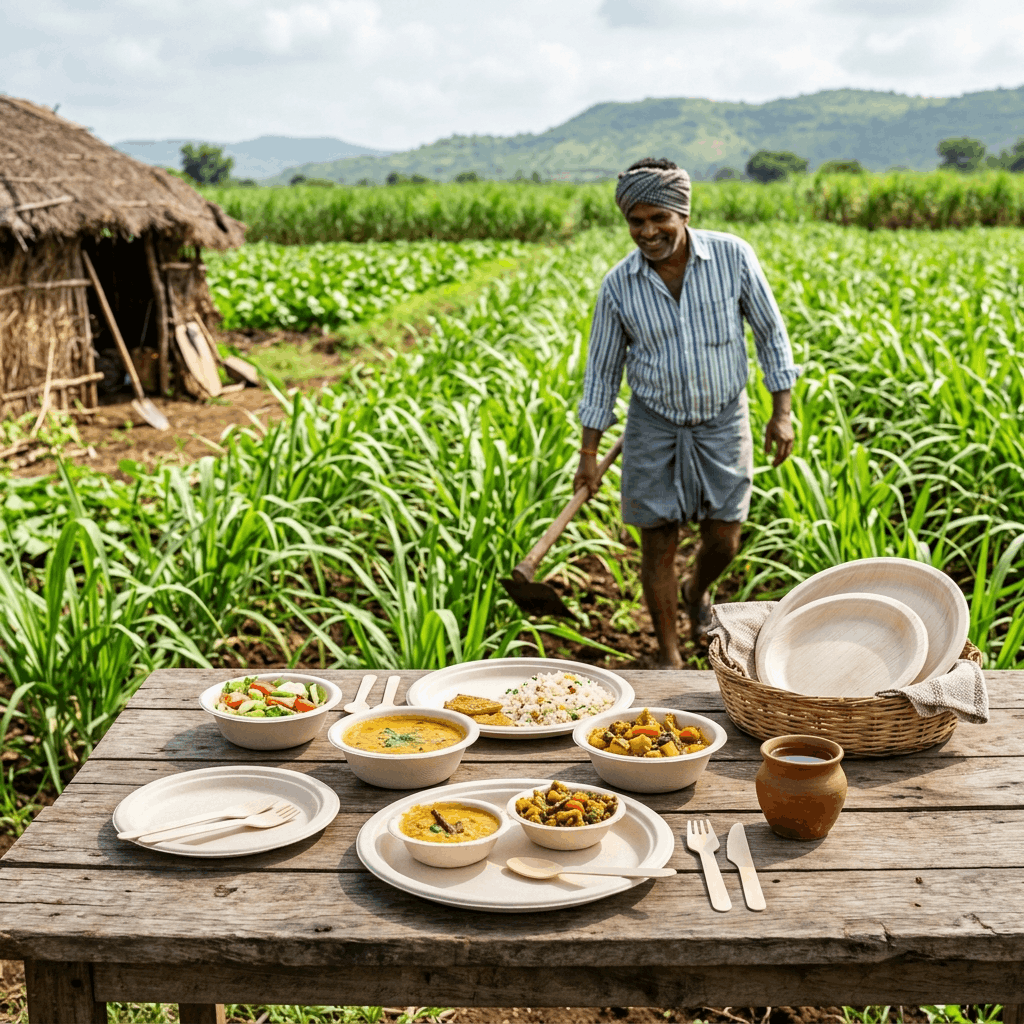
Bagasse is the dry fibrous residue left after sugarcane stalks are crushed to extract juice. For every tonne of sugarcane processed, approximately 280–300 kg of bagasse is generated as a by-product. India is the world's second-largest sugarcane producer, with over 500 million tonnes of cane crushed annually across 500+ sugar mills — generating over 140 million tonnes of bagasse every year. Traditionally, most bagasse was burned in boilers or left to rot, causing significant air and land pollution. Converting bagasse into tableware solves this waste problem while creating valuable, saleable products. A single bagasse plate-making machine can produce 1,000–1,500 plates per hour. With 8 hours of daily operation, a single machine produces 8,000–12,000 plates per day. The cost of bagasse as raw material is extremely low — many sugar mills sell it for ₹500–₹800 per tonne or even provide it free to interested manufacturers. The finished plates sell at ₹2–₹8 each, depending on size and compartment design, resulting in outstanding profit margins.
Uses of Bagasse Plates & Bowls
Bagasse tableware is one of the sturdiest biodegradable options available. Unlike leaf plates, bagasse plates can hold hot liquids for 30–60 minutes, making them ideal for hot meals, soups, and biryanis served at events. They are naturally oil and moisture resistant due to their fibrous structure, making them perfect for oily foods like fried items. The major use cases include: wedding and party catering (the biggest market segment), school and college canteens, hospital and corporate cafeterias, outdoor festivals and food courts, airline and railway meal trays, and premium food delivery packaging. Bagasse is also used to make bowls, trays, clamshell containers, cups, and even plates with multiple compartments. In international markets, bagasse products are sold as premium compostable tableware, fetching prices of ₹5–₹20 per piece. With growing corporate sustainability commitments (ESG goals), large companies are actively switching to bagasse tableware for all their events and canteen operations.
1
Step 1: Sourcing & Preparing Bagasse
Procure bagasse from nearby sugar mills. Dry the bagasse completely to remove moisture (moisture content must be below 10%). Wet bagasse will not press properly and will produce weak, crumbling plates. Store in a dry, covered shed.
2
Step 2: Pulping the Bagasse
Grind the dry bagasse into a fine pulp using a pulping machine. Mix the pulp with water to create a slurry with approximately 2–3% fiber concentration. Add food-grade binding agents (starch or natural gum) to improve plate strength. Strain out any oversized fiber chunks.
3
Step 3: Wet Pressing in Molds
Pour measured quantities of bagasse pulp slurry into the press molds. Apply high pressure (50–150 tons) using a hydraulic press to squeeze out excess water and form the plate shape. The initial pressed plate still contains 50–60% moisture at this stage.
4
Step 4: Drying (Hot Press or Oven)
Transfer the wet-pressed plates to a hot press or conveyor oven at 150–200°C. This second pressing simultaneously dries the plate and hardens its structure. The entire hot-press drying cycle takes 3–5 minutes per batch. Alternatively, plates can be sun-dried for 4–6 hours, though this is slower.
5
Step 5: Trimming, Inspection & Packing
Trim any rough edges or flash from the plate rims using an automatic or manual trimmer. Inspect for cracks, uneven surfaces, or weak spots. Pack in stacks of 25 or 50 with paper interleaving. Label with brand, material details, and composting instructions.
Profitability & Investment Return
Bagasse plate manufacturing has one of the best return-on-investment profiles among all agro-based industries. A semi-automatic line producing 8,000 plates/day at ₹3 average selling price generates ₹24,000 per day in revenue. With raw material (bagasse: ~₹1,000/day), power (₹500/day), labor (₹1,500/day), and packaging costs totaling ~₹5,000/day, the net daily profit is approximately ₹19,000 — or ₹5.7 lakh per month. A fully automatic line with higher volume can generate ₹15–₹20 lakh per month. The initial machine investment for a semi-automatic unit ranges from ₹10–₹30 lakh and typically pays back within 12–18 months. Many sugar mills themselves have set up bagasse product manufacturing units as a vertical integration strategy, because the raw material is free and the margins are excellent.
Bagasse Manufacturing & Environmental Benefits
Every bagasse plate manufactured is a double environmental win: it prevents bagasse from being burned (which causes air pollution) and replaces a plastic or thermocol plate (which would end up in landfills for centuries). When composted, bagasse plates enrich the soil with organic carbon and break down within 45–90 days. Unlike polystyrene (thermocol) plates that never decompose, bagasse plates leave zero toxic residue. Sugarcane itself is a carbon-fixing crop — sugarcane plantations absorb more CO2 per hectare than most other crops. By using bagasse (a by-product of sugarcane) rather than virgin materials, bagasse plate manufacturing achieves an exceptionally low lifecycle carbon footprint. International sustainability organizations and corporate ESG programs increasingly prefer suppliers with certified bagasse products due to these environmental credentials.
Certifications & Quality Standards
For domestic sales of bagasse tableware: FSSAI registration is mandatory as these products come in contact with food. For premium buyers and exports: ISO 9001 quality management certification and compostability certification (EN 13432 in Europe, ASTM D6400 in USA) are highly desirable and open doors to premium-price markets. BIS has published standards for compostable food containers in India that bagasse plates can comply with. Ensure your products are free of PFAS (perfluoroalkyl substances), bleach, and any non-food-safe chemicals. Many European supermarkets and food chains require suppliers to provide a full material safety data sheet (MSDS) before listing products. Maintaining these certifications builds long-term buyer trust and commands a 20–30% price premium.
Selling Channels for Bagasse Products
The best market channels for bagasse tableware are: (1) Direct sales to wedding catering companies (they buy in lakhs of pieces per year), (2) Food courts and food festivals — approach organizers directly with samples, (3) Corporate cafeteria managers — pitch sustainability benefits plus pricing, (4) Online marketplaces: Amazon Business, Flipkart B2B, IndiaMART, (5) Export: register with APEDA and list on Alibaba for international buyers, (6) Supermarkets and eco-retail stores — approach store managers with product samples and certificates, (7) Government institutions via GeM portal. Start locally, build quality, collect testimonials, and then expand to pan-India and exports. An important and often overlooked channel is social media marketing. Creating a YouTube channel or Instagram page that documents your factory process and finished product builds consumer trust and attracts direct B2C orders. Many small bagasse manufacturers have built thriving businesses purely through WhatsApp Business networks and Instagram marketing. Additionally, approaching local Rotary clubs, Lions clubs, and CSR departments of corporations for bulk sustainable event supply can open doors to large, recurring institutional orders. Document your eco-friendly story, show the raw bagasse versus finished plate transformation, and actively engage with eco-conscious communities online — this organic marketing approach costs nothing and delivers powerful results.
Machinery Setup for Bagasse Plates
Key machines required for bagasse plate manufacturing: (1) Pulper machine — ₹2–₹5 lakh, (2) Hydraulic wet press — ₹5–₹15 lakh per line, (3) Hot press / drying oven — ₹3–₹8 lakh, (4) Trimming machine — ₹1–₹3 lakh, (5) Packaging machine — ₹1–₹2 lakh. Total investment for a semi-automatic line: ₹12–₹30 lakh. Fully automatic lines from Chinese or Indian manufacturers cost ₹50–₹2 crore depending on output capacity. Power consumption: 20–50 kW per production line. Minimum space required: 2,000–5,000 sq ft. Machine manufacturers are found in Coimbatore, Pune, Delhi, and Ahmedabad.
🏭 Start Your Bagasse Plate Factory
Need help with machinery sourcing, raw material, or market connections? Chat with us on WhatsApp: +91 95372 30173
Frequently Asked Questions about Bagasse Plates
Are sugarcane bagasse plates microwave safe? +
Yes, bagasse plates are microwave safe up to 120°C and can be used in conventional ovens up to 200°C for short periods. This makes them superior to plastic plates (which release toxic chemicals when heated) and paper plates (which can become soggy). Bagasse plates are also freezer safe, making them suitable for meal prep and food delivery packaging that needs to be reheated.
How long does a bagasse plate take to decompose? +
Under composting conditions (warm, moist, with microbes), a bagasse plate will completely decompose in 45–90 days. In a landfill (anaerobic conditions), it will decompose in 6–12 months — far faster than thermocol plates (never) or plastic plates (400+ years). Bagasse plates can also be added directly to a home compost bin after use.
What is the minimum investment to start a bagasse unit? +
A manual or semi-manual bagasse plate unit can be started with as little as ₹5–₹8 lakh for basic machinery. A semi-automatic line with 1,000+ plates/hour capacity costs ₹12–₹20 lakh. Government subsidy schemes like PMEGP and MSME loans cover up to 25–35% of project cost, reducing your actual investment significantly.
Can I use bagasse from juice shops, not sugar mills? +
Yes! The bagasse from street-side sugarcane juice shops is essentially the same material. However, it tends to be wetter and less uniform. You'll need a dryer or longer sun-drying time. For a micro-level pilot unit, collecting bagasse from local juice shops is a zero-cost way to test your production process before investing in bulk procurement from sugar mills.
Is bagasse plate business profitable in tier-2 cities? +
Absolutely. In fact, tier-2 and tier-3 cities are often ideal locations because: (1) Proximity to sugarcane-growing regions means lower raw material transportation cost, (2) Lower labor and land costs compared to metros, (3) Growing catering and events industry in smaller cities, (4) Less competition than metro markets. Many successful bagasse units are operating profitably in cities like Nashik, Amravati, Sangli, and Kolhapur (Maharashtra) and Bellary and Bidar (Karnataka).