📅 July 2026 | ✍️ Mitti Gold Organic | 🗂️ Farming
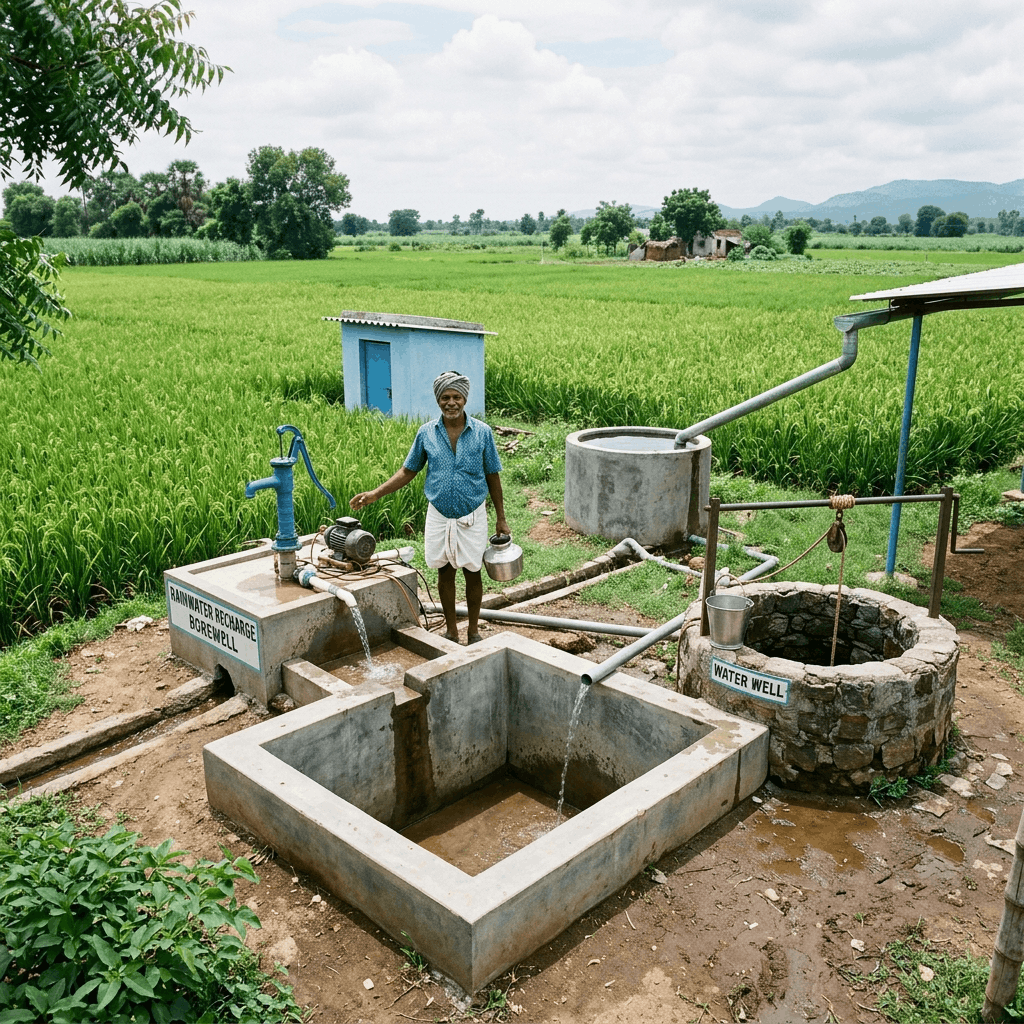
Introduction to Rainwater Harvesting for Farmers
Water scarcity is undeniably one of the most significant and pressing challenges faced by farmers today across the globe, but particularly in agricultural regions dependent on seasonal monsoons. With a rapidly changing climate, unpredictable rainfall patterns, and alarmingly depleting groundwater levels, relying solely on uncertain monsoons or traditional surface water sources is no longer a viable or sustainable strategy for modern agriculture. The continuous extraction of water from aquifers without adequate replenishment has led to a drastic drop in the water table, causing borewells to dry up prematurely and leaving farmers in a state of crisis during crucial crop growth stages.
Rainwater harvesting and actively recharging borewells and water wells presents a sustainable, environmentally friendly, and cost-effective solution to this growing crisis. By intentionally capturing and directing rainwater runoff into underground aquifers, farmers can ensure a continuous, reliable water supply even during prolonged droughts. This practice not only safeguards the current season's crop yields but also secures the agricultural future of the land for generations to come. This comprehensive guide covers absolutely everything you need to know about rainwater recharge systems, from the fundamental science behind groundwater replenishment to the practical, step-by-step construction of recharge pits on your farm.
Quantity, Capacity, and Catchment Guidelines
Understanding the volume of water you can harvest is the first critical step in designing an effective recharge system. The amount of water you can capture and store depends primarily on two factors: the size of your catchment area (which could be a rooftop, a paved surface, or the natural slopes of your agricultural field) and the average annual rainfall in your specific region. To put this into perspective, even a moderate rainfall of just 10 millimeters on a 1-acre plot (approximately 4,000 square meters) translates to 40,000 liters of water. Over the course of a good monsoon season, a single acre can easily capture hundreds of thousands of liters of precious rainwater.
For a standard, dedicated borewell recharge pit designed to handle agricultural runoff, a recommended size is typically 3x3x3 meters (approximately 10x10x10 feet). This substantial volume is necessary to accommodate sudden, heavy downpours without overflowing. The pit must be systematically filled with specific filtering materials—starting with large boulders at the bottom, followed by medium-sized pebbles or gravel, and topped with a thick layer of coarse river sand. This multi-layered filtration approach is absolutely essential. It ensures that massive volumes of water per bigha (or acre) can be recharged effectively and rapidly, without causing destructive soil erosion on the surface or dangerous waterlogging that could damage crop roots. The capacity must always be calculated to match the peak flow rate of the catchment area during the heaviest expected storms.
How to Implement the Recharge System Effectively
Implementing a rainwater recharge system requires careful, strategic planning and an understanding of the natural topography of your land. First, you must conduct a thorough survey to identify the natural slopes and drainage patterns of your field. The goal is to naturally divert the maximum amount of surface runoff towards the lowest point of the land, which is ideally where your well or borewell should be located, or where you will construct the recharge pit.
Construct the primary catchment pit adjacent to the borewell casing. This pit acts as the vital first line of defense, a primary filter that traps mud, silt, agricultural debris, and other contaminants before the water reaches the aquifer. A slotted PVC pipe is then used to connect the bottom of the filtering pit directly to the borewell casing. It is imperative that this pipe is wrapped in a durable nylon mesh screen to prevent any fine sand from entering the borewell and damaging the submersible pump.
Implementation doesn't end with construction; maintenance is an ongoing requirement. Regular upkeep is crucial for optimal performance. Before the onset of every monsoon season, the top layer of sand in the filter pit must be scraped off, cleaned, and replaced, as it will likely be clogged with fine silt from the previous year. Additionally, the surrounding catchment channels must be cleared of weeds and obstructions to ensure a smooth, unimpeded flow of water into the system.
Comparing Results: Before and After Recharge Implementation
The transformational results of implementing a properly designed rainwater recharge system are nothing short of spectacular, often turning barren, stressed farms into highly productive agricultural enterprises. Before implementing recharge systems, many farmers report that their borewells would reliably dry up by early summer, precisely when crops need water the most. This tragic timing forced farmers into desperate measures: either purchasing exorbitantly expensive water tankers, severely cutting into their profit margins, or abandoning their crops entirely, leading to devastating financial losses.
After the installation of a recharge system, the narrative changes dramatically. The most immediate and noticeable impact is a significant, measurable rise in the water table. Farmers consistently report possessing active, yielding borewells year-round, which makes multiple cropping cycles (Rabi, Kharif, and Zaid) entirely possible. This multi-cropping capability exponentially increases the annual income of the farm.
Furthermore, it is not just the quantity of water that improves, but the quality as well. Continuous extraction of groundwater often leads to increased salinity and the concentration of harmful minerals like fluoride. Recharging the aquifer with fresh, pure rainwater naturally dilutes this salinity. The resulting softer, sweeter water is vastly better for crop health, preventing salt stress in plants and maintaining the long-term fertility of the topsoil.
Supporting the Soil Ecosystem and Beneficial Creatures
It is a common misconception that rainwater harvesting only benefits the crops directly. In reality, it rejuvenates the entire agricultural ecosystem from the ground up. The increased, consistent moisture levels in the soil profile profoundly support the invisible workforce of the farm: earthworms and beneficial soil microorganisms. These creatures are the biological engine of soil fertility. They thrive in environments with stable moisture, breaking down organic matter rapidly and turning it into rich, nutrient-dense humus.
A healthy water table ensures that the soil remains biologically active even during dry spells. This sustained activity improves soil structure, aeration, and water-holding capacity, creating a positive feedback loop. Moreover, the enhanced moisture supports native vegetation along the borders of the field. This flora is essential for sustaining populations of pollinators, such as bees, butterflies, and beneficial predatory insects that naturally control pest populations. By recharging the groundwater, you are essentially investing in the biodiversity and ecological balance of your entire farm.
Protection from Drought and Agricultural Diseases
A continuous, reliable water supply is arguably the single best defense against the devastating impacts of drought. However, the benefits extend far beyond simply preventing dehydration. When crops face water stress, their physiological processes are disrupted, and their natural immune systems become severely weakened. In this weakened state, they become highly susceptible to attacks from pests and aggressive fungal or bacterial diseases.
By ensuring deep, consistent irrigation through recharged groundwater reserves, crops can develop robust, extensive root systems and thick, strong stems. These healthy plants are naturally equipped to resist common agricultural diseases without the need for excessive chemical interventions. Furthermore, by directing excess surface water into recharge pits, farmers actively prevent the accumulation of stagnant water in the fields. Waterlogging is a primary cause of root rot and provides ideal breeding grounds for harmful fungi and destructive insects. Thus, rainwater recharge acts as a dual protective mechanism: hydrating the plant for strength and removing stagnant water to prevent disease.
Step-by-Step Installation Guide for Borewell Recharge
Step 1: Site Selection, Surveying, and Excavation
Begin by surveying your land to identify the natural flow of water during heavy rain. Select a location near your existing borewell or water well that sits at a naturally lower elevation to capture maximum runoff. Excavate a pit measuring approximately 10x10 feet in width and 10 feet deep. Ensure the sides of the pit are stable. If the soil is loose, you may need to reinforce the walls with a basic brick lining, leaving weep holes for water lateral movement.
Step 2: Constructing the Multi-Layered Filtration Bed
The filtration bed is the heart of the system. Fill the bottom of the excavated pit with large boulders (approximately 3 to 4 feet deep). This creates large void spaces for rapid water accumulation. Next, add a layer of medium-sized gravel or pebbles (about 2 to 3 feet deep) to catch smaller debris. Finally, top the pit with a thick layer of coarse river sand (2 to 3 feet deep). This top layer acts as a fine filter, removing silt and clay particles before the water descends.
Step 3: Creating the Casing Connection and Silt Trap
Install a PVC pipe connecting the very bottom of the filtering pit directly to the borewell casing. It is crucial to drill small holes (slots) into the borewell casing where the pipe connects, allowing water to enter the aquifer. Wrap the slotted section and the connecting pipe tightly in a fine, durable nylon mesh screen. Additionally, construct a small, shallow silt trap pit right before the main filter pit to catch heavy mud before it clogs your primary sand filter.
Market Impact, ROI, and Economic Benefits
For commercial farmers, commercial nurseries, and large-scale gardeners, water security directly translates into robust financial security and market dominance. With a fully recharged and reliable well, farmers gain the strategic flexibility to grow high-value, water-intensive cash crops—such as exotic vegetables, export-quality fruits, and spices—even during the scorching summer months when market supply is critically low. This ability to produce out-of-season crops allows farmers to command premium market prices, drastically increasing their profit margins.
Commercial plant nurseries can maintain their delicate plant inventory without the exorbitant operational cost of importing water via tankers, ensuring business continuity. For farmers targeting international export markets, consistent water access guarantees the uniform size, pristine appearance, and high quality of the yield—strict prerequisites for passing export quality control. Ultimately, the relatively low initial investment in a rainwater recharge system offers one of the highest Returns on Investment (ROI) in the agricultural sector, paying for itself often within a single drought season through saved crops and enhanced yields.
📦 Bulk Orders & Export
Mitti Gold Organic: For bulk orders of all organic fertilizers — Farmers, Nurseries, and Export. WhatsApp: +91 95372 30173