📅
June 2026 | ✍️ Mitti Gold Organic | 🗂️
Farming
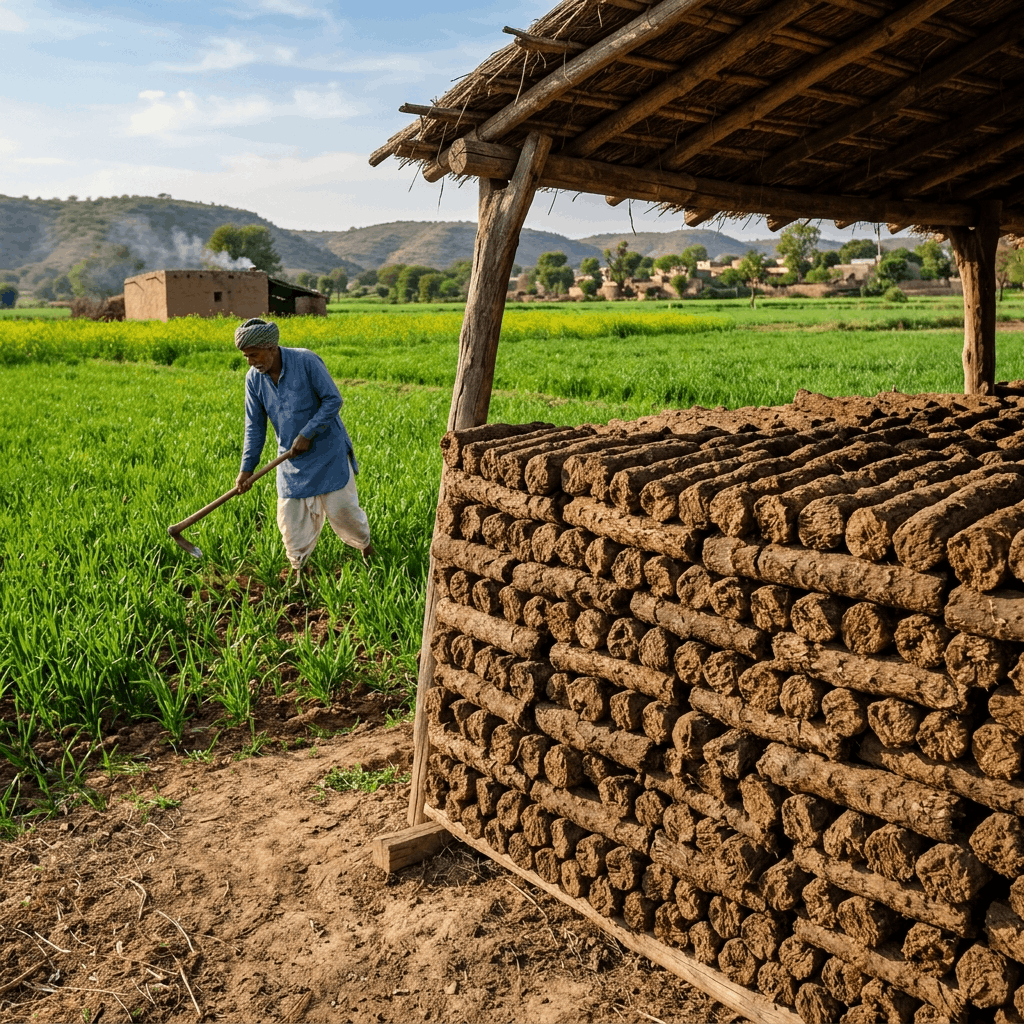
How Much Fire Wood Can Be Produced from Cow Dung?
A single cow produces 10–15 kg of fresh dung per day. After natural moisture evaporation (drying), this yields approximately 4–6 kg of dry dung material. A standard cow dung fire stick machine (also called a dung log or dung pellet machine) can process 50–150 kg of dung per hour, producing 8–20 kg of finished fire sticks depending on the moisture content and machine capacity. A small Gaushala with 50 cows generates 500–750 kg of fresh dung daily, yielding 200–300 kg of dry dung logs per day. At a selling price of ₹25–₹50 per kg, this represents ₹5,000–₹15,000 in daily revenue from waste that was previously discarded or causing hygiene problems. For dairy farmers, this additional income stream from cow dung significantly improves the economic viability of maintaining cattle — making it a win-win for animal welfare and farmer income. A medium-scale unit processing dung from 200+ cows can produce 1,000+ kg of fire sticks per day, generating a monthly revenue of ₹7.5–₹15 lakh.
Uses of Cow Dung Fire Sticks
Cow dung fire sticks (also called dung wood, gober lakdi, or biomass logs) are used wherever firewood is required. The primary applications include: (1) Crematoriums (Antyesti Ghar) — this is the single largest market, as dung wood is increasingly accepted as a cleaner, more spiritual alternative to natural wood for Hindu cremation rituals; (2) Havan and Yagya ceremonies — dung logs burn with a sattvic, fragrant flame ideal for religious ceremonies; (3) Home cooking in rural areas — where firewood is expensive or scarce; (4) Dhabas and restaurants using wood-fired chulhas (stoves); (5) Brick kilns, pottery kilns, and tile kilns — as a cheaper, locally available fuel source; (6) Biomass power plants that run on agricultural residue; (7) Export — premium "sacred cow dung logs" are exported to Indian diaspora communities in the USA, UK, Canada, and UAE for religious use at premium prices. The demand for crematorium dung wood is particularly strong and growing as more crematoriums across India adopt the "Moksha Dham" concept of eco-cremation using cow dung logs.
1
Step 1: Dung Collection & Initial Drying
Collect fresh cow dung from the cattle shed daily. Mix in a small amount of dry straw or sawdust (5–10% by weight) to help bind the mixture and absorb excess moisture. Spread in a thin layer on a flat, sunny surface and allow to sun-dry for 1–2 days until the moisture content drops to 20–25%.
2
Step 2: Preparing the Mixture
Once partially dried, mix the dung uniformly. For stronger sticks: add 5–8% lime powder or agricultural gypsum to improve density and burn time. For fragrant sticks: add a small amount of camphor, sandalwood powder, or dried cow dung ash (gobar vibhuti) to improve the religious scent during burning.
3
Step 3: Machine Processing
Feed the prepared dung mixture into the hopper of the dung log machine. The machine uses a screw extruder mechanism to compress and shape the mixture into uniform cylinders (typically 4–6 inches in diameter) or pellets (6–10 mm diameter). The extrusion process also further compacts the material, increasing its density and burn time.
4
Step 4: Shaping & Cutting
The extruded log is cut to the desired length (typically 30–45 cm per log, similar to standard firewood). A cutting guide attached to the machine ensures uniform pieces. For pellets, the machine cuts automatically into 6–10 mm pieces. Uniform dimensions are important for packaging, transport, and market acceptance.
5
Step 5: Final Drying & Packaging
Stack the formed logs or pellets in a well-ventilated, covered shed for 5–10 days of natural air drying (or 2–4 hours in a mechanical dryer). Moisture content must drop below 10–12% for optimal burning. Pack in jute bags, wooden crates, or custom-printed packaging for branding. Label with weight, type, and usage instructions.
Income Generation for Gaushalas & Dairy Farmers
For Gaushalas (cow shelters) that house unproductive or old cattle, the dung log business is a financial lifeline. A Gaushala with 100 cows generates 1,000–1,500 kg of fresh dung daily, yielding 300–500 kg of finished fire sticks. At ₹30/kg selling price, this is ₹9,000–₹15,000 daily revenue — over ₹2.7–₹4.5 lakh per month. This revenue can entirely cover the feeding and maintenance cost of the Gaushala's cattle, making it financially self-sustaining without depending on donations. For individual dairy farmers, a small dung log unit (investment: ₹30,000–₹1,00,000 for the machine) can generate ₹3,000–₹10,000 per month in additional income from dung that would otherwise be wasted. Combined with biogas production and vermicomposting, the total additional income from dairy waste can often exceed the income from milk itself — completely transforming the economics of cattle farming.
Environmental & Spiritual Significance
The use of cow dung as a fuel has deep roots in Indian civilization — going back thousands of years to Vedic traditions. Cow dung (gobar) is considered sacred and purifying in Hindu tradition. Burning cow dung logs in havans, yagyas, and cremations is believed to purify the air — a belief that modern science partially supports, as cow dung combustion produces antibacterial compounds that can reduce certain airborne pathogens. From an environmental standpoint, every kg of cow dung used as fire logs saves approximately 1.5–2 kg of firewood from being cut — directly protecting trees and forests. India's cremation industry alone uses an estimated 50–75 million trees annually. If even 30% of this is replaced by cow dung wood, it would save 15–22 million trees every year. Gaushalas across India have been increasingly recognized as environmental institutions that simultaneously protect cows, reduce waste, generate clean fuel, and prevent deforestation.
Tree Conservation & Carbon Footprint
India has a severe deforestation problem, with forests being cleared for agriculture, urban expansion, and firewood. The cremation, brick kiln, and cooking fuel industries are among the biggest consumers of firewood in rural India. By replacing firewood with cow dung logs, each unit of dung-log production directly offsets an equivalent amount of wood fuel consumption. This has measurable impact on forest cover conservation. Additionally, the methane that would naturally be released as fresh dung decomposes (a potent greenhouse gas) is instead captured within the dense, compressed log structure and released slowly as CO2 during burning — a significantly less damaging greenhouse gas. Several climate organizations are now awarding carbon credits to Gaushalas and dung-log producers for this net reduction in methane emissions, creating yet another revenue stream.
Where to Sell Cow Dung Fire Sticks
Key market channels for cow dung logs: (1) Crematoriums (Antyesti Griha, Moksha Dham) — approach managers directly with samples; these are high-volume, repeat buyers, (2) Temple trusts and religious organizations for havan and yagya ceremonies, (3) Local dhabas and wood-fired restaurant owners, (4) Brick kilns and pottery units — sell by the tonne, (5) Organic and eco-conscious consumers via online platforms (Amazon, Flipkart, WhatsApp business networks), (6) Indian diaspora communities abroad (USA, UK, UAE) who use cow dung logs for religious rituals — export fetches premium prices of ₹100–₹300/kg, (7) Agricultural input shops and organic stores. Build your brand story around the spiritual and environmental benefits of cow dung logs — this resonates powerfully with both religious and eco-conscious buyers.
Machines Required for Dung Log Production
The key machine is a biomass briquette/log making machine or a dung pellet extruder. Available variants: (1) Manual screw extruder — ₹8,000–₹20,000, capacity 30–50 kg/hour, (2) Semi-automatic electric extruder — ₹30,000–₹80,000, capacity 80–150 kg/hour, (3) Automatic high-pressure briquette press — ₹1,50,000–₹5,00,000, capacity 200–500 kg/hour. Additional equipment: a dung mixing trough, a solar or mechanical drying rack, a weighing scale, and packaging materials. Power consumption: 1–7.5 kW depending on machine size. Minimum space: 500–1,500 sq ft. Manufacturers are found in Jaipur, Agra, Lucknow, and Pune. Always test the machine with your local dung sample before purchasing — the moisture content and fiber composition of dung varies by cattle breed and feed type.
🔥 Start Your Gober Lakdi Business
Mitti Gold Organic supports Gaushalas and dairy farmers with dung wood manufacturing guidance. Chat with us: +91 95372 30173
Frequently Asked Questions about Cow Dung Fire Sticks
Does cow dung wood smell bad when burning? +
No — properly dried cow dung logs have virtually no unpleasant odor when burning. The characteristic smell associated with burning fresh dung comes from its high moisture and ammonia content. Once the log is properly dried below 10% moisture, the combustion is clean and produces a mild, earthy fragrance. When camphor, sandalwood, or loban (benzoin resin) is added during manufacturing, the logs burn with a very pleasant, sattvic fragrance — making them ideal for religious ceremonies.
How long does a dung log burn compared to regular wood? +
A properly made, compressed cow dung log burns 1.5–2 times longer than an equivalent volume of regular firewood. This is because the compression process significantly increases the density of the log, meaning more fuel is packed into the same space. For cremation use, a full set of dung logs sufficient for cremation typically costs ₹1,500–₹3,000 — compared to ₹5,000–₹8,000 for the same quantity of conventional firewood. This cost saving makes dung logs extremely attractive to crematorium operators.
Is government permission required to sell dung fire sticks? +
No special government permission is required for small-scale dung log manufacturing and selling. MSME/Udyam registration is recommended for legal protection and to access government benefits. For larger units supplying to crematoriums or institutions, a basic trade license from the local municipality may be required. GST registration is needed if annual turnover exceeds ₹40 lakh (₹20 lakh for service-heavy states). No environmental clearance is required for units below 5 tonnes/day production.
Can dung from buffaloes or other animals be used? +
Yes. Buffalo dung, goat dung, sheep dung, and horse dung can all be used to make fire logs, though the quality and burning characteristics differ. Buffalo dung produces denser, higher-calorie logs than cow dung. Goat and sheep dung is drier with higher nitrogen content, making it suitable for pellets. Horse dung has high fiber content. For religious (puja/havan) use, cow dung (go-mutra and gobar) is specifically preferred for its sanctity in Hindu tradition. For fuel applications, any ruminant dung works well.
What are the storage and transportation requirements? +
Dry dung logs should be stored in a cool, dry, covered space away from rain and moisture. Once moisture content drops below 10%, they have a very long shelf life — 6–12 months under proper storage conditions. For transport, pack in jute bags or wooden crates. Avoid plastic packaging (it traps moisture). Long-distance transport in open trucks is fine as long as the logs are covered with a tarpaulin. The product is non-hazardous, non-perishable, and can be shipped by rail freight at agricultural commodity rates.