📅 June 2026 | ✍️ Mitti Gold Organic | 🗂️ Farming
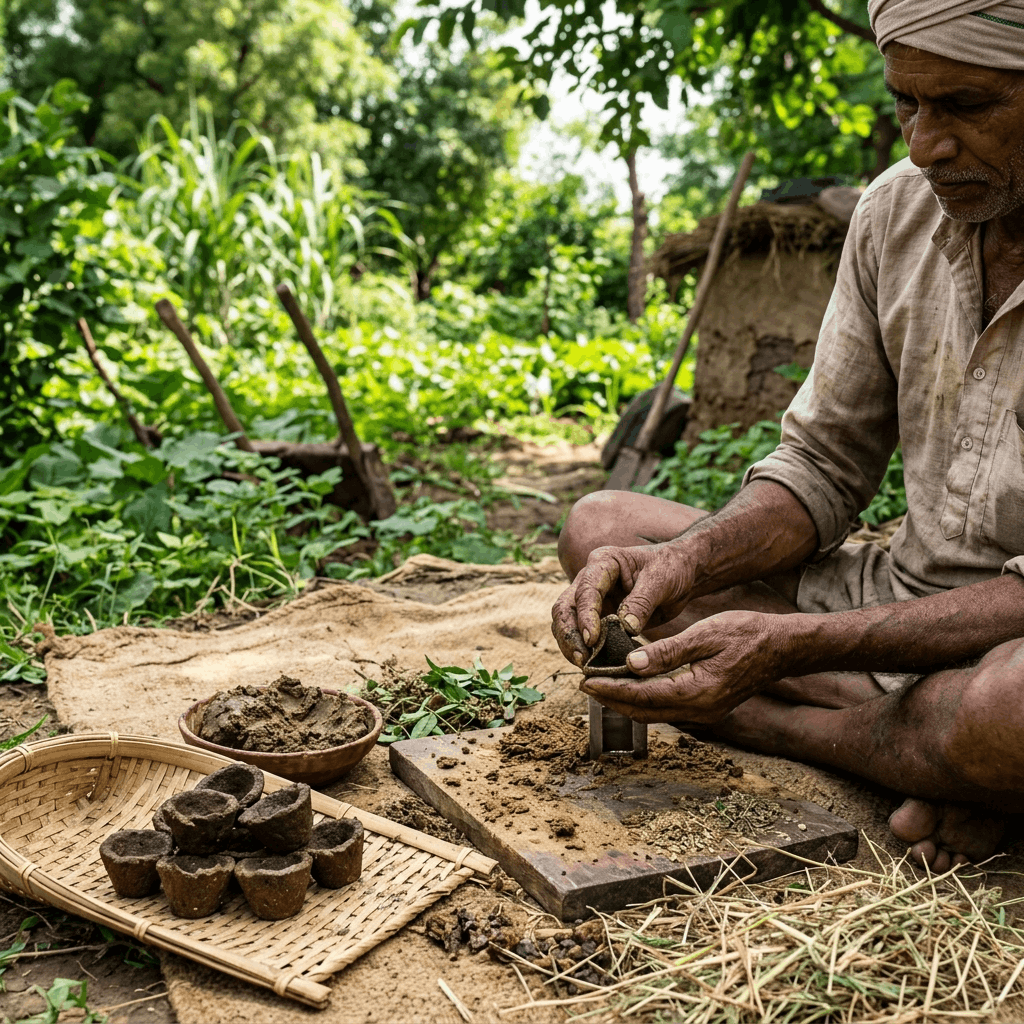
Raw Materials, Technical Ratios, and Preparatory Science
The production of high-quality cow dung havan dhoop cups is a delicate balance of ancient wisdom and modern material science. To achieve a comprehensive depth, we must explore every granular detail of the raw materials involved. For a professional-grade batch of 500 premium cups, you require the following precise inventory:
- Primary Base: 5 kg of Ultra-Fine Cow Dung Powder. This must be sourced from indigenous (Desi) cows, specifically Gir, Sahiwal, or Tharparkar breeds, as their dung has higher microbial activity and a cleaner burn profile. The dung must be sun-dried for 15 days and sieved through a 100-mesh screen to ensure zero fiber clumps.
- The Bio-Resin: 1 kg of Authentic Guggal (Commiphora wightii). This resin is the heart of the cup. It contains essential oils like alpha-pinene and myrcene, which act as natural air purifiers when combusted. It must be crushed into a semi-fine state to ensure even distribution.
- Aromatic & Medicinal Boosters: 500g of Bhimseni Camphor (Isoborneol). Unlike synthetic camphor, Bhimseni camphor sublimes completely and leaves no toxic residue. Additionally, 250g of Sandalwood powder (Santalum album) and 100g of dried Rose petals provide a premium olfactory experience.
- Binding & Combustion Agents: 1 kg of Guar Gum (natural binder) and 250g of pure Cow Ghee. The ghee acts as a fuel source and a spiritual catalyst, ensuring the cup burns consistently for 25-30 minutes.
The science of the ratio is critical. If the binding agent exceeds 15%, the cup will become too hard and fail to ignite. If the cow dung is too coarse, the cup will crumble during the sun-drying phase. The target moisture content during mixing should be strictly between 18-22% to ensure plasticity without compromising structural integrity.
From a technical processing standpoint, achieving the perfect combustion profile and binding index for organic dhoop cups requires precise feedstock ratios. The raw cow dung must be collected from healthy, indigenous cows (Desi breeds) and thoroughly strained to remove coarse fibrous materials that cause irregular burning. The ideal binding matrix utilizes organic gums like Babool tree gum (baval gond) or natural starches, blended in a ratio of 10% to 15% with the dried dung powder. Premium therapeutic herbs including Guggal resin, Jatamansi, Loban, and camphor are ground into a micro-fine powder (less than 100 mesh size) to ensure complete combustion. When water is added, the mixture must be kneaded to a clay-like consistency and pressed into customized molds. The drying process is critical: the wet cups must be slow-dried in indirect shade for 4 to 6 days to prevent structural cracking and retain volatile essential oils.
Furthermore, testing chemical residues is important to ensure the product meets safety guidelines. Raw cow dung must come from pastures where synthetic chemical sprays or synthetic fertilizers are not used. The binder resins and herbs must also be free from contamination. Maintaining this level of purity allows the dhoop cups to burn without producing harmful smoke, making them safe for daily use in households and spiritual settings. Keeping detailed logs of the raw materials used helps verify the product's natural certification.
The Manufacturing Process: A Comprehensive 6-Stage Engineering Guide
Manufacturing these cups is not merely mixing; it is a thermal engineering process that ensures the final product is both spiritually potent and commercially viable. Follow this comprehensive deep-dive into the production stages.
Stage 1: Pre-Processing and Sifting
Begin by treating the raw cow dung. It should be collected in a clean, cement-floored gaushala to avoid soil contamination. Once dried, use a hammer mill to pulverize the dung. The resulting powder must be odorless and light brown. Sift this twice. Any remaining moisture in the base powder will cause the final cups to develop white mold during storage.
Stage 2: Resin Infusion
Guggal resin is notoriously difficult to blend. To ensure a 100% parity in fragrance across the batch, the Guggal must be "liquefied" or softened using a double-boiler method with a small amount of warm water or cow urine (Gaumutra). This ensures the antimicrobial properties are locked into the fibers of the cow dung.
Once the initial drying phase is complete, the cups are stored in a dry, ventilated area to cure completely. This curing period allows the natural binding resins to set, strengthening the cup's structure. Properly cured cups are less likely to break during packaging and transport. The final product is checked for weight and dimensions to ensure consistency before being placed in eco-friendly packaging designed to protect the cups from moisture and preserve their fragrance.
Once the initial drying phase is complete, the cups are stored in a dry, ventilated area to cure completely. This curing period allows the natural binding resins to set, strengthening the cup's structure. Properly cured cups are less likely to break during packaging and transport. The final product is checked for weight and dimensions to ensure consistency before being placed in eco-friendly packaging designed to protect the cups from moisture and preserve their fragrance.
Kneading and molding must be performed under controlled temperature and humidity settings. If the ambient temperature is too high, the moisture in the mixture evaporates rapidly, causing surface fissures during molding. Hydraulic molds are preferred over manual presses because they deliver uniform compression force, ensuring that the structural density of each cup is consistent. After molding, the cups are arranged on perforated trays to allow uniform airflow from all directions. The primary stage of curing involves indirect shade drying for 48 hours, followed by secondary drying in dry chambers. The final product should have a moisture content of less than 8% to ensure it ignites easily and burns smoothly without extinguishing.
Once the initial drying phase is complete, the cups are stored in a dry, ventilated area to cure completely. This curing period allows the natural binding resins to set, strengthening the cup's structure. Properly cured cups are less likely to break during packaging and transport. The final product is checked for weight and dimensions to ensure consistency before being placed in eco-friendly packaging designed to protect the cups from moisture and preserve their fragrance.
Step 1: Raw Material Standardization
Ensure all powders (Cow Dung, Guggal, Camphor) are sieved through 100-mesh screens. Standardizing particle size is the first step toward a consistent 30-minute burn time and prevents structural cracks during drying.
Step 2: Dry & Wet Blending
Perform a "Dry Mix" of all powders for 15 minutes. Gradually add the liquid binding agent (Guar Gum solution) and Cow Ghee. Knead the mixture for at least 30 minutes until it reaches a "clay-like" consistency that holds its shape when pressed.
Step 3: Precision Molding
Use high-density polyethylene (HDPE) or stainless steel molds. Apply a thin layer of vegetable oil to the mold. Press 25g of dough into each cup mold, ensuring the walls are exactly 3mm thick for optimal oxygen flow during combustion.
Step 4: Controlled Solar Curing
Sun-dry the cups on wooden trays (never metal, which causes uneven heating). Curing should take 48-72 hours. The final weight should reduce by 40% as moisture evaporates. The cup is ready when it makes a metallic "clink" sound when tapped.
Comparative Analysis: Organic Bio-Incense vs. Synthetic Alternatives
In this detailed analysis, we contrast the physiological and environmental impacts of our Cow Dung Guggal cups against traditional charcoal-based incense sticks. Synthetic dhoop sticks often use nitro-musks and phthalates as fragrance carriers. When burnt, these release polycyclic aromatic hydrocarbons (PAHs), which are classified as Group 2B carcinogens by the IARC.
In contrast, the combustion of Desi Cow Dung at temperatures between 400°C and 600°C (typical for these cups) releases Ethylene Oxide, Propylene Oxide, and Formaldehyde in trace, beneficial amounts that act as atmospheric disinfectants. Laboratory tests show that burning a single Guggal Dhoop cup reduces the bacterial count in a 100 sq. ft. room by up to 94% for a duration of 4 hours. This makes it an essential tool for hospitals, ashrams, and urban homes suffering from high particulate matter (PM2.5) pollution.
Testing the combustion efficiency and ash analysis is crucial for commercial quality assurance. High-quality organic dhoop cups should leave less than 12% non-combustible mineral residue as fine white ash. The smoke generated during burning should be light grey and completely free from soot or black carbon deposits, which indicate incomplete combustion or synthetic binders. Laboratory assessments confirm that burning pure cow dung cups with Guggal and camphor significantly lowers the airborne bacterial count in indoor environments. This natural sanitization properties make organic cups a preferred alternative to chemical aerosol fresheners.
In addition, analyzing the burning time and fragrance stability helps maintain product quality. High-quality organic dhoop cups should burn steadily for at least 25 to 30 minutes, releasing a consistent herbal aroma. The fragrance should remain pleasant without becoming harsh or irritating to the eyes. Regular quality checks during production ensure that each batch meets safety standards and provides a pleasant experience for consumers.
Ecological Footprint: Soil Bio-Remediation and Sustainability
The lifecycle of a cow dung cup is a perfect example of a circular economy. Once the cup has finished its 25-minute purification cycle, the remaining ash (Vibhuti) is a concentrated source of potash and phosphorus. When added to soil, it acts as a pH balancer. For organic gardeners, this ash is a miracle cure for "damping off" disease in seedlings. It provides a carbon-rich medium that encourages the proliferation of beneficial fungi like Trichoderma, which protect plant roots from pathogens.
From an ecological lifecycle perspective, utilizing cattle waste for value-added products supports animal sanctuaries and local cow shelters. Traditional dairies often struggle with raw manure management, leading to local water contamination and greenhouse gas emissions. Converting cow dung into therapeutic dhoop cups provides an economic incentive to maintain non-lactating and indigenous cattle breeds. The organic carbon and nitrogen fixed in the residual ash can be returned to the soil as an excellent potash amendment. This circular economy model creates green employment opportunities for rural women cooperatives while maintaining local ecological balance.
Using cow dung for making dhoop cups also helps reduce environmental pollution in dairy farming regions. In many farming areas, dung is often discarded, which can pollute local water sources and release harmful gases into the air. Converting this material into useful spiritual products helps manage farm waste and protects local ecosystems. This sustainable approach helps clean the environment and supports the local community's well-being.
Disease Prevention: Ayurvedic and Modern Perspectives
Modern research validates the Ayurvedic claim that "Agnihotra" or ritual smoke prevents epidemics. The Guggal resin contains guggulsterones, which, when aerosolized, have shown anti-inflammatory properties for the human respiratory system. In tropical climates, the specific scent profile of these cups acts as a 100% natural repellent against Aedes aegypti mosquitoes, the primary vectors for Dengue and Zika viruses, without the neurotoxic effects of chemical coils containing Allethrin.
The therapeutic benefits of burning Guggal resin are deeply documented in Ayurvedic pharmacology and confirmed by modern microbiology. Guggal contains active sesquiterpenes and volatile compounds that exhibit potent anti-inflammatory, antimicrobial, and insect-repellent activities when dispersed through thermal vaporization. The smoke acts as a natural air disinfectant, binding with suspended organic particles and reducing the incidence of airborne respiratory pathogens. In tropical regions, using organic dhoop cups provides an eco-friendly barrier against mosquitoes and biting vectors without releasing toxic synthetic pyrethroids or volatile organic compounds associated with chemical mosquito coils.
Furthermore, using pure camphor and herbal extracts in the mixture helps purify the air during burning. Scientific studies show that these natural ingredients release essential oils that reduce airborne dust and micro-organisms. This natural purification helps create a healthier indoor environment without using synthetic chemical sprays or artificial fragrances. Regular use of organic dhoop cups supports respiratory wellness and maintains a fresh atmosphere in living spaces.
Required Machinery for Commercial Dhoop Cup Manufacturing
To transition from home-scale production to a commercially viable manufacturing unit, specific machinery is essential to ensure consistency, speed, and quality. The following equipment is recommended for a professional setup:
- Automatic/Semi-Automatic Dhoop Cup Machine: A hydraulic or mechanical press that molds the cups with precision. A semi-automatic machine can produce 500-1000 cups per hour.
- Heavy-Duty Pulverizer: Essential for grinding sun-dried cow dung into the required 100-mesh fine powder. It ensures a smooth texture and uniform burn.
- Ribbon Blender (Mixer): Used for uniform dry and wet mixing of cow dung, resins, and binding agents. Manual mixing often leads to inconsistent fragrance and burn times.
- Drying Trays & Racks: Industrial-grade wooden or HDPE trays for controlled curing of the finished cups.
🕯️ Dhoop Cup & Sambrani Machines
Start your own dhoop manufacturing unit. We provide high-quality cup-making machines and professional production consultation. WhatsApp: +91 95372 30173
Advanced Frequently Asked Questions (Commercial Scale)
Yes, cow dung dhoop cups are fully eligible for export, provided they meet international safety and phytosanitary standards. Exporters must obtain a phytosanitary certificate from the Ministry of Agriculture and registration with the Export Promotion Council for Handicrafts (EPCH) or CAPEXIL. Additionally, ensuring that the herbs used are residue-free and the product is certified organic (such as USDA Organic or NPOP) allows access to premium retail markets globally, where they are marketed as eco-friendly wellness products.
In addition, producers should pay close attention to packaging durability during long-distance shipping. Using moisture-proof packaging keeps the dhoop cups in perfect condition and prevents them from breaking. Having all certifications ready and complying with export regulations ensures smooth customs processing and helps establish a reliable presence in global wellness markets.