📅 July 2026 | ✍️ Mitti Gold Organic | 🗂️ Machinery & Markets
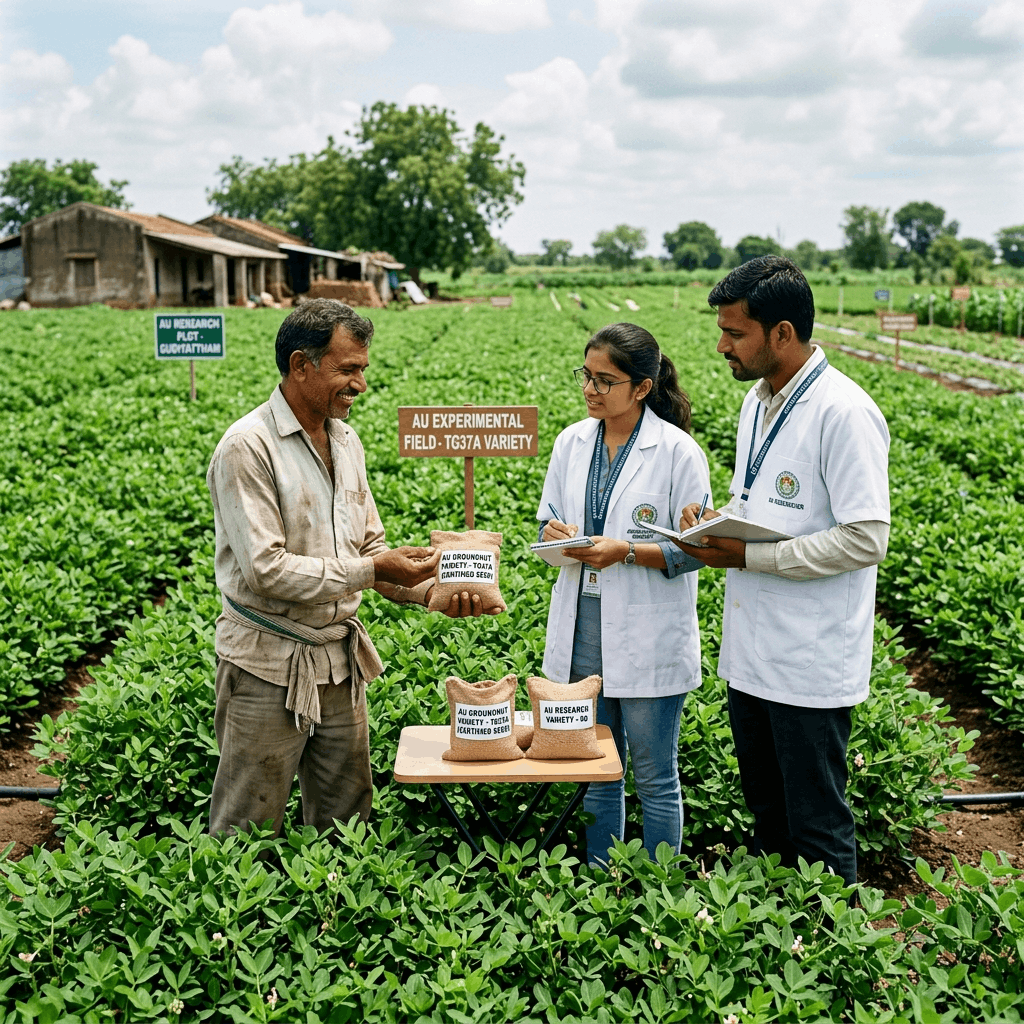
The Gold Standard of Trusted Seeds for Farmers
Groundnut farming is deeply entrenched in the agricultural fabric of India, particularly in states like Gujarat, Andhra Pradesh, and Tamil Nadu. The absolute driving force behind the immense success and profitability of this crop in these regions is the relentless, world-class research conducted by Indian agricultural universities, most notably the Junagadh Agricultural University (JAU), ICRISAT, and Tamil Nadu Agricultural University (TNAU). These institutions have single-handedly revolutionized groundnut cultivation.
Over decades of meticulous cross-breeding and exhaustive field trials, these universities have bred elite groundnut varieties that are lightyears ahead of traditional, saved seeds. They have developed varieties that mature incredibly fast to beat the retreating monsoon, possess deep roots to withstand severe drought, and are genetically programmed to deliver unbelievably high oil content. By choosing to plant university-certified seeds, a farmer is essentially purchasing a scientifically engineered guarantee. They are acquiring genuine, highly refined local genetics that have been specifically designed and rigorously tested to absolutely thrive in their exact regional soil type and unpredictable climate.
Scientifically Researched Seed Rate Recommendations
One of the greatest benefits of using university seeds is the extremely precise, highly researched agronomic guidelines that accompany them. Universities do not provide generic advice; they provide specific formulas for success. For their immensely popular, compact \"Bunch\" varieties (such as the legendary GG series developed in Gujarat), the recommendation is highly specific, typically demanding exactly 20 to 25 kilograms of bold, graded kernels per bigha to ensure a dense, highly productive canopy.
For their robust, Spreading (Runner) varieties, the rate is carefully calculated to be lower, preventing the aggressive vines from overcrowding and strangling each other, which would otherwise lead to massive foliage growth but terrible pod formation. Strictly adhering to these highly researched, recommended seed rates ensures the absolute optimal plant population. It strikes the perfect balance—dense enough to maximize yield and shade out weeds, but sparse enough to ensure adequate airflow, preventing the buildup of humidity that invites devastating fungal diseases.
Adopting Best Practices for University Seeds
To unlock the massive genetic potential engineered into these university seeds, farmers must commit to adopting the university's complete, comprehensive \"Package of Practices.\" Simply buying the good seed and farming it using outdated methods is a waste of money. The package begins months before sowing, mandating deep summer ploughing to expose and destroy soil-borne pests and deeply loosen the soil to allow for easy peg penetration later in the season.
Crucially, the university package emphasizes specialized techniques that traditional farmers often skip. This includes the mandatory, precise application of Gypsum at the critical \"pegging\" stage to ensure every single pod fills completely with large kernels, eliminating the problem of empty shells. Furthermore, researchers heavily advocate for advanced sowing methods, such as utilizing the \"raised bed\" or \"broad bed furrow\" system. This technique vastly improves water drainage during heavy monsoon downpours, preventing the pods from rotting in waterlogged soil, while making mechanical harvesting significantly easier and cleaner.
Achieving Unprecedented High Yields and Premium Quality Pods
The primary, unwavering goal of university agricultural breeding programs is to directly increase the net income of the smallholder farmer. They achieve this by releasing varieties with proven, undeniable track records of success. Varieties such as GG-20, TG-37A (a highly popular Trombay Groundnut variety), and the Kadiri series have transformed the economic landscape of entire districts.
Farmers who transition from local, uncertified seeds to these premium university varieties consistently report staggering results. The most immediate difference is a massive increase in the physical pod yield. The pods themselves are significantly larger, and the devastating issue of empty pods (known as \"pops,\" caused by calcium deficiency or poor genetics) is virtually eliminated. Overall, farmers routinely document a massive 20% to 30% increase in total yield, resulting in a drastically higher financial return per acre at the end of the season.
The immense financial impact of adopting these elite, university-bred varieties is truly transformative for the entire rural economy. When a farmer consistently harvests massive yields of premium-quality, high-oil groundnuts, their increased purchasing power actively stimulates the local village economy. Furthermore, the exceptional quality of these scientifically bred seeds ensures they remain highly viable for longer periods in storage. This crucial characteristic allows farmers to strategically hold back a portion of their harvest during the peak season when market prices crash due to oversupply, and intelligently sell their premium crop months later during the off-season when extreme scarcity drives market prices to their absolute peak, fundamentally maximizing their annual agricultural income.
Supercharging Natural Nitrogen Fixation
University research extends far beyond just the seed itself; it delves deeply into the complex biology of the soil. Groundnuts are legumes that rely on a symbiotic relationship with Rhizobium bacteria to extract free nitrogen from the atmosphere. However, not all bacteria are equally efficient. Universities have isolated, cultured, and tested highly specific, hyper-efficient strains of Rhizobium bacteria that are perfectly matched to their specific seed varieties.
When a farmer purchases seed from a university counter, they are strongly urged to also purchase the corresponding, university-developed Rhizobium inoculant. Treating the seeds with these elite bacterial strains ensures the rapid formation of massive, robust nodules on the roots. This supercharges the plant's ability to fix massive quantities of free atmospheric nitrogen deep into the soil. This biological process acts as a massive dose of natural, free fertilizer, ensuring lush, vigorous plant growth while drastically reducing the farmer's dependence on expensive, chemical urea, and leaving the soil incredibly fertile for whichever crop is planted next in the rotation.
Genetically Engineered Built-in Disease Resistance
Perhaps the single greatest, most financially impactful achievement of agricultural universities is their success in breeding powerful, genetic resistance against the most devastating groundnut diseases. Groundnut farmers historically suffered catastrophic, total crop losses due to the rapid spread of Early and Late Leaf Spot (commonly known as Tikka disease) and the highly aggressive Collar Rot, which destroys the plant at the soil line.
By intentionally planting university varieties that have been explicitly genetically engineered over decades to resist these specific, lethal pathogens, farmers are buying an incredible biological insurance policy. The plants naturally fight off the infections without assistance. This built-in resistance saves the farmer thousands of rupees that would have otherwise been spent on multiple, desperate applications of highly toxic chemical fungicides, while simultaneously ensuring that the harvest is fully protected against sudden, unexpected disease outbreaks triggered by unseasonal humid weather.
Crucial Steps for Procurement and Sowing
Step 1: Early Booking and Direct Procurement
Because of their proven, massive yield potential, authentic university seeds are in incredibly high demand and sell out very rapidly. Do not wait until the monsoon arrives. Contact your local Krishi Vigyan Kendra (KVK) or the university's direct seed production center months in advance of the sowing season to officially book and secure your required seed allocation.
Step 2: Mandatory Comprehensive Soil Testing
Universities strongly advise against blind farming. Before sowing their elite seeds, you must conduct a comprehensive soil test at a government lab. Groundnuts have incredibly specific nutritional requirements, particularly for Sulfur and Calcium. Apply fertilizers exactly according to the soil test report to unlock the maximum genetic potential of the university seed.
Step 3: Critical Gypsum Application at Pegging
This is the most critical step often missed by traditional farmers. At the flowering and \"pegging\" stage (when the flower stalks bend down to enter the soil to form pods), you must apply the exact university-recommended dose of Gypsum directly to the soil surface. Gypsum provides the massive rush of readily available Calcium required to ensure the formation of bold, heavy, completely filled groundnut pods.
Industry Favorites and Maximizing Commercial Value
The commercial market does not view all groundnuts equally. Commercial oil extraction mills, large-scale peanut butter manufacturers, and massive food processors actively and specifically seek out particular university varieties because of their superior internal qualities. For instance, universities have bred specific varieties containing exceptionally high levels of oleic acid. These high-oleic varieties have a massively extended shelf life (they do not go rancid quickly) and are therefore highly prized and bought at a massive premium by the commercial snack industry.
Similarly, varieties scientifically proven to possess a 50%+ oil content command premium, top-tier rates at local APMC mandis from oil extractors. The most guaranteed, surefire way to maximize your farming profitability is not just to grow a good crop, but to strategically grow the exact, specific university variety that the most lucrative sector of the industry is actively demanding and willing to pay a premium for.
📦 Bulk Orders & Export
Mitti Gold Organic: For bulk orders of all organic fertilizers — Farmers, Nurseries, and Export. WhatsApp: +91 95372 30173