📅 June 2026 | ✍️ Mitti Gold Organic | 🗂️ Govt Schemes
Subsidy Amount and Budget Allocation
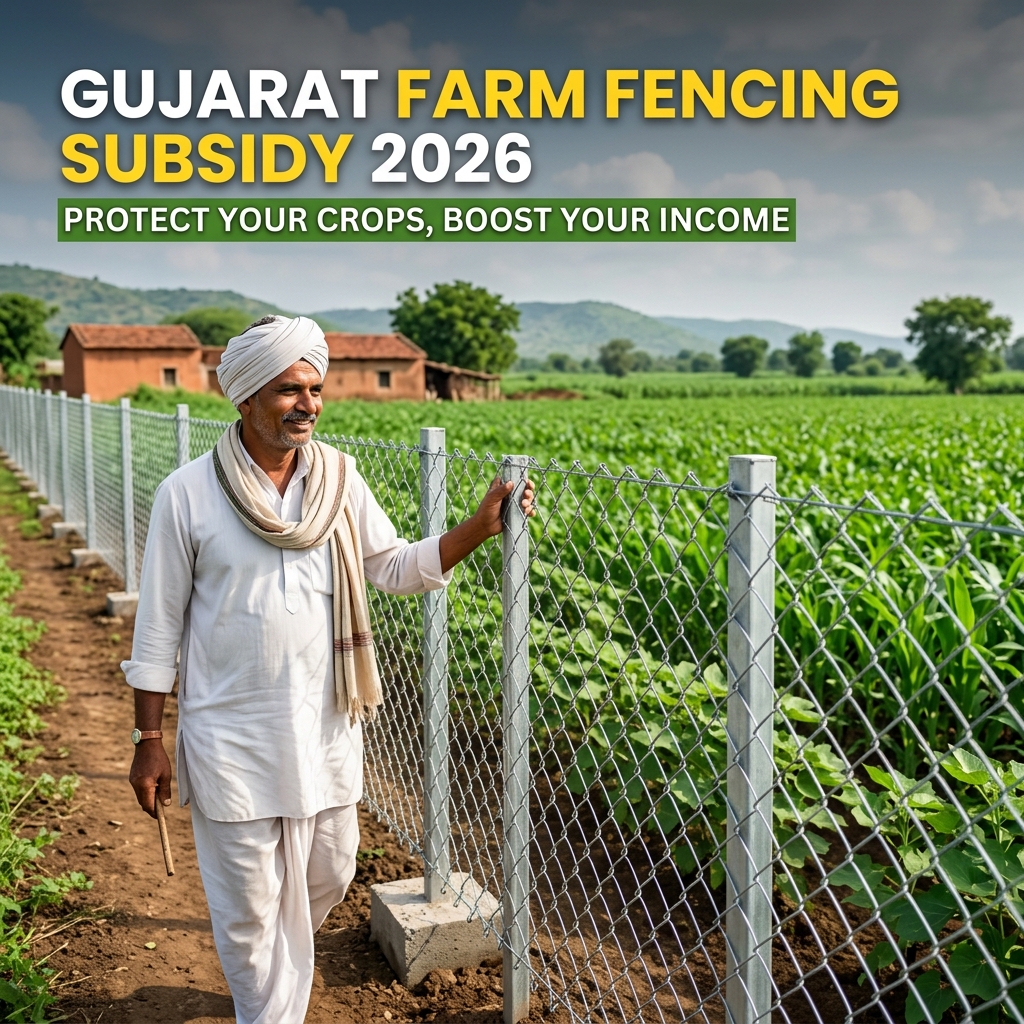
The Gujarat Farm Fencing Subsidy 2026 is a critical intervention by the State Department of Agriculture to minimize crop losses due to wildlife. For the 2026-27 fiscal year, the government has allocated enhanced funds to support farmers in installing durable barbed wire fences. The subsidy covers a significant portion of the cost for materials and labor.
Financial Assistance Details
The current scheme provides a subsidy of Rs. 200 per running meter or 50% of the total estimated cost, whichever is lower. For an average farm size of 1 to 2 hectares, a farmer can receive between Rs. 40,000 to Rs. 1,50,000 depending on the perimeter length. This makes it affordable for even small landholders to secure their property.
Material Specifications
- Wire Quality: Must be Galvanized Iron (GI) barbed wire (12x14 or 12x12 gauge).
- Pillars: RCC (Cement) pillars or treated iron angles with a minimum height of 6 feet.
- Spacing: Pillars should be spaced at 10-12 feet intervals for maximum stability.
How to Apply: i-Khedut Portal 2026
Success in claiming the subsidy depends on following the "Order of Operations" prescribed by the i-Khedut portal.
Step-by-Step Application Guide
Online Application
Register on the i-Khedut portal during the open window, providing all necessary land and personal details.
Record Verification
The local Gram Sevak or Taluka Agriculture Officer (TAO) will verify your land records (7/12, 8-A).
Wait for Pre-Approval
Do NOT start work until you receive the official "Pre-Approval Letter" (Purva-Manjuri).
Execution and Billing
Complete the fencing work according to technical standards. Ensure you keep all GST-compliant bills.
Official Inspection
Post-work inspection includes GPS-tagged photography and physical measurement by agriculture officials.
Subsidy Credit (DBT)
Once approved, the subsidy amount is credited directly to your Aadhaar-linked bank account.
Long-Term Outcomes and ROI
The primary outcome of farm fencing is the elimination of night-guarding labor and a 15-20% increase in harvestable yield by preventing animal damage. Farmers can compare their outcomes by looking at the "boundary loss" reduction. A fenced farm allows for high-value vegetable cultivation which was previously impossible due to fear of stray cattle. The Return on Investment (ROI) for the farmer's share of the fence is typically achieved within just 2-3 cropping seasons.
Ecological Impact and Soil Biology
While fencing keeps large animals out, it creates a protected "micro-climate" for smaller beneficial creatures. By reducing the trampling of soil by heavy stray cattle, the soil structure remains loose and aerated. This allows earthworm populations and soil-dwelling insects to thrive, further enhancing the effectiveness of organic amendments like Mitti Gold Vermicompost.
Protection from Disease and Pests
Wild animals are often carriers of various plant diseases and parasites. By preventing their entry, farmers reduce the biological "bridge" that brings pests like wild-boar lice or fungal spores from the forest to the farm. A secured perimeter is the first step in a "Biosecurity Plan" for any organic farm.
Focus: Farmers and Agriculture Exporters
For exporters, a fenced farm is often a requirement for "Traceability" and "Organic Certification." It ensures that the crop is not contaminated by outside animals, which is crucial for international food safety standards (APEDA/NPOP). For the Indian farmer, it represents peace of mind and the ability to sleep soundly while their crops grow safely.
📅 Official Application & Deadline Guide
📦 Bulk Orders & Export
Mitti Gold Organic: For bulk orders of all organic fertilizers — Farmers, Nurseries, and Export. WhatsApp: +91 95372 30173