📅
June 2026 | ✍️ Mitti Gold Organic | 🗂️
Govt Schemes
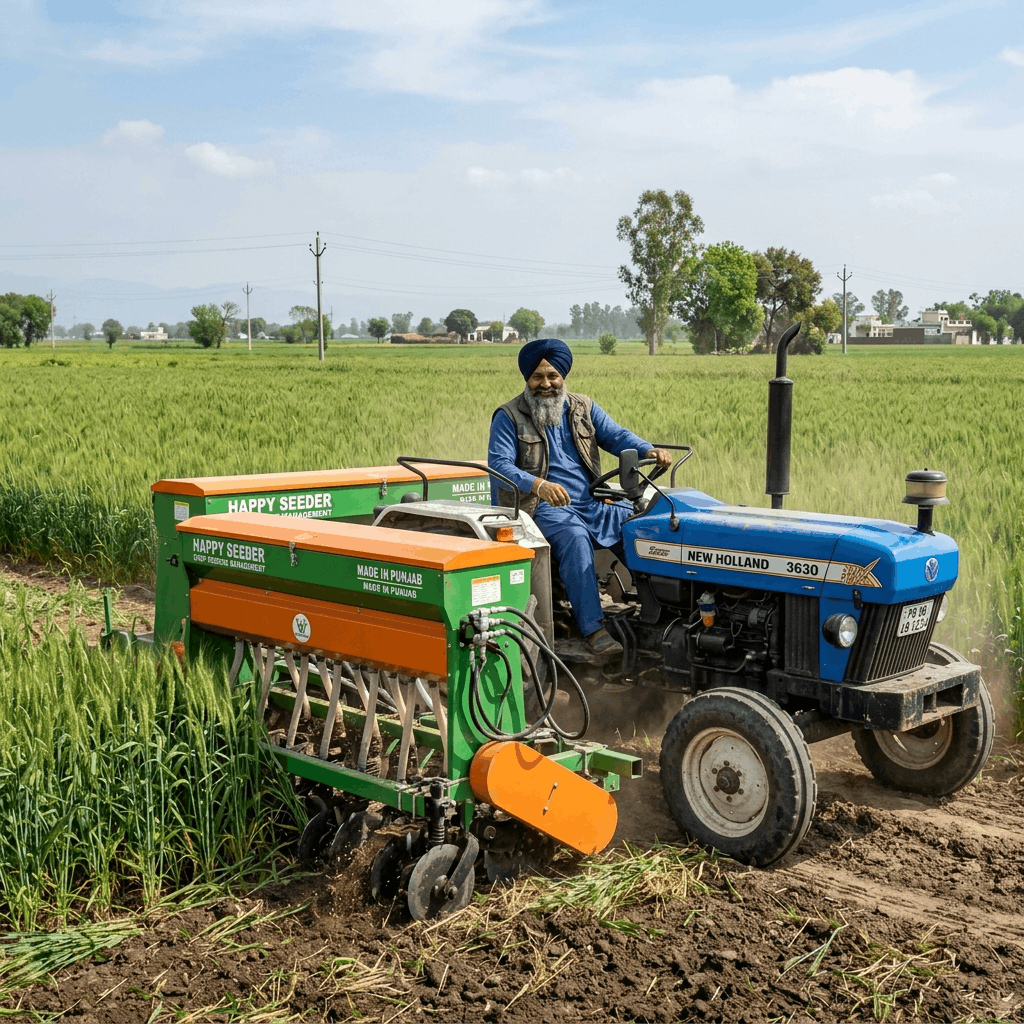
Application Rates: Managing Millions of Tons of Paddy Straw
The state of Punjab is the granary of India, but the intensive rice-wheat cropping system generates over 20 million tons of paddy straw (stubble) every year. Historically, the narrow 20-day window between paddy harvesting and wheat sowing forced farmers to burn this residue, causing severe air pollution across North India and destroying vital soil nutrients. To combat this, the Government of Punjab, backed by the Central Government, has launched the upgraded Crop Residue Management (CRM) Scheme 2026. The objective is to manage 100% of the crop residue through in-situ (incorporating into the soil) and ex-situ (removing for biogas/industry) methods. The "Application Rates" for this machinery are massive: the government is distributing thousands of Super Seeders, Happy Seeders, Smart Seeder machines, and Mulchers. Under the CRM 2026 guidelines, individual farmers are eligible for a flat 50% financial subsidy on these high-cost machines, while Custom Hiring Centers (CHCs) operated by farmer groups, cooperatives, or FPOs receive an enormous 80% subsidy. This heavy financial backing allows farmers to process 2 to 3 tons of heavy paddy stubble per acre directly into the soil, converting a pollution crisis into rich organic compost.
How to Use Product: In-Situ Incorporation Machinery
Understanding how to use CRM machinery is critical for successful wheat sowing. The Super Seeder is the most advanced and highly subsidized machine under the scheme. It works by plowing the standing paddy stubble, simultaneously sowing the wheat seeds, and then covering the seeds with the chopped straw as a protective mulch—all in a single tractor pass. When to apply: The machinery must be deployed immediately after the paddy harvest (typically late October to mid-November). For optimal results, the paddy should be harvested using a combine harvester equipped with a Super SMS (Straw Management System), which evenly distributes the loose straw across the field. The Super Seeder then seamlessly chops and mixes this straw into the top 2-3 inches of soil. The incorporated straw slowly decomposes over the winter, releasing rich organic carbon, potassium, and nitrogen back into the soil, drastically reducing the farmer's dependency on chemical urea and DAP fertilizers for the subsequent wheat crop.
1
Apply Online via Punjab Agri Portal
Farmers or CHCs must submit their subsidy application online through the official Punjab Agriculture Portal (agrimachinerypb.com) during the specified window, linking their Aadhaar and land records.
2
Harvest with Super SMS Combine
Ensure your paddy is harvested using a combine fitted with a Super Straw Management System. This cuts and spreads the loose straw evenly, preventing machinery choking.
3
Single-Pass Sowing with Super Seeder
Attach the subsidized Super Seeder to a high-horsepower tractor (50 HP+). Drive through the field to simultaneously chop the stubble, sow the wheat seed, and lay down organic mulch in one pass.
How to Compare Product Outcomes: CRM Sowing vs Stubble Burning
The agronomic outcomes of using CRM machinery versus the destructive practice of stubble burning are night and day:
- Soil Nutrient Retention: Burning 1 ton of stubble destroys 5.5 kg of Nitrogen, 2.3 kg of Phosphorus, 25 kg of Potassium, and 1.2 kg of Sulfur. CRM machinery retains 100% of these nutrients in the soil, saving thousands of rupees in fertilizer costs.
- Weed Suppression and Moisture: The chopped straw acts as a natural mulch cover, reducing weed emergence by 40% and conserving soil moisture, which saves at least one complete irrigation cycle.
- Yield Increase: Wheat sown with a Super Seeder shows robust root development and tillering due to higher organic carbon, leading to a 5% to 10% increase in final grain yield compared to burnt fields.
How to Help into Creature: Saving Soil Microbiome
Stubble burning is a biological catastrophe; the intense heat (reaching up to 700°C) instantly incinerates the top 1-inch of the soil, killing all beneficial soil creatures, including earthworms, nitrogen-fixing bacteria, and vital mycorrhizal fungi. The CRM scheme directly helps these creatures survive and thrive. By using a Happy Seeder or Super Seeder, the straw is chopped and returned to the earth. This raw organic matter serves as an unlimited food buffet for earthworms and decomposing microbes. Over just two seasons of practicing zero-burning, the soil biology recovers rapidly. Earthworm populations explode, turning the heavy, compacted clay soils of Punjab into soft, aerated, and highly porous earth. This biological revival is the ultimate key to breaking the hardpan layer and ensuring long-term agricultural sustainability.
Protection from Disease: Yellow Rust and Aphids
Incorporating crop residue provides surprising natural protection from disease. The straw mulch layer regulates the soil microclimate, keeping the root zone warmer during freezing winter nights and cooler during sudden heat waves in March. This temperature buffering reduces abiotic stress on the wheat crop, making it naturally more resistant to devastating fungal diseases like Yellow Rust. Furthermore, the thick mulch layer prevents the splashing of soil-borne pathogens onto the lower leaves during irrigation or rain. Additionally, fields managed with CRM machinery harbor higher populations of natural predatory insects (like spiders and ladybird beetles) that live in the straw cover. These predators actively hunt and consume aphids and other sucking pests, providing free, biological pest control without the need for toxic chemical pesticide sprays.
Market: Farmer, Nursery, Gardener, Export
The CRM scheme 2026 opens massive new market opportunities. For the Farmer, establishing a Custom Hiring Center (CHC) with an 80% subsidy is a highly lucrative rural business; renting out Super Seeders to neighboring farmers generates substantial seasonal income. In the Ex-Situ market, farmers can bale their straw and sell it directly to Compressed Bio Gas (CBG) plants, biomass power plants, and paper mills at ₹1,500 to ₹2,500 per ton. For the Nursery and Export sectors, the adoption of CRM practices allows farmers to certify their wheat as "sustainable" or "zero-burn." Large multinational food corporations and exporters are increasingly offering premium prices for sustainably procured wheat to meet their global ESG (Environmental, Social, and Governance) targets, shifting the entire Punjab agriculture sector towards a high-value, eco-friendly export economy.
📅 Official Application & Deadline Guide
⏳
Last Date of Application
April 24, 2026
🚜 Punjab CRM Scheme 2026 Machinery Support
Need help selecting the right CRM machinery or applying for the 50-80% government subsidy? Contact our experts. WhatsApp: +91 95372 30173
Punjab CRM Scheme 2026 FAQ
What is the maximum subsidy under the Punjab CRM Scheme 2026? +
Individual farmers receive a 50% subsidy, while Custom Hiring Centers (CHCs), FPOs, and registered farmer groups are eligible for a massive 80% subsidy on CRM machinery.
Which machines are covered under the CRM subsidy? +
The subsidy covers Super Seeders, Happy Seeders, Smart Seeders, Mulchers, Reversible MB Plows, Super SMS for combines, and Straw Balers.
What is the benefit of a Super Seeder over a Rotavator? +
A Super Seeder chops the paddy straw, sows the wheat seed, and covers it with a mulch layer all in a single pass, saving fuel, time, and incorporating the organic matter safely.
How does in-situ residue management save fertilizer costs? +
Incorporating 1 ton of paddy straw returns large amounts of Nitrogen, Phosphorus, and Potassium back to the soil, reducing the need for chemical Urea and DAP by up to 20%.
Where do I apply for the CRM machinery subsidy in Punjab? +
Applications must be submitted online through the official Punjab Department of Agriculture machinery portal (agrimachinerypb.com) during the active application window.