📅 July 2026 | ✍️ Mitti Gold Organic | 🗂️ Machinery & Markets
Why Choose University-Developed Seeds Over Private Brands?
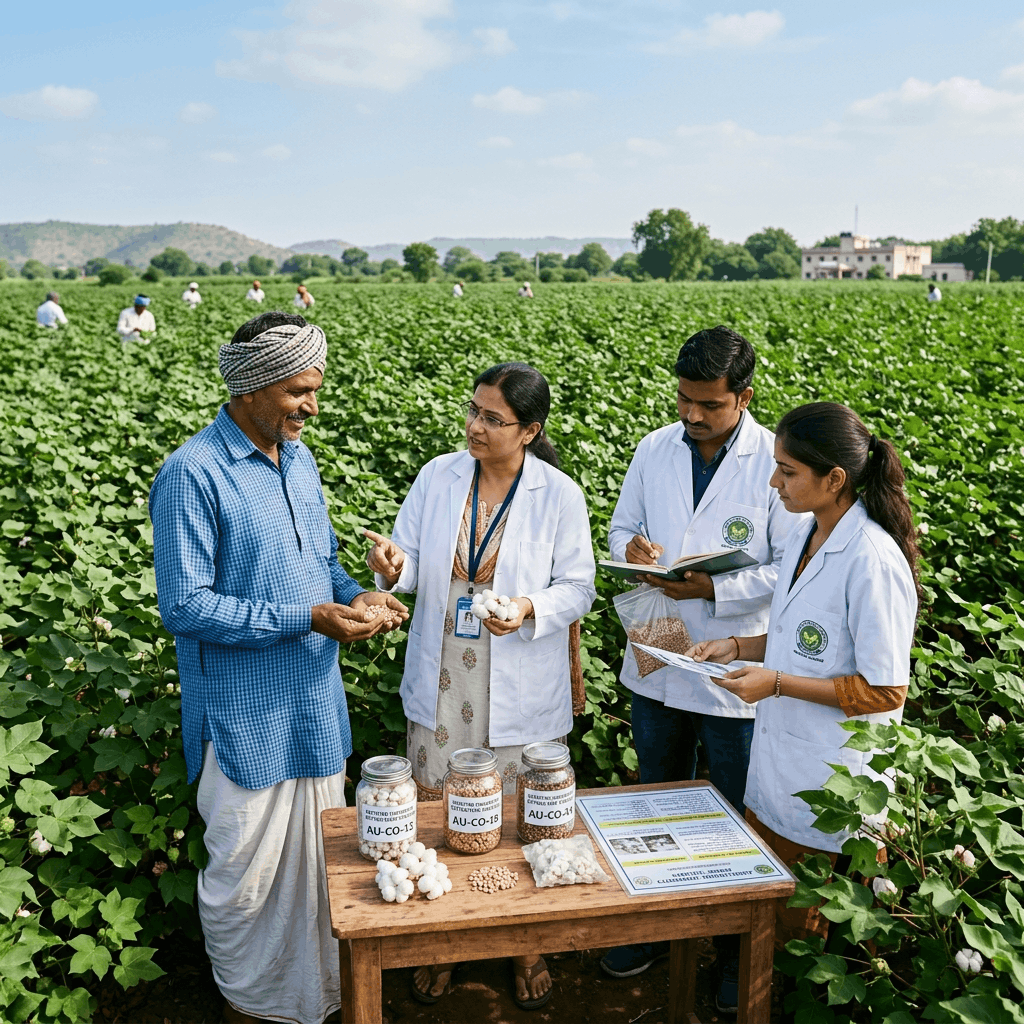
The commercial cotton seed market in India is overwhelmingly dominated by massive, multinational private corporations selling heavily marketed, expensive Bt Cotton hybrids. However, operating quietly in the background, premier Indian agricultural institutions—such as the Central Institute for Cotton Research (CICR), Punjab Agricultural University (PAU), and Junagadh Agricultural University (JAU)—have been relentlessly developing and releasing outstanding, high-yielding cotton varieties and hybrids tailored specifically for the Indian farmer.
Choosing university-developed seeds offers several profound advantages over private brands. First and foremost is the cost. Because these seeds are developed by public institutions funded by the government, they are not priced to maximize corporate profits. They are distributed at highly subsidized, affordable rates through state seed corporations, drastically lowering a farmer's initial seasonal investment. Second, these seeds are rigorously tested over multiple years across diverse, real-world Indian agro-climatic zones before they are ever released to the public. This means they are not just bred for theoretical maximum yield in a controlled greenhouse; they are hardened and proven to perform under the exact harsh realities, heat stresses, and unpredictable monsoons that local farmers face every single year.
Sowing Rates and High-Density Planting Systems (HDPS)
Agricultural universities provide extremely optimized, deeply researched guidelines regarding seed rates. For their specific, robust hybrids, the recommended sowing rate generally mirrors standard practices, hovering around 450 to 900 grams per bigha. However, universities are the primary pioneers of a revolutionary new farming method known as the High-Density Planting System (HDPS), utilizing specialized \"compact\" cotton varieties.
These compact varieties are genetically bred to grow straight up rather than branching out widely. Because of this compact architecture, farmers can plant them incredibly close together. Under the HDPS method, the seed rate is significantly higher, often double that of a spreading hybrid. While you spend more on seed upfront, you achieve a massive plant population per acre. Even if each compact plant produces fewer bolls than a large hybrid, the sheer number of plants per acre results in a massive overall yield increase, particularly benefiting smallholder farmers with limited land area.
Sourcing Authenticity and Expert Consultation
One of the most significant risks in modern cotton farming is accidentally purchasing counterfeit, fake Bt seeds from unscrupulous private dealers. When dealing with university varieties, this risk is completely eliminated. Farmers can purchase these seeds directly from the source: university research stations, regional Krishi Vigyan Kendras (KVKs), or authorized counters of the National Seeds Corporation (NSC). Buying directly from these government entities guarantees 100% genetic purity and extremely high germination rates.
Furthermore, this direct sourcing provides an invaluable opportunity for free, expert consultation. When purchasing seed at a KVK, a farmer is interacting directly with the very agricultural scientists who bred or tested the seed. Farmers can receive highly specific, personalized advice on exact sowing dates, required fertilizer dosages for their specific soil type, and the precise irrigation schedule necessary to maximize the yield of that exact variety on their land.
Stability, Resilience, and Yield Performance
The breeding philosophy of agricultural universities differs fundamentally from private corporations. While a private company might breed a hybrid that delivers a record-breaking yield only under perfect, heavily irrigated, and heavily fertilized conditions (a \"high-input, high-output\" model), universities breed primarily for stability and resilience. They understand that the average Indian farmer relies on unpredictable rain and may not afford maximum fertilizer inputs.
Therefore, university varieties are bred to be robust survivors. Under optimal conditions, they yield exceptionally well. But more importantly, under suboptimal conditions—such as a delayed monsoon, a prolonged dry spell, or poor soil fertility—university varieties consistently outperform sensitive private hybrids. They guarantee a reliable, profitable baseline harvest, protecting the farmer from total ruin during a bad weather year.
The financial stability provided by university-bred seeds extends far beyond the individual harvest season. By fundamentally lowering the initial input costs (cheaper seeds and reduced need for expensive chemical interventions) and guaranteeing a highly reliable baseline yield even in terrible weather years, these public-sector varieties actively prevent farmers from falling into the vicious, devastating cycle of high-interest agricultural debt. This newfound financial freedom allows farmers to finally reinvest their profits back into their land—purchasing labor-saving machinery, installing highly efficient drip irrigation systems, or educating their children. Ultimately, the widespread adoption of these resilient, locally adapted university seeds is the single most powerful tool for ensuring the long-term, multi-generational prosperity and absolute independence of the Indian cotton farming community.
Reviving Sustainable, Indigenous \"Desi\" Cotton
Perhaps the most vital contribution of agricultural universities is their relentless effort to revive and improve indigenous \"Desi\" cotton varieties (botanically known as Gossypium arboreum or herbaceum). These native plants have evolved over thousands of years in the Indian subcontinent. Because they are native, they are incredibly deeply adapted to the local ecosystem and require a fraction of the water compared to imported American cotton varieties.
Desi cotton is inherently resistant to a wide array of sucking pests that devastate modern Bt hybrids. Because they require virtually no chemical pesticide sprays, fields of Desi cotton rapidly become thriving havens for beneficial farm biodiversity. The natural predator population explodes, creating a self-regulating, balanced ecological system. By growing and promoting Desi cotton, universities are championing a highly sustainable, low-input farming model that drastically reduces the chemical burden on the environment and the financial burden on the farmer.
Breeding for Regional Pests and Devastating Diseases
The greatest strength of a university seed is its hyper-regional specificity. India is a vast country with radically different pest pressures in different states. Private companies often sell a single \"blockbuster\" hybrid nationwide, which may fail disastrously when exposed to a specific regional disease. Universities, however, breed seeds specifically to conquer local threats.
For instance, in Northern India (Punjab, Haryana, Rajasthan), the absolute greatest threat to cotton is the Cotton Leaf Curl Virus (CLCuV). Universities in this region have focused decades of research entirely on breeding specialized varieties that are highly resistant to this specific, devastating virus. In Central and Southern India, where drought and sucking pests are the primary issues, local universities breed for extreme drought tolerance and thick, hairy leaves that naturally repel Jassids and Whiteflies. When you buy a university seed, you are buying a localized, genetic armor designed specifically for your farm's greatest threats.
Adopting the University Package of Practices
Step 1: Consult Your Local Krishi Vigyan Kendra (KVK)
Do not guess which variety to plant. Visit your nearest KVK well before the season begins. Discuss your specific soil type, whether your land is irrigated or rainfed, and your previous pest issues. The scientists will recommend the exact university variety scientifically proven to perform best in your specific village or block.
Step 2: Procure Authentic Seed and the \"Package of Practices\"
Purchase the seed directly from the KVK or an authorized government counter. Crucially, ask for the \"Package of Practices\" booklet that accompanies the seed. This invaluable document details the exact, scientifically determined fertilizer schedule, spacing, and irrigation timing required to maximize the yield of that specific seed.
Step 3: Strict Adherence to the Sowing Window
University research identifies an incredibly precise sowing window—often a span of just 15 to 20 days—during which planting will result in the absolute maximum yield. Planting too early or too late drastically reduces output. Strictly adhere to the recommended dates provided in the package of practices.
Market Acceptance and Emerging Niche Markets
Historically, there was a misconception that public sector varieties produced inferior lint quality compared to private hybrids. This is entirely false today. Modern university hybrids produce exceptionally high-quality, long-staple lint that easily meets and exceeds all stringent industrial spinning standards set by commercial textile mills, ensuring excellent market prices.
Furthermore, universities are creating entirely new, highly lucrative niche markets by reviving Desi cotton. There is an explosive global demand for organic, Non-Bt cotton from sustainable fashion brands, the medical industry (for high-absorbency surgical cotton), and eco-conscious consumers. Because Desi cotton requires almost no chemicals, it is incredibly easy to certify as organic. Universities provide the high-quality Desi seeds that allow farmers to tap into these high-premium, specialized markets, offering a highly profitable alternative to the standard commercial cotton market.
📦 Bulk Orders & Export
Mitti Gold Organic: For bulk orders of all organic fertilizers — Farmers, Nurseries, and Export. WhatsApp: +91 95372 30173